School of Biological Sciences, University of Adelaide, Adelaide, South Australia, Australia.
Australian Research Council Centre of Excellence for Australian Biodiversity and Heritage, University of Adelaide, Adelaide, South Australia, Australia.
PeerJ. 2022 Feb 23;10:e12982. doi: 10.7717/peerj.12982. eCollection 2022.
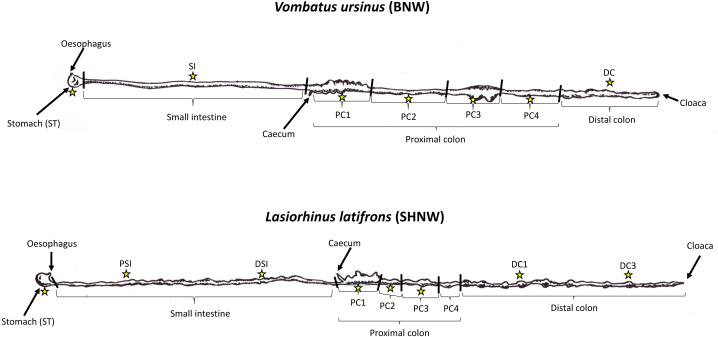
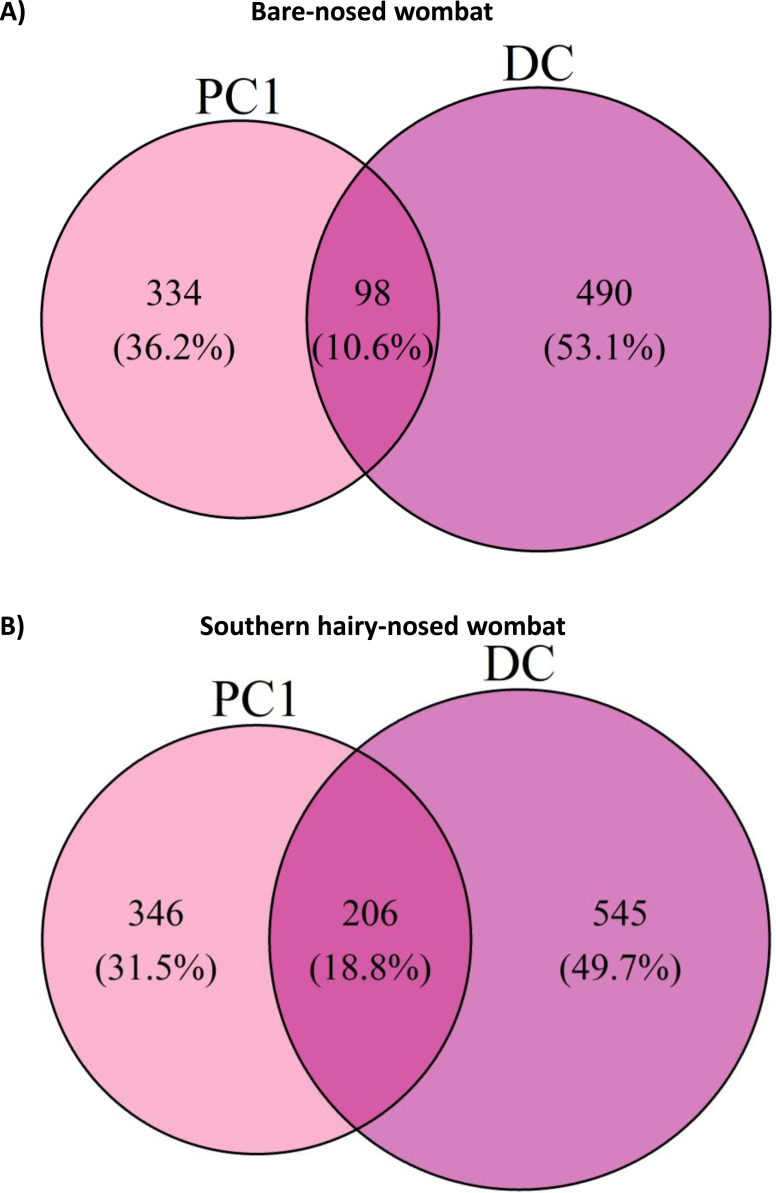
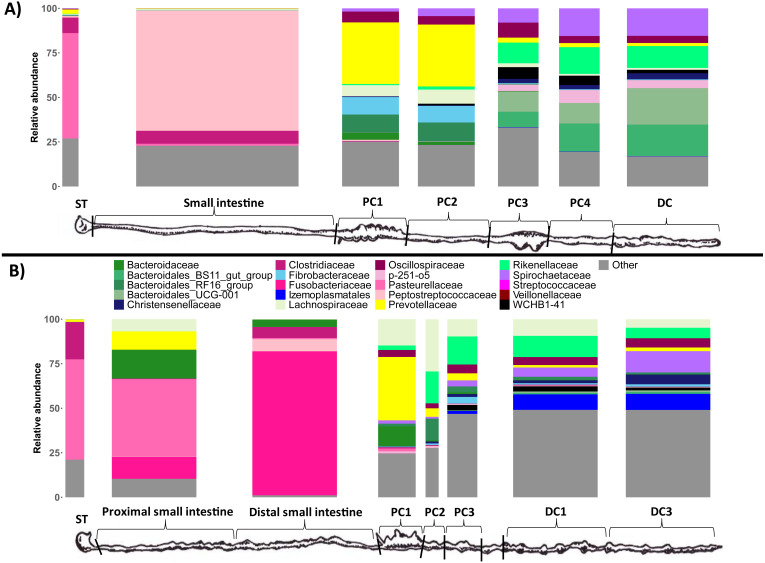
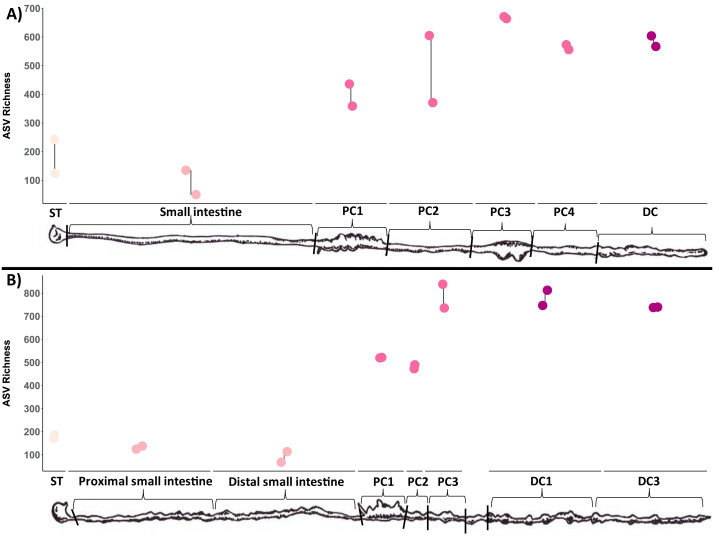
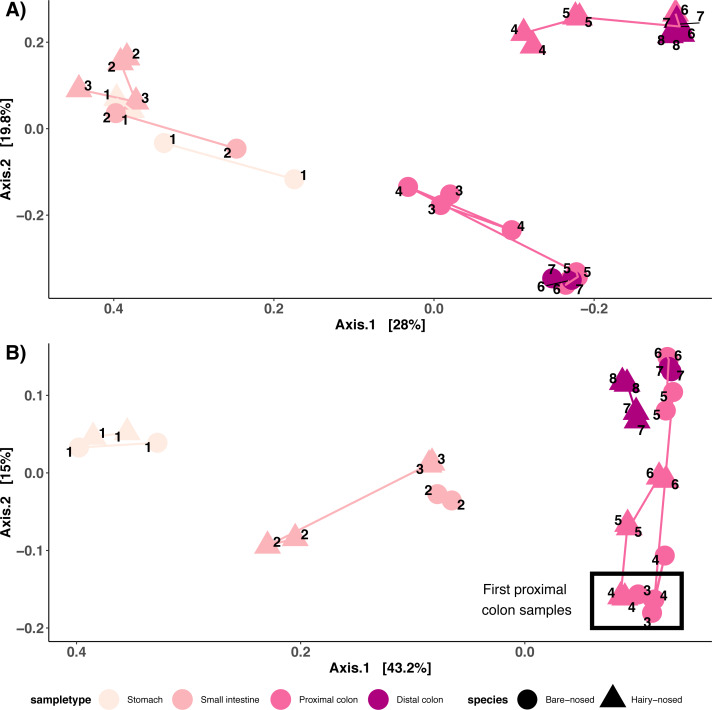
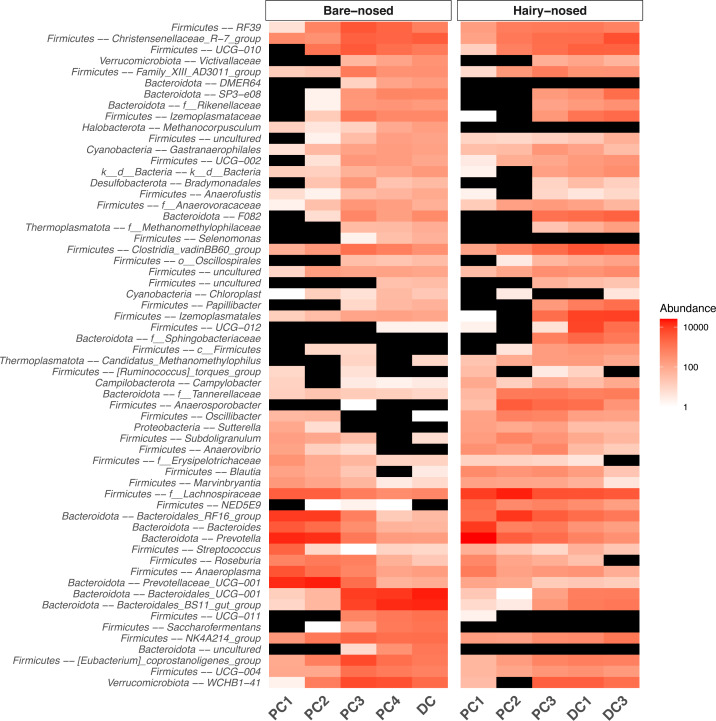
Most herbivorous mammals have symbiotic microbes living in their gastrointestinal tracts that help with harvesting energy from recalcitrant plant fibre. The bulk of research into these microorganisms has focused on samples collected from faeces, representing the distal region of the gastrointestinal (GI) tract. However, the GI tract in herbivorous mammals is typically long and complex, containing different regions with distinct physico-chemical properties that can structure resident microbial communities. Little work has been done to document GI microbial communities of herbivorous animals at these sites. In this study, we use 16S rRNA gene sequencing to characterize the microbial biogeography along the GI tract in two species of wombats. Specifically, we survey the microbes along four major gut regions (stomach, small intestine, proximal colon, distal colon) in a single bare-nosed wombat () and a single southern hairy-nosed wombat (). Our preliminary results show that GI microbial communities of wombats are structured by GI region. For both wombat individuals, we observed a trend of increasing microbial diversity from stomach to distal colon. The microbial composition in the first proximal colon region was more similar between wombat species than the corresponding distal colon region in the same species. We found several microbial genera that were differentially abundant between the first proximal colon (putative site for primary plant fermentation) and distal colon regions (which resemble faecal samples). Surprisingly, only 10.6% (98) and 18.8% (206) of amplicon sequence variants (ASVs) were shared between the first proximal colon region and the distal colon region for the bare-nosed and southern hairy-nosed wombat, respectively. These results suggest that microbial communities in the first proximal colon region-the putative site of primary plant fermentation in wombats-are distinct from the distal colon, and that faecal samples may have limitations in capturing the diversity of these communities. While faeces are still a valuable and effective means of characterising the distal colon microbiota, future work seeking to better understand how GI microbiota impact the energy economy of wombats (and potentially other hindgut-fermenting mammals) may need to take gut biogeography into account.
大多数食草哺乳动物的胃肠道中都存在共生微生物,这些微生物有助于从难以消化的植物纤维中获取能量。大多数关于这些微生物的研究都集中在从粪便中采集的样本上,这些样本代表了胃肠道(GI)的远端区域。然而,食草哺乳动物的胃肠道通常很长且复杂,包含具有不同理化特性的不同区域,这些区域可以构成常驻微生物群落。在这些部位,很少有关于食草动物胃肠道微生物群落的记录。在这项研究中,我们使用 16S rRNA 基因测序来描述两种袋熊的胃肠道微生物生物地理学。具体来说,我们调查了单个裸鼻袋熊和单个南部毛鼻袋熊的四个主要肠道区域(胃、小肠、近端结肠、远端结肠)中的微生物。我们的初步结果表明,GI 微生物群落的结构受到 GI 区域的影响。对于这两种袋熊个体,我们观察到从胃到远端结肠,微生物多样性呈增加趋势。在同一物种中,两种袋熊的第一近端结肠区域的微生物组成比相应的远端结肠区域更相似。我们发现了一些在第一近端结肠(植物发酵的主要部位)和远端结肠区域(与粪便样本相似)之间丰度差异较大的微生物属。令人惊讶的是,裸鼻袋熊和南部毛鼻袋熊的第一近端结肠区域和远端结肠区域之间分别只有 10.6%(98 个)和 18.8%(206 个)的扩增子序列变异(ASV)是共有的。这些结果表明,第一近端结肠区域(袋熊中植物发酵的主要部位)的微生物群落与远端结肠不同,粪便样本可能在捕捉这些群落的多样性方面存在局限性。虽然粪便仍然是描述远端结肠微生物群的一种有价值且有效的方法,但未来的研究如果要更好地了解胃肠道微生物如何影响袋熊(以及可能其他后肠发酵的哺乳动物)的能量代谢,可能需要考虑肠道生物地理学。