Robles-Fontán Mónica M, Nieves Elvis G, Cardona-Gerena Iris, Irizarry Rafael A
CDC Foundation-Puerto Rico Department of Health, Río Piedras, PR, United States.
Puerto Rico Department of Health, Río Piedras, PR, United States.
Lancet Reg Health Am. 2022 May;9:100212. doi: 10.1016/j.lana.2022.100212. Epub 2022 Feb 24.
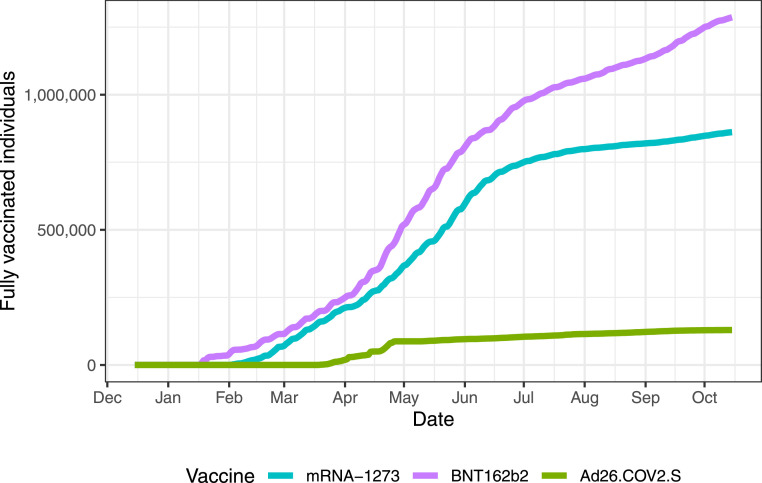
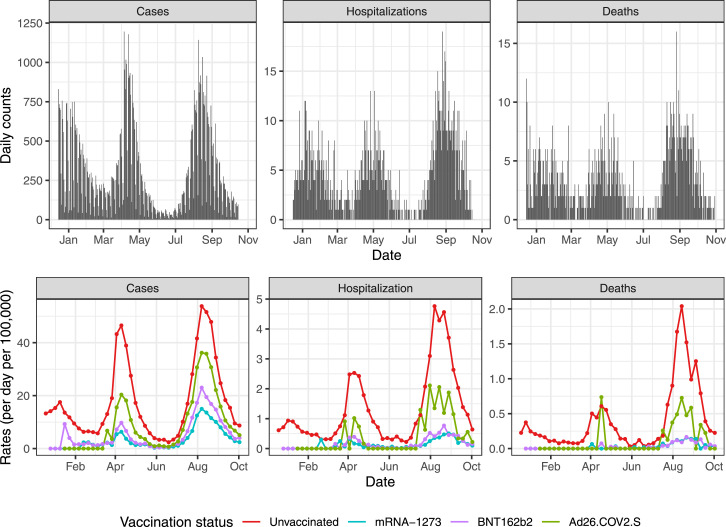
On July 15, 2021, with 58% of the population fully vaccinated, the start of a COVID-19 surge was observed in Puerto Rico. On July 22, 2021, the government of Puerto Rico started imposing a series of strict vaccine mandates. Two months later, over 70% of the population was vaccinated, more than in any US state, and laboratory-confirmed SARS-CoV-2 had dropped substantially. The decision to impose mandates, as well as current Department of Health recommendations related to boosters, were guided by the data and the effectiveness estimates presented here.
Between December 15, 2020, when the vaccination process began in Puerto Rico, and October 15, 2021, 2,276,966 individuals were fully vaccinated against COVID-19. During this period 112,726 laboratory-confirmed SARS-CoV-2 infections were reported. These data permitted us to quantify the outcomes of the immunization campaign and to compare effectiveness of the mRNA-1273 (Moderna), BNT162b2 (Pfizer), and Ad26.COV2.S (J&J) vaccines. We obtained vaccination status, SARS-CoV-2 test results, and COVID-19 hospitalizations and deaths, from the Department of Health. We fit statistical models that adjusted for time-varying incidence rates and age group to estimate vaccine effectiveness, since the time of vaccination, against lab-confirmed SARS-CoV-2 infection, and COVID-19 hospitalization and death.
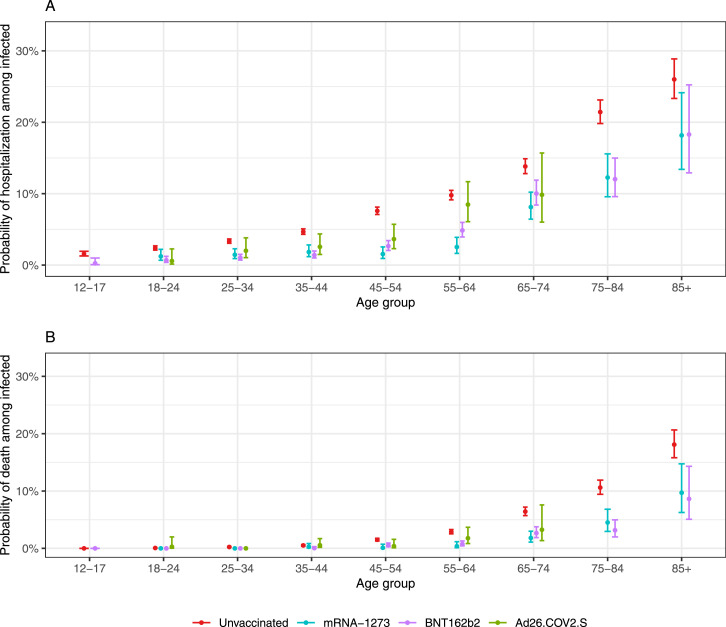
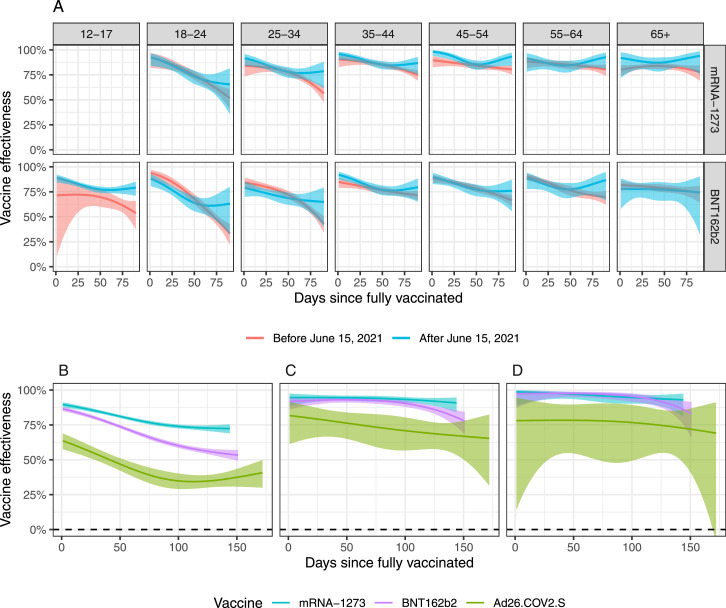
Two weeks after final dose, the mRNA-1273, BNT162b2, and Ad26.COV2.S vaccines had an effectiveness of 90% (95% CI: 88-91), 87% (85-88), and, 64% (58-69), respectively. After five months, effectiveness waned to about 70%, 50%, and 40%, respectively. We found no evidence that effectiveness was different after the Delta variant became dominant. For those infected, the vaccines provided further protection against COVID-19 hospitalization and deaths across all age groups, and this conditional effect did not wane in time.
The mRNA-1273 and BNT162b2 vaccines were highly effective across all age groups. They were still effective after five months although the protection against SARS-CoV-2 infection waned. The Ad26.COV2.S vaccine was effective but to a lesser degree compared to the mRNA vaccines. Although, conditional on infection, protection against adverse outcomes did not wane, the waning in effectiveness resulted in a decreased protection against serious COVID-19 outcomes across time.
RAI's work was partly funded by NIH Grant R35GM131802.
2021年7月15日,波多黎各有58%的人口完成了新冠疫苗全程接种,此时观察到新冠疫情开始激增。2021年7月22日,波多黎各政府开始实施一系列严格的疫苗强制令。两个月后,超过70%的人口接种了疫苗,这一比例高于美国任何一个州,实验室确诊的新冠病毒感染病例大幅下降。实施强制令的决定以及卫生部目前关于加强针的建议,均以此处呈现的数据和有效性估计为依据。
在2020年12月15日(波多黎各开始疫苗接种之时)至2021年10月15日期间,共有2,276,966人完成了新冠疫苗全程接种。在此期间,报告了112,726例实验室确诊的新冠病毒感染病例。这些数据使我们能够量化免疫接种活动的结果,并比较mRNA-1273(莫德纳)、BNT162b2(辉瑞)和Ad26.COV2.S(强生)疫苗的有效性。我们从卫生部获取了疫苗接种状态、新冠病毒检测结果以及新冠住院和死亡情况。我们拟合了统计模型,对随时间变化的发病率和年龄组进行了调整,以估计自接种疫苗之时起,针对实验室确诊的新冠病毒感染、新冠住院和死亡的疫苗有效性。
在接种最后一剂疫苗两周后,mRNA-1273、BNT162b2和Ad26.COV2.S疫苗的有效性分别为90%(95%置信区间:88 - 91)、87%(85 - 88)和64%(58 - 69)。五个月后,有效性分别降至约70%、50%和40%。我们没有发现证据表明在德尔塔变异株成为主导毒株后有效性有所不同。对于那些感染了新冠病毒的人,这些疫苗在所有年龄组中都进一步提供了针对新冠住院和死亡的保护,并且这种条件性效果并未随时间减弱。
mRNA-1273和BNT162b2疫苗在所有年龄组中都非常有效。尽管对新冠病毒感染的保护作用有所减弱,但五个月后它们仍然有效。Ad26.COV2.S疫苗是有效的,但与mRNA疫苗相比程度较低。尽管在感染的条件下,对不良后果的保护作用并未减弱,但有效性的下降导致随着时间推移对严重新冠疫情后果的保护作用降低。
RAI的工作部分由美国国立卫生研究院(NIH)的R35GM131802拨款资助。