Department of Pharmacology, Institute of Neuroscience, Biomedical Research Center (CIBM) Faculty of Medicine, University of Granada, Granada, Spain.
Department of Psychobiology, Institute of Neuroscience, Biomedical Research Center (CIBM), University of Granada, Spain.
Addict Biol. 2022 Mar;27(2):e13153. doi: 10.1111/adb.13153.
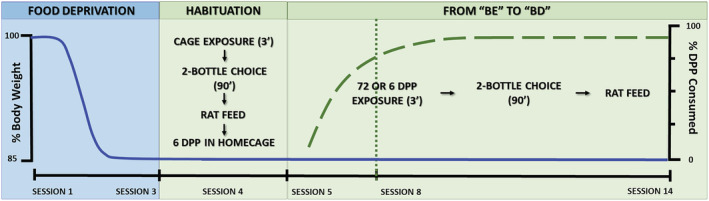
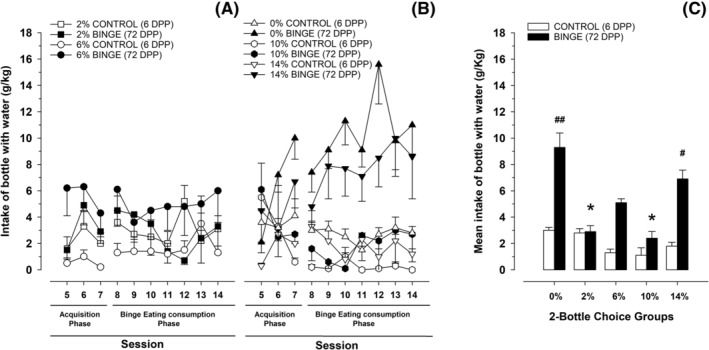
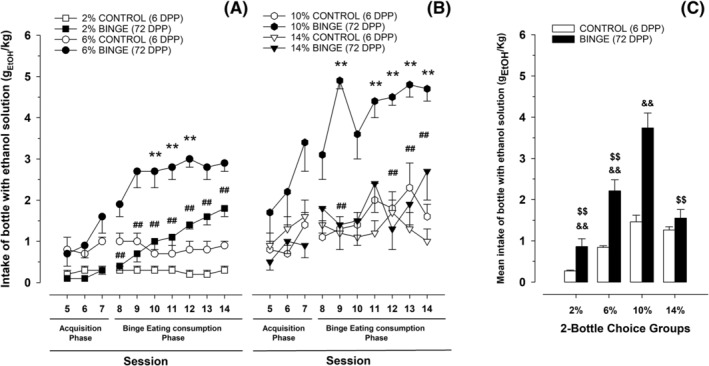
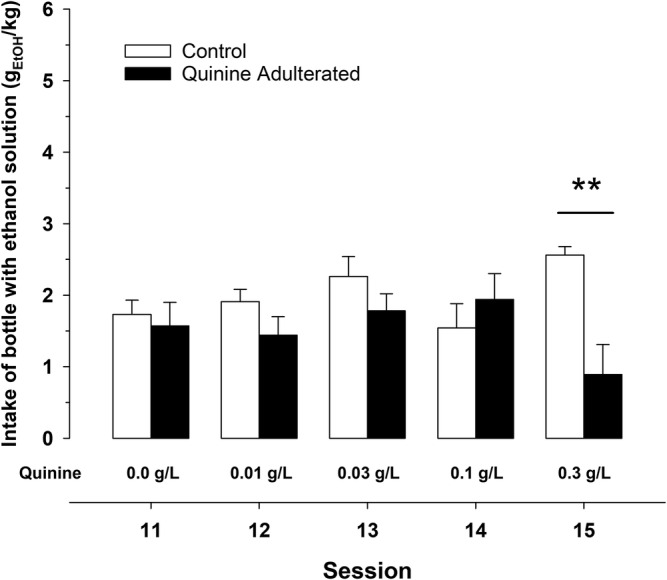
Animal models of alcohol (ethanol) self-administration are crucial to dissect the neurobiological mechanisms underlying alcohol dependence, yet only a few of these induce pharmacologically relevant levels of alcohol consumption and rarely the alcohol self-administration co-occurs with other addictive behaviours. The present study aims to validate a novel model of voluntary ethanol consumption in male Wistar rats, in which ethanol access follows a binge eating experience. Over 10 sessions, Wistar rats were exposed to binge or control eating (i.e., the ingestion of 11.66 and 0.97 kcal/3 min, respectively, derived from a highly palatable food), immediately followed by two-bottle choice intake tests (2%, 6%, 10% or 14% w/w ethanol vs. water). Rats exposed to binge eating drank significantly more 6% or 10% (w/w) ethanol than control peers, reaching up to 6.3 g /kg. Rats stimulated with 2%, 6%, 10% or 14% ethanol after binge eating, but not those given those ethanol concentrations after control eating, exhibited significant within-group increases in ethanol drinking. This ethanol consumption was not altered by quinine adulteration (up to 0.1 g/L), and it was blocked by naltrexone (10 mg/kg), administered immediately before binge eating. Blood ethanol levels significantly correlated with ethanol consumption; and the more ethanol consumed, the greater the distance travelled in an open field test conducted after the two-bottle choice test. Altogether, this self-administration model seems a valid and robust alternative with remarkable potential for research on different stages of the alcohol addiction and, particularly, to assess interactions between alcohol consumption and others addictive-like behaviours.
动物酒精(乙醇)自我给药模型对于剖析酒精依赖的神经生物学机制至关重要,但只有少数模型能诱导与药理学相关的酒精消耗水平,且很少有模型能使酒精自我给药与其他成瘾行为同时发生。本研究旨在验证雄性 Wistar 大鼠中一种新的自愿性乙醇消耗模型,其中乙醇的获取遵循暴食体验。在 10 个疗程中,Wistar 大鼠暴露于暴食或对照饮食(即分别摄入 11.66 和 0.97 kcal/3 分钟,源自高可口食物),随后立即进行双瓶选择摄入测试(2%、6%、10%或 14%w/w 乙醇与水相比)。与对照组相比,暴露于暴食饮食的大鼠明显饮用了更多的 6%或 10%(w/w)乙醇,达到 6.3 g/kg。在暴食后接受 2%、6%、10%或 14%乙醇刺激的大鼠,但在对照饮食后接受这些乙醇浓度刺激的大鼠,表现出显著的组内乙醇饮用量增加。这种乙醇消耗不受奎宁(高达 0.1 g/L)掺杂的影响,并且在暴食前立即给予纳曲酮(10 mg/kg)时被阻断。血液乙醇水平与乙醇消耗显著相关;消耗的乙醇越多,在双瓶选择测试后进行的开阔场测试中行进的距离就越大。总之,这种自我给药模型似乎是一种有效且强大的替代方法,具有研究酒精成瘾不同阶段的显著潜力,特别是评估酒精消耗与其他类成瘾行为之间的相互作用。