School of Pharmacy, Queen's University Belfast, Medical Biology Centre, 97 Lisburn Road, Belfast BT9 7BL, U.K.
Mol Pharm. 2022 Apr 4;19(4):1191-1208. doi: 10.1021/acs.molpharmaceut.1c00988. Epub 2022 Mar 2.
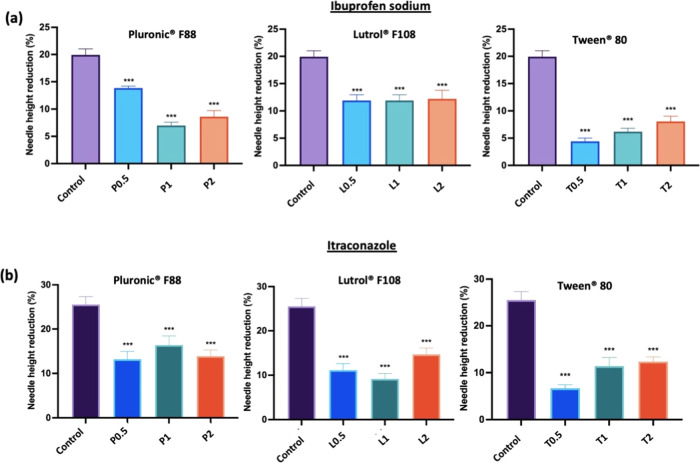
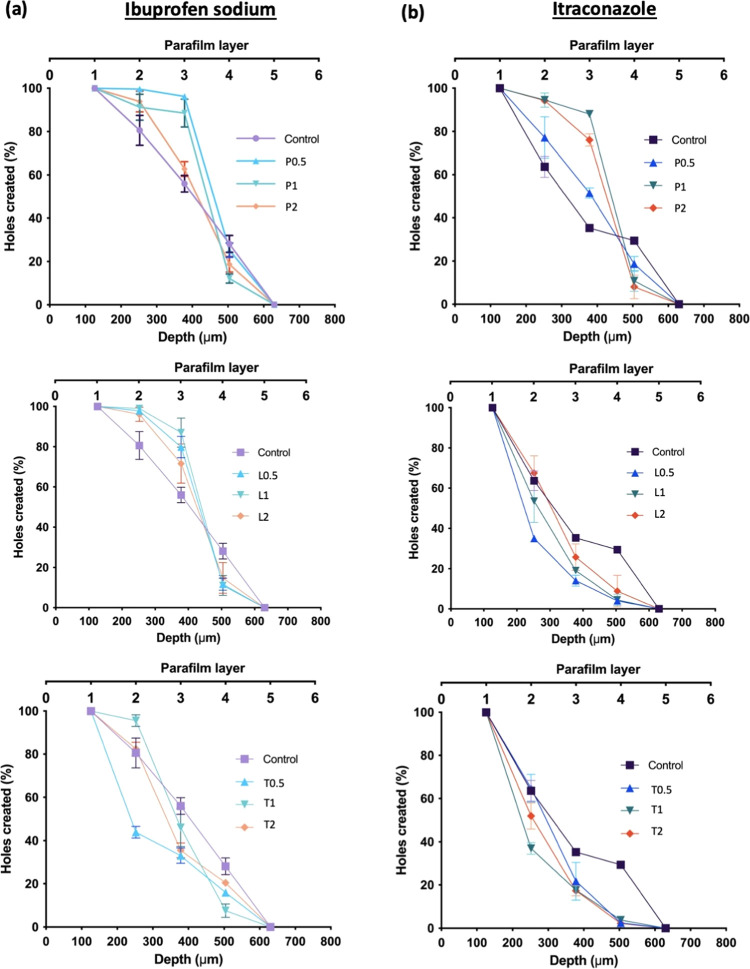
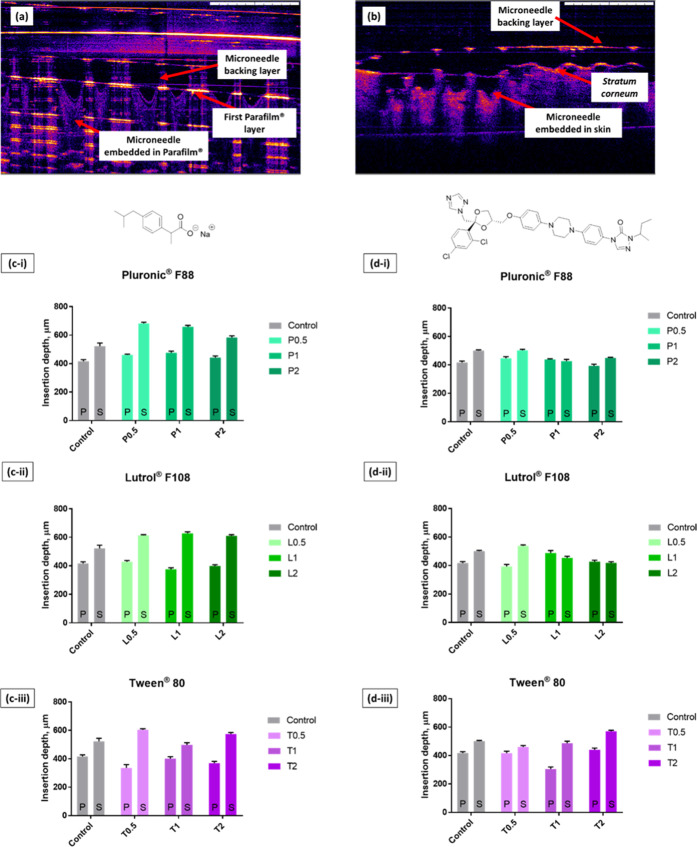
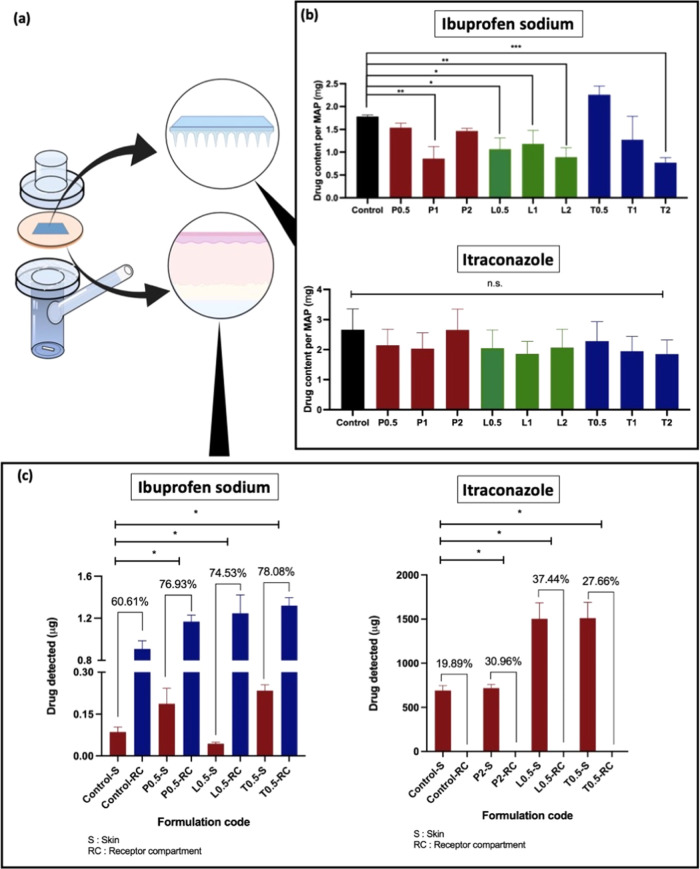
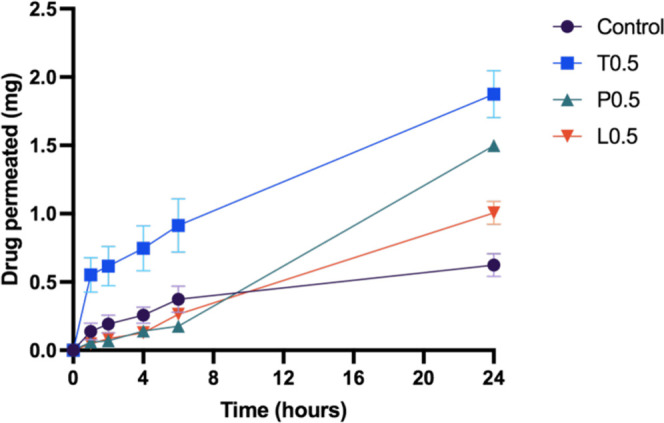
The need for biocompatible polymers capable of dissolving in the skin while exhibiting reasonable mechanical features and delivery efficiency limits the range of materials that could be utilized in fabricating dissolving microneedle array patches (MAPs). The incorporation of additives, such as surfactants, during microneedle fabrication might be an alternative solution to overcome the limited range of materials used in fabricating dissolving MAPs. However, there is a lacuna in the knowledge on the effect of surfactants on the manufacture and performance of dissolving MAPs. The current study explores the role of surfactants in the manufacture and performance of dissolving MAPs fabricated from poly(vinyl alcohol) (PVA) and poly(vinyl pyrrolidone) (PVP) loaded with the model drugs, ibuprofen sodium and itraconazole. Three nonionic surfactants, Lutrol F108, Pluronic F88, and Tween 80, in solutions at varying concentrations (0.5, 1.0, and 2.0% w/w) were loaded into these dissolving MAPs. It was discovered that all of the dissolving MAPs that incorporated surfactant displayed a lower reduction in the microneedle height (≈10%) relative to the control formulation (≈20%) when subjected to a compressive force of 32 N. In addition, the incorporation of surfactants in some instances enhanced the insertion profile of these polymeric MAPs when evaluated using neonatal porcine skin. The incorporation of surfactant into ibuprofen sodium-loaded dissolving MAPs improved the insertion depth of MAPs from 400 μm down to 600 μm. However, such enhancement was not apparent when the MAPs were loaded with the model hydrophobic drug, itraconazole. Skin deposition studies highlighted that the incorporation of surfactant enhanced the delivery efficiency of both model drugs, ibuprofen sodium and itraconazole. The incorporation of surfactant enhanced the amount of ibuprofen sodium delivered from 60.61% up to ≈75% with a majority of the drug being delivered across the skin and into the receptor compartment. On the other hand, when surfactants were added into MAPs loaded with the model hydrophobic drug itraconazole, we observed enhancement in intradermal delivery efficiency from 20% up to 30%, although this did not improve the delivery of the drug across the skin. This work highlights that the addition of nonionic surfactant is an alternative formulation strategy worth exploring to improve the performance and delivery efficiency of dissolving MAPs.
具有生物相容性的聚合物,在能溶解于皮肤的同时还需具备合理的机械性能和输送效率,这限制了可用于制造溶解微针贴片(MAP)的材料范围。在微针制造过程中加入添加剂,如表面活性剂,可能是克服用于制造溶解 MAP 的材料范围有限的另一种解决方案。然而,目前对于表面活性剂对溶解 MAP 的制造和性能的影响的认识还存在空白。本研究探讨了表面活性剂在由聚(乙烯醇)(PVA)和聚(乙烯基吡咯烷酮)(PVP)制成的、负载模型药物布洛芬钠和伊曲康唑的溶解 MAP 的制造和性能中的作用。三种非离子表面活性剂,即 Lutrol F108、Pluronic F88 和 Tween 80,在不同浓度(0.5、1.0 和 2.0%w/w)的溶液中被载入这些溶解 MAP 中。研究发现,与对照制剂(≈20%)相比,所有载入表面活性剂的溶解 MAP 在受到 32N 的压缩力时,其微针高度的降低幅度较小(≈10%)。此外,在使用新生仔猪皮肤评估时,在某些情况下,表面活性剂的加入增强了这些聚合物 MAP 的插入特性。将表面活性剂载入布洛芬钠负载的溶解 MAP 中,可将 MAP 的插入深度从 400μm 降低至 600μm。然而,当 MAP 负载模型疏水性药物伊曲康唑时,这种增强并不明显。皮肤沉积研究强调,表面活性剂的加入增强了两种模型药物,布洛芬钠和伊曲康唑的输送效率。表面活性剂的加入将布洛芬钠的输送量从 60.61%提高到了约 75%,大部分药物穿过皮肤并进入受体室。另一方面,当将模型疏水性药物伊曲康唑载入 MAP 中并加入表面活性剂时,我们观察到皮内输送效率从 20%提高到了 30%,尽管这并没有改善药物穿过皮肤的输送。这项工作强调,添加非离子表面活性剂是一种值得探索的替代制剂策略,可以提高溶解 MAP 的性能和输送效率。