Departamento de Ciencias Farmacéuticas y de la Salud, Facultad de Farmacia, Universidad San Pablo-CEU, CEU Universities, Madrid, Spain.
Institute of Neuroscience and Physiology, The Sahlgrenska Academy at the University of Gothenburg, Gothenburg, Sweden.
Alzheimers Dement. 2022 Nov;18(11):2292-2307. doi: 10.1002/alz.12643. Epub 2022 Mar 2.
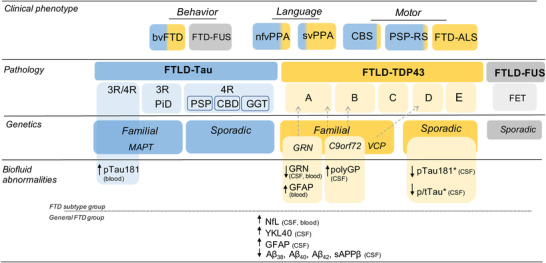
Frontotemporal dementia (FTD) covers a spectrum of neurodegenerative disorders with different phenotypes, genetic backgrounds, and pathological states. Its clinicopathological diversity challenges the diagnostic process and the execution of clinical trials, calling for specific diagnostic biomarkers of pathologic FTD types. There is also a need for biomarkers that facilitate disease staging, quantification of severity, monitoring in clinics and observational studies, and for evaluation of target engagement and treatment response in clinical trials. This review discusses current FTD biofluid-based biomarker knowledge taking into account the differing applications. The limitations, knowledge gaps, and challenges for the development and implementation of such markers are also examined. Strategies to overcome these hurdles are proposed, including the technologies available, patient cohorts, and collaborative research initiatives. Access to robust and reliable biomarkers that define the exact underlying pathophysiological FTD process will meet the needs for specific diagnosis, disease quantitation, clinical monitoring, and treatment development.
额颞叶痴呆(FTD)涵盖了一系列具有不同表型、遗传背景和病理状态的神经退行性疾病。其临床病理多样性挑战了诊断过程和临床试验的实施,需要特定的病理 FTD 类型的诊断生物标志物。此外,还需要能够促进疾病分期、严重程度量化、临床和观察性研究监测以及临床试验中评估靶标结合和治疗反应的生物标志物。本文综述了当前基于生物体液的 FTD 生物标志物的知识,同时考虑了不同的应用。还研究了此类标志物的开发和实施所面临的局限性、知识空白和挑战。提出了克服这些障碍的策略,包括可用的技术、患者队列和合作研究计划。获得能够准确定义潜在病理生理学 FTD 过程的强大且可靠的生物标志物将满足特定诊断、疾病定量、临床监测和治疗开发的需求。