Sant Pau Memory Unit, Department of Neurology, Institut d'Investigacions Biomèdiques Sant Pau - Hospital de Sant Pau, Universitat Autònoma de Barcelona, 08041, Barcelona, Spain.
Centro de Investigación Biomédica en Red en Enfermedades Neurodegenerativas (CIBERNED), 28031, Madrid, Spain.
Transl Neurodegener. 2021 Dec 10;10(1):50. doi: 10.1186/s40035-021-00275-w.
Astrocytes play an essential role in neuroinflammation and are involved in the pathogenesis of neurodenegerative diseases. Studies of glial fibrillary acidic protein (GFAP), an astrocytic damage marker, may help advance our understanding of different neurodegenerative diseases. In this study, we investigated the diagnostic performance of plasma GFAP (pGFAP), plasma neurofilament light chain (pNfL) and their combination for frontotemporal dementia (FTD) and Alzheimer's disease (AD) and their clinical utility in predicting disease progression.
pGFAP and pNfL concentrations were measured in 72 FTD, 56 AD and 83 cognitively normal (CN) participants using the Single Molecule Array technology. Of the 211 participants, 199 underwent cerebrospinal (CSF) analysis and 122 had magnetic resonance imaging. We compared cross-sectional biomarker levels between groups, studied their diagnostic performance and assessed correlation between CSF biomarkers, cognitive performance and cortical thickness. The prognostic performance was investigated, analyzing cognitive decline through group comparisons by tertile.
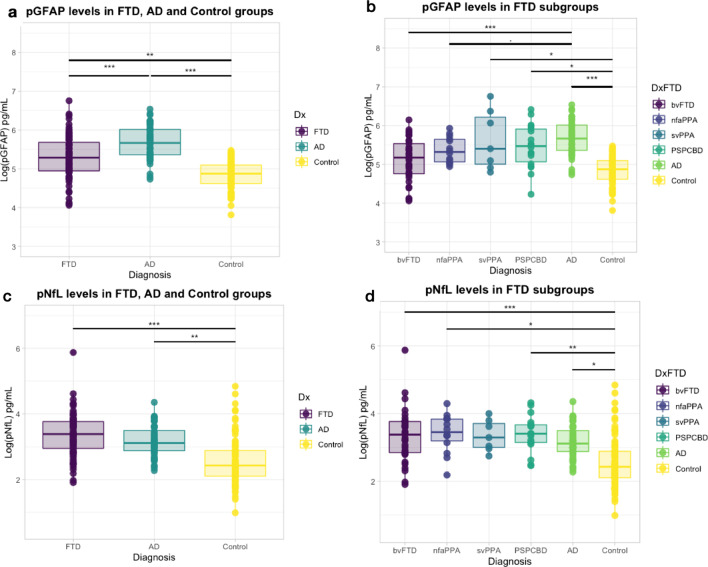
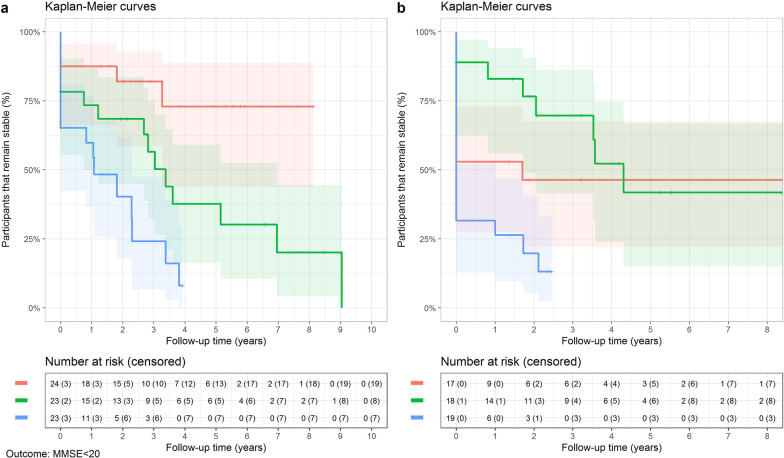
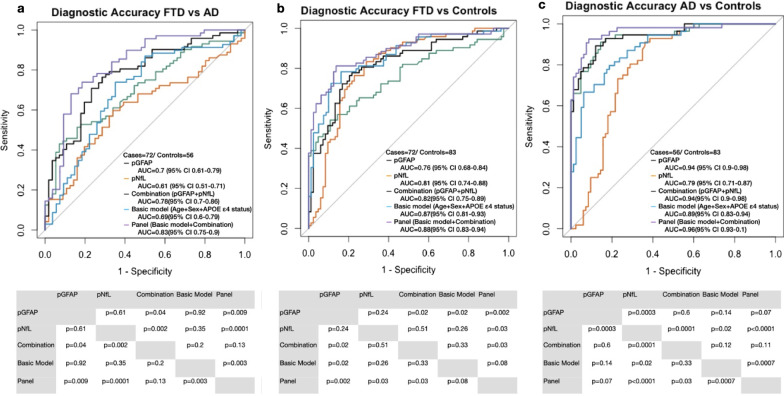
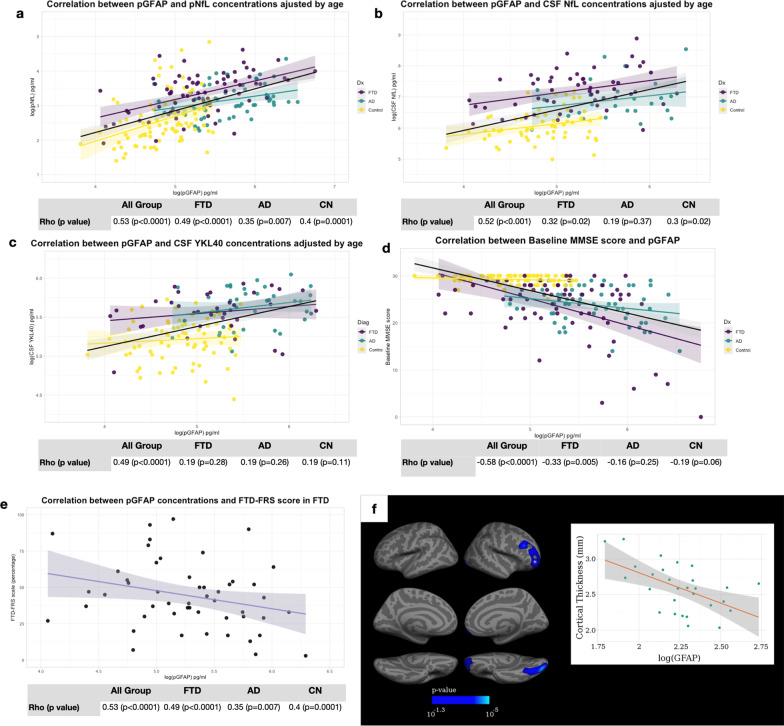
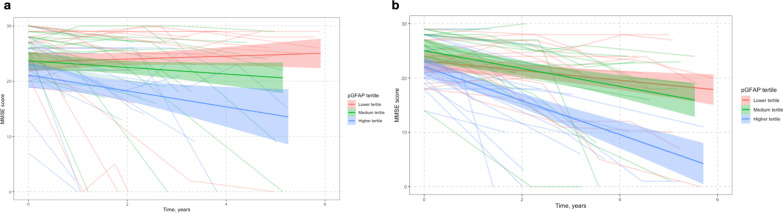
Unlike pNfL, which was increased similarly in both clinical groups, pGFAP was increased in FTD but lower than in AD (all P < 0.01). Combination of both plasma markers improved the diagnostic performance to discriminate FTD from AD (area under the curve [AUC]: combination 0.78; pGFAP 0.7; pNfL 0.61, all P < 0.05). In FTD, pGFAP correlated with cognition, CSF and plasma NfL, and cortical thickness (all P < 0.05). The higher tertile of pGFAP was associated with greater change in MMSE score and poor cognitive outcome during follow-up both in FTD (1.40 points annually, hazard ratio [HR] 3.82, P < 0.005) and in AD (1.20 points annually, HR 2.26, P < 0.005).
pGFAP and pNfL levels differ in FTD and AD, and their combination is useful for distinguishing between the two diseases. pGFAP could also be used to track disease severity and predict greater cognitive decline during follow-up in patients with FTD.
星形胶质细胞在神经炎症中起着至关重要的作用,并参与神经退行性疾病的发病机制。研究胶质纤维酸性蛋白(GFAP),一种星形胶质细胞损伤标志物,可能有助于我们深入了解不同的神经退行性疾病。在这项研究中,我们研究了血浆 GFAP(pGFAP)、血浆神经丝轻链(pNfL)及其组合在额颞叶痴呆(FTD)和阿尔茨海默病(AD)中的诊断性能及其在预测疾病进展中的临床应用。
使用单分子阵列技术测量了 72 名 FTD、56 名 AD 和 83 名认知正常(CN)参与者的 pGFAP 和 pNfL 浓度。在 211 名参与者中,199 名进行了脑脊液(CSF)分析,122 名进行了磁共振成像。我们比较了各组之间的横断面生物标志物水平,研究了它们的诊断性能,并评估了 CSF 生物标志物与认知表现和皮质厚度之间的相关性。通过三分位组比较分析认知下降来研究预后表现。
与 pNfL 不同,pNfL 在两个临床组中均有相似程度的升高,而 pGFAP 在 FTD 中升高,但低于 AD(均 P < 0.01)。两种血浆标志物的联合使用提高了区分 FTD 和 AD 的诊断性能(曲线下面积[AUC]:联合 0.78;pGFAP 0.7;pNfL 0.61,均 P < 0.05)。在 FTD 中,pGFAP 与认知、CSF 和血浆 NfL 以及皮质厚度相关(均 P < 0.05)。在 FTD 中,pGFAP 较高的三分位组与 MMSE 评分的更大变化以及随访期间较差的认知结果相关(每年 1.40 分,危险比[HR]3.82,P < 0.005)和 AD(每年 1.20 分,HR 2.26,P < 0.005)。
FTD 和 AD 中 pGFAP 和 pNfL 水平不同,两者联合使用有助于区分这两种疾病。pGFAP 还可用于跟踪疾病严重程度,并预测 FTD 患者随访期间认知下降更大。