
轮班工作期间进食不足会改变心脏的转录组,导致大鼠心脏组织纤维化和炎症。
Lack of food intake during shift work alters the heart transcriptome and leads to cardiac tissue fibrosis and inflammation in rats.
机构信息
Department of Biology, Texas A&M University, College Station, TX, 77843, USA.
Program of Genetics, Texas A&M University, College Station, TX, 77843, USA.
出版信息
BMC Biol. 2022 Mar 3;20(1):58. doi: 10.1186/s12915-022-01256-9.
BACKGROUND
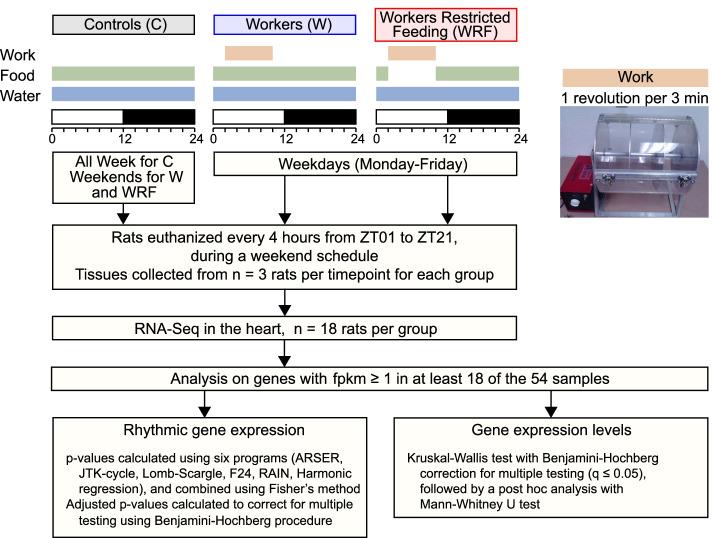
Many epidemiological studies revealed that shift work is associated with an increased risk of a number of pathologies, including cardiovascular diseases. An experimental model of shift work in rats has additionally been shown to recapitulate aspects of metabolic disorders observed in human shift workers, including increased fat content and impaired glucose tolerance, and used to demonstrate that restricting food consumption outside working hours prevents shift work-associated obesity and metabolic disturbance. However, the way distinct shift work parameters, such as type of work, quantity, and duration, affect cardiovascular function and the underlying mechanisms, remains poorly understood. Here, we used the rat as a model to characterize the effects of shift work in the heart and determine whether they can be modulated by restricting food intake during the normal active phase.
RESULTS
We show that experimental shift work reprograms the heart cycling transcriptome independently of food consumption. While phases of rhythmic gene expression are distributed across the 24-h day in control rats, they are clustered towards discrete times in shift workers. Additionally, preventing food intake during shift work affects the expression level of hundreds of genes in the heart, including genes encoding components of the extracellular matrix and inflammatory markers found in transcriptional signatures associated with pressure overload and cardiac hypertrophy. Consistent with this, the heart of shift worker rats not eating during work hours, but having access to food outside of shift work, exhibits increased collagen 1 deposition and displays increased infiltration by immune cells. While maintaining food access during shift work has less effects on gene expression, genes found in transcriptional signatures of cardiac hypertrophy remain affected, and the heart of shift worker rats exhibits fibrosis without inflammation.
CONCLUSIONS
Together, our findings unraveled differential effects of food consumption on remodeled transcriptional profiles of the heart in shift worker rats. They also provide insights into how shift work affects cardiac function and suggest that some interventions aiming at mitigating metabolic disorders in shift workers may have adverse effects on cardiovascular diseases.
背景
许多流行病学研究表明,轮班工作与许多病理学的风险增加有关,包括心血管疾病。大鼠轮班工作的实验模型还显示出重现了人类轮班工人中观察到的代谢紊乱的某些方面,包括脂肪含量增加和葡萄糖耐量受损,并用于证明限制工作时间外的食物摄入可以预防轮班工作相关的肥胖和代谢紊乱。然而,不同轮班工作参数(如工作类型、数量和持续时间)如何影响心血管功能及其潜在机制仍知之甚少。在这里,我们使用大鼠作为模型来描述轮班工作对心脏的影响,并确定在正常活动期限制食物摄入是否可以调节这些影响。
结果
我们表明,实验性轮班工作独立于食物摄入重新编程心脏的循环转录组。虽然在对照大鼠中,节律性基因表达的相位分布在 24 小时内,但在轮班工人中它们聚集在离散的时间。此外,在轮班工作期间限制食物摄入会影响心脏中数百个基因的表达水平,包括编码细胞外基质成分和炎症标志物的基因,这些基因在与压力超负荷和心肌肥厚相关的转录特征中被发现。与此一致,在轮班工作期间不进食但在轮班工作之外有食物摄入的轮班工作大鼠的心脏胶原 1 沉积增加,并显示出免疫细胞浸润增加。虽然在轮班工作期间保持食物摄入对基因表达的影响较小,但仍会影响到与心肌肥厚相关的转录特征中的基因,并且轮班工作大鼠的心脏会出现纤维化而没有炎症。
结论
总的来说,我们的研究结果揭示了食物摄入对轮班工作大鼠心脏重塑转录谱的不同影响。它们还提供了关于轮班工作如何影响心脏功能的见解,并表明一些旨在减轻轮班工人代谢紊乱的干预措施可能对心血管疾病产生不利影响。



 Zotero 插件