Department of Clinical Laboratory, Union Hospital, Tongji Medical College, Huazhong University of Science and Technology, Wuhan, 430022, China.
Research Center for Tissue Engineering and Regenerative Medicine, Union Hospital, Tongji Medical College, Huazhong University of Science and Technology, Wuhan, 430022, China.
Genome Med. 2022 Mar 2;14(1):26. doi: 10.1186/s13073-022-01033-x.
The RNA profiles of tumor-educated platelets (TEPs) possess pathological features that could be used for early cancer detection. However, the utility of TEP RNA profiling in detecting early colorectal cancer (CRC) versus noncancerous colorectal diseases has not yet been investigated. This study assesses the diagnostic capacity of TEP RNA profiles in a cohort of patients with CRC and noncancerous diseases.
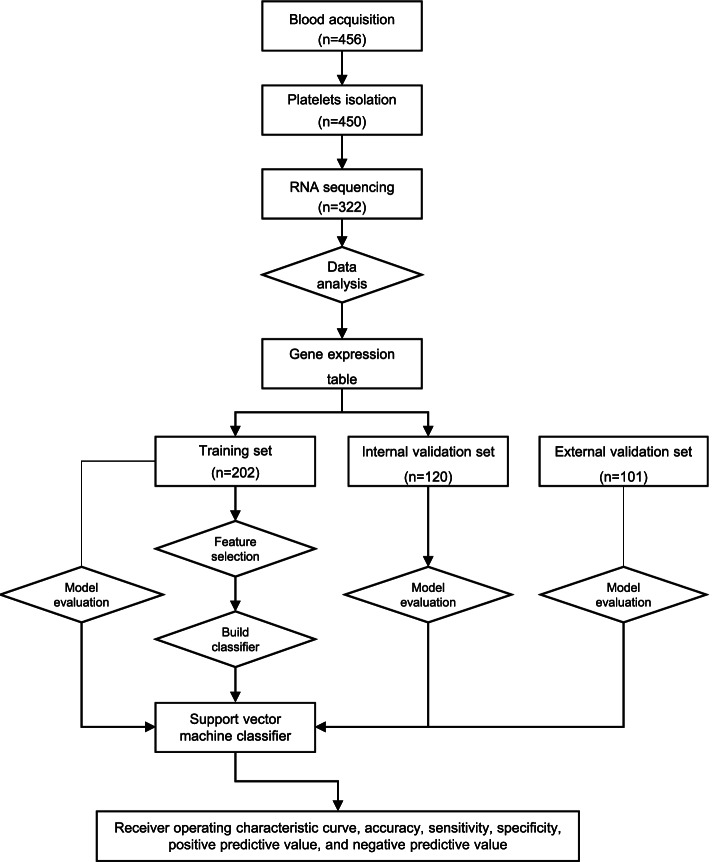
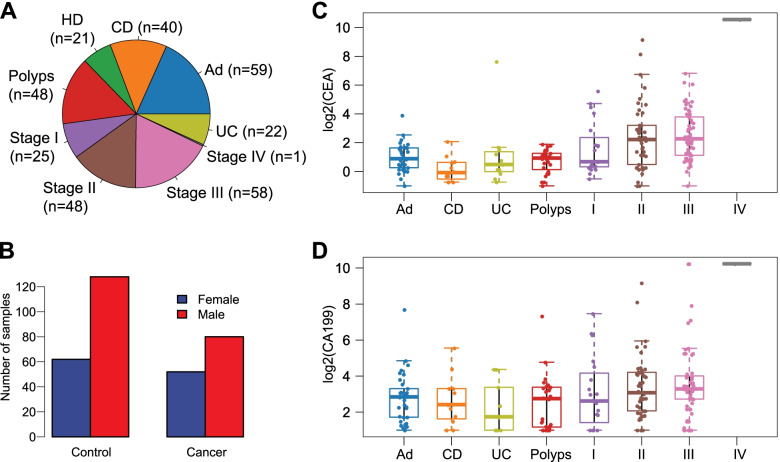
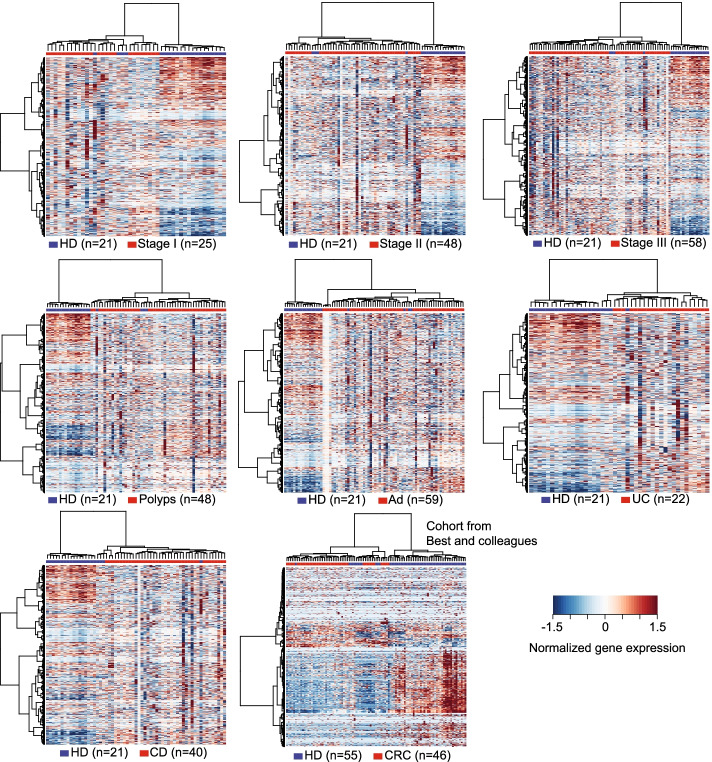
Transcriptome sequencing for platelets isolated from 132 patients with CRC at early and late stages and 190 controls consisting of healthy donors and patients with ulcerative disease, Crohn's disease, polyps, and adenomas was performed and analyzed using binary particle swarm optimization coupled with support vector machine to identify genes that contributed to the classification of CRC patients versus controls. The area under the receiver operating curves (AUROCs) and the accuracy of TEP RNA profiles in CRC diagnosis were assessed.
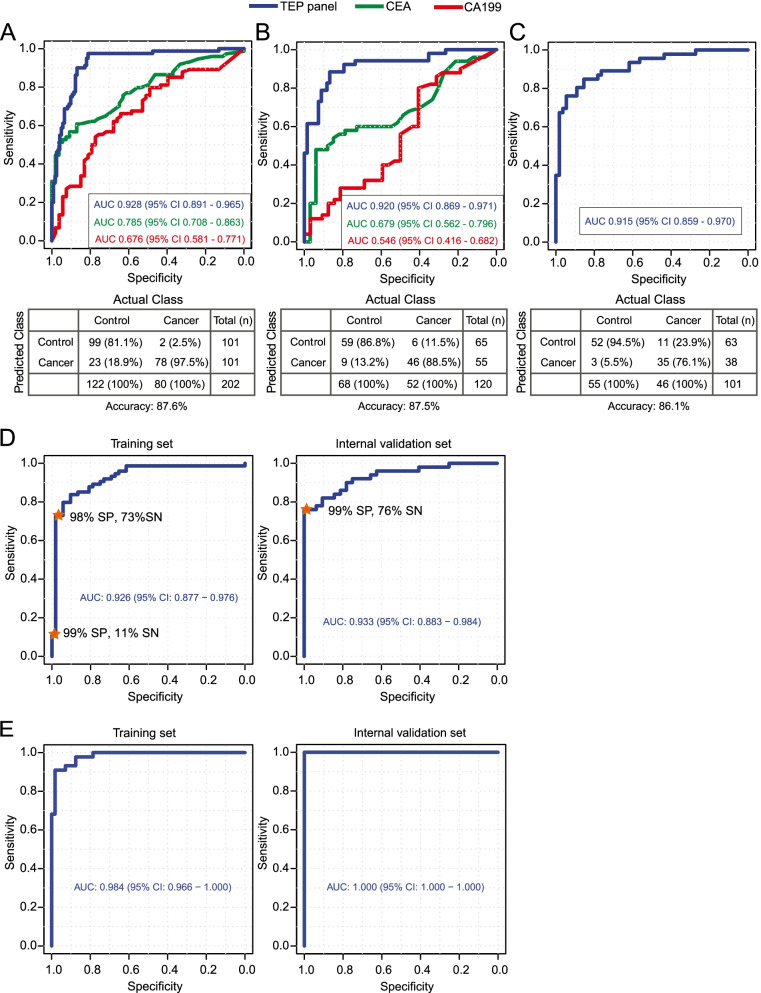
TEP RNA profiling achieved high performance in distinguishing and staging CRC patients from the controls. Using the swarm intelligence algorithm, the 921 most contributive genes that classified CRC patients from the controls were identified. AUROCs of 0.928 for the training set via leave-one-out cross-validation and 0.92 for the validation set were achieved, both of which were significantly higher than the clinically utilized serum biomarkers: carcinoembryonic antigen and cancer antigen 19-9. Notably, an AUROC of 0.915 in an external validation set was achieved. For predicting different CRC stages, an AUROC of 0.984 was achieved in the training set and 1.000 in the internal validation set.
RNA profiles of TEPs are of potential diagnostic value for identifying early CRC from noncancerous diseases. Prospective studies are needed to validate its clinical relevance.
肿瘤衍生血小板(TEP)的 RNA 谱具有病理特征,可用于早期癌症检测。然而,尚未研究 TEP RNA 谱在检测早期结直肠癌(CRC)与非癌性结直肠疾病中的效用。本研究评估了 TEP RNA 谱在 CRC 患者和非癌性疾病患者队列中的诊断能力。
对 132 例早期和晚期 CRC 患者及 190 例对照(包括健康供体和溃疡性疾病、克罗恩病、息肉和腺瘤患者)分离的血小板进行转录组测序,使用二进制粒子群优化与支持向量机结合分析,以鉴定有助于区分 CRC 患者与对照的基因。评估接受者操作特征曲线(AUROCs)和 TEP RNA 谱在 CRC 诊断中的准确性。
TEP RNA 谱在区分和分期 CRC 患者与对照方面表现出良好的性能。使用群体智能算法,鉴定出了 921 个最有助于区分 CRC 患者与对照的基因。通过留一法交叉验证,训练集的 AUROC 为 0.928,验证集为 0.92,均显著高于临床应用的血清生物标志物:癌胚抗原和癌抗原 19-9。值得注意的是,在外部验证集中实现了 0.915 的 AUROC。对于预测不同的 CRC 阶段,在训练集中实现了 0.984 的 AUROC,在内部验证集中实现了 1.000 的 AUROC。
TEP 的 RNA 谱具有识别早期 CRC 与非癌性疾病的潜在诊断价值。需要前瞻性研究来验证其临床相关性。