Department of Oncology, The First Affiliated Hospital of Dalian Medical UniversityDalianP.R. China.
Department of Oncology, Dalian Fifth Peoples HospitalDalianP.R. China.
Oncol Res. 2022 May 4;29(1):63-74. doi: 10.3727/096504022X16462176651719. Epub 2022 Mar 2.
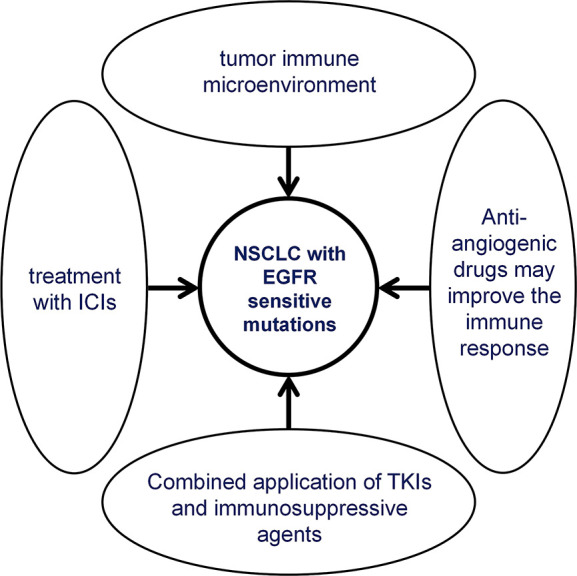
Lung cancer is a malignant tumor with high incidence and mortality across the world. The use of immune checkpoint inhibitors for lung cancer has improved the prognosis of some lung cancer patients to a greater extent and provided a new direction for the clinical treatment of lung cancer. Immunotherapy still has limitations in terms of its appropriate population and adverse reactions. Particularly for non-small cell lung cancer (NSCLC) patients with epidermal growth factor receptor (EGFR) mutation, there has been no major breakthrough in current immunotherapy. Whether immunotherapy can bring new benefits after drug resistance is induced by tyrosine kinase inhibitor-targeted therapy and whether the combination of immunotherapy with other treatments can improve the prognosis remain to be studied in depth. In this article, we provide a detailed review of the relevant characteristics of the tumor microenvironment of NSCLC with EGFR mutation and the current research on immunotherapy for NSCLC with EGFR mutation.
肺癌是一种发病率和死亡率都很高的恶性肿瘤。免疫检查点抑制剂在肺癌中的应用在更大程度上改善了一些肺癌患者的预后,并为肺癌的临床治疗提供了新的方向。免疫疗法在其适用人群和不良反应方面仍存在局限性。特别是对于表皮生长因子受体(EGFR)突变的非小细胞肺癌(NSCLC)患者,目前免疫疗法尚未取得重大突破。免疫疗法在酪氨酸激酶抑制剂靶向治疗诱导耐药后是否能带来新的获益,以及免疫疗法与其他治疗方法联合应用是否能改善预后,仍需要深入研究。本文详细综述了 EGFR 突变 NSCLC 的肿瘤微环境相关特征以及 EGFR 突变 NSCLC 的免疫治疗研究现状。