Department of Biochemistry, University of Veterinary Medicine Hannover, Hannover, Germany.
Research Center for Emerging Infections and Zoonoses (RIZ), University of Veterinary Medicine Hannover, Hannover, Germany.
Front Immunol. 2022 Feb 14;13:836278. doi: 10.3389/fimmu.2022.836278. eCollection 2022.
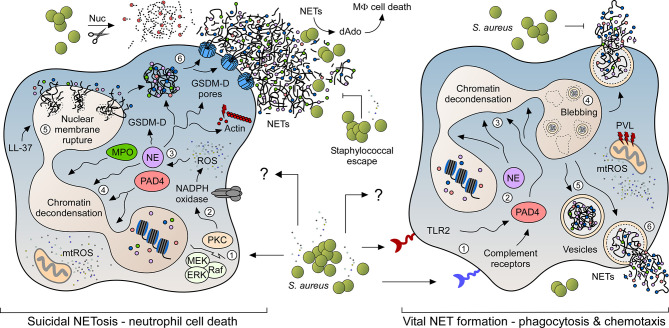
NETosis is a multi-facetted cellular process that promotes the formation of neutrophil extracellular traps (NETs). NETs as web-like structures consist of DNA fibers armed with granular proteins, histones, and microbicidal peptides, thereby exhibiting pathogen-immobilizing and antimicrobial attributes that maximize innate immune defenses against invading microbes. However, clinically relevant pathogens often tolerate entrapment and even take advantage of the remnants of NETs to cause persistent infections in mammalian hosts. Here, we briefly summarize how , a high-priority pathogen and causative agent of fatal diseases in humans as well as animals, catalyzes and concurrently exploits NETs during pathogenesis and recurrent infections. Specifically, we focus on toxigenic and immunomodulatory effector molecules produced by staphylococci that prime NET formation, and further highlight the molecular and underlying principles of suicidal NETosis compared to vital NET-formation by viable neutrophils in response to these stimuli. We also discuss the inflammatory potential of NET-controlled microenvironments, as excessive expulsion of NETs from activated neutrophils provokes local tissue injury and may therefore amplify staphylococcal disease severity in hospitalized or chronically ill patients. Combined with an overview of adaptation and counteracting strategies evolved by to impede NET-mediated killing, these insights may stimulate biomedical research activities to uncover novel aspects of NET biology at the host-microbe interface.
NETosis 是一种多方面的细胞过程,可促进中性粒细胞细胞外陷阱 (NETs) 的形成。NETs 呈网状结构,由带有颗粒蛋白、组蛋白和杀菌肽的 DNA 纤维组成,从而表现出固定病原体和抗菌属性,最大限度地增强先天免疫防御以抵御入侵的微生物。然而,临床上相关的病原体通常能够耐受捕获,甚至利用 NETs 的残余物在哺乳动物宿主中引起持续感染。在这里,我们简要总结了作为一种高优先级病原体以及人类和动物致命疾病的病原体,如何在发病机制和反复感染过程中催化和利用 NETs。具体而言,我们专注于葡萄球菌产生的毒力和免疫调节效应分子,这些分子可引发 NET 形成,并进一步强调了与对这些刺激物做出反应的存活中性粒细胞的致命 NET 形成相比,自杀 NETosis 的分子和潜在原理。我们还讨论了 NET 控制的微环境的炎症潜力,因为从活化的中性粒细胞中过度排出 NET 会引起局部组织损伤,因此可能会加重住院或慢性病患者的葡萄球菌病严重程度。结合葡萄球菌为阻碍 NET 介导的杀伤而进化出的适应和对抗策略概述,这些见解可能会激发生物医学研究活动,以揭示宿主-微生物界面上 NET 生物学的新方面。