The Wellcome Trust Research Laboratory, Division of Gastrointestinal Sciences, Christian Medical College, Vellore,India.
Indian Council of Medical Research - Regional Medical Research Centre, Bhubaneswar, Odisha,India.
J Infect Dis. 2021 Nov 23;224(Supple 5):S593-S600. doi: 10.1093/infdis/jiab409.
Children suffer the highest burden of the typhoid fever, with a considerable proportion shedding Salmonella Typhi in stool, potentially resulting in transmission of S Typhi.
We enrolled 70 children with blood culture-confirmed typhoid fever (index cases), from 63 households, during community-based fever surveillance in India. The index cases and their household contacts were followed up with stool samples at multiple time points over 3 weeks and 1 week, respectively. S Typhi was detected using quantitative real-time polymerase chain reaction.
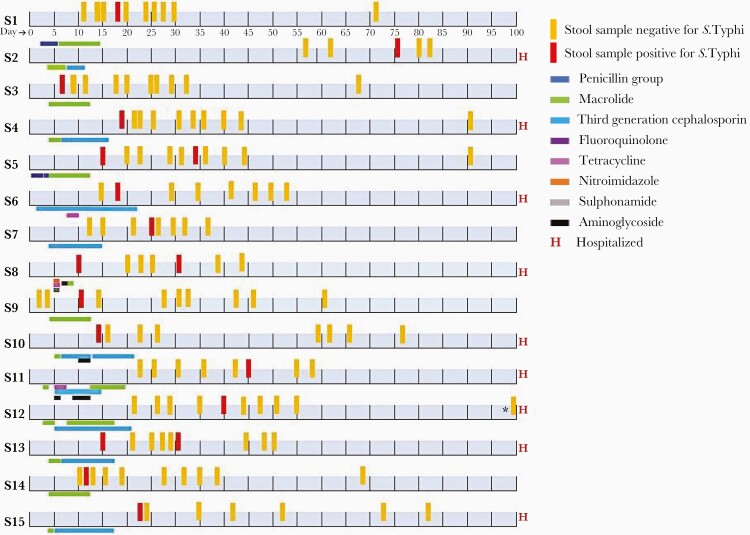
Fifteen of 70 (21.4%) children with culture-confirmed typhoid fever shed S Typhi in stool after onset of fever. Ten of 15 children shed S Typhi for a median of 11.5 (range, 3-61) days from the day of completion of antibiotics. Of 172 household contacts from 56 of the 63 index case households, 12 (7%) contacts in 11 (19.6%) households had S Typhi in stool. Five of the 12 contacts who were shedding S Typhi were asymptomatic, whereas 7 reported recent fever.
One in 5 children with typhoid fever shed S Typhi, with shedding persisting even after antibiotics. One in 5 households had at least 1 contact of the child shedding S Typhi, highlighting potential concurrent typhoid infections in households in settings with poor water and sanitation.
儿童是伤寒的主要负担人群,其中相当一部分患者粪便中会排出伤寒沙门氏菌,从而可能导致伤寒沙门氏菌的传播。
我们在印度进行社区发热监测时,从 63 户家庭中招募了 70 名血培养确诊的伤寒儿童(索引病例)。对索引病例及其家庭接触者进行了随访,分别在 3 周和 1 周内多次采集粪便样本。使用实时定量聚合酶链反应检测伤寒沙门氏菌。
在 70 名确诊为伤寒的儿童中,有 15 名(21.4%)在发热后粪便中排出伤寒沙门氏菌。在完成抗生素治疗后的第 11.5 天(范围为 3-61 天),有 10 名儿童的中位排菌时间为 11.5 天(范围为 3-61 天)。在来自 63 个索引病例家庭的 172 个家庭接触者中,有 12 个(7%)家庭中的 11 个(19.6%)家庭接触者的粪便中存在伤寒沙门氏菌。在 12 名排菌的接触者中,有 5 名无症状,而 7 名有近期发热史。
5 分之一的伤寒儿童会排出伤寒沙门氏菌,即使在使用抗生素后,仍会持续排菌。在 5 分之一的家庭中,至少有 1 名儿童的接触者排出了伤寒沙门氏菌,这突出表明在卫生和环境卫生条件较差的环境中,家庭中可能存在同时发生的伤寒感染。