Berendsen S, Nummenin E, Schirmbeck F, de Haan L, van Tricht M J
University Medical Center Amsterdam, Academic Medical Center, Department of Psychiatry, Amsterdam, the Netherlands.
Dimence Mental Health Care, Department of Psychosis, Deventer, the Netherlands.
Schizophr Res Cogn. 2021 Dec 14;28:100232. doi: 10.1016/j.scog.2021.100232. eCollection 2022 Jun.
Clinical staging has been developed to capture the large heterogeneity in schizophrenia spectrum disorders. Including cognitive performance in the staging model may improve its clinical validity. Moreover, cognitive functioning could predict transition across stages. However, current evidence of the association between cognition and clinical staging is inconsistent. Therefore, we aim to assess whether cognitive parameters are associated with clinical stages in a large sample of patients with schizophrenia spectrum disorders and to identify cognitive markers at baseline that are associated with stage-transition at three and six-year follow-up.
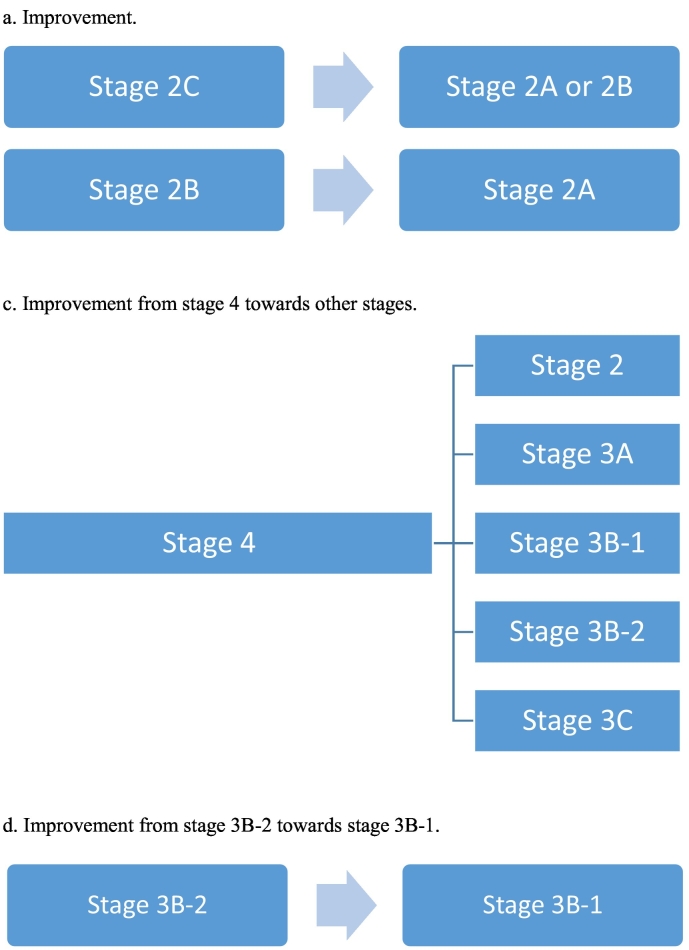
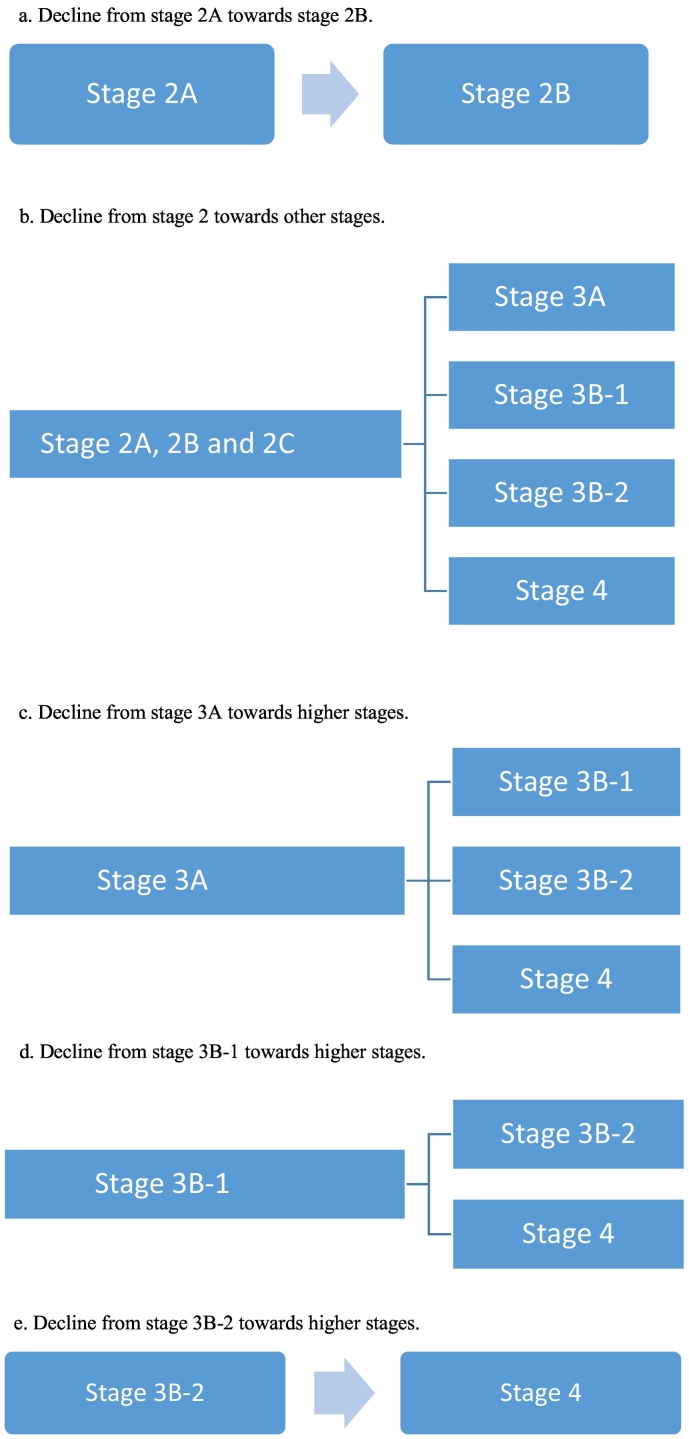
We applied the staging model of Fusar-Poli et al. (2017) in 927 patients with non-affective psychotic disorders, assessed at baseline, and after three and six-year follow-up. Cognitive performance was assessed with a standard test battery. Generalized linear mixed models were used to analyze associations of cognitive performance with staging and stage-transition at follow-up.
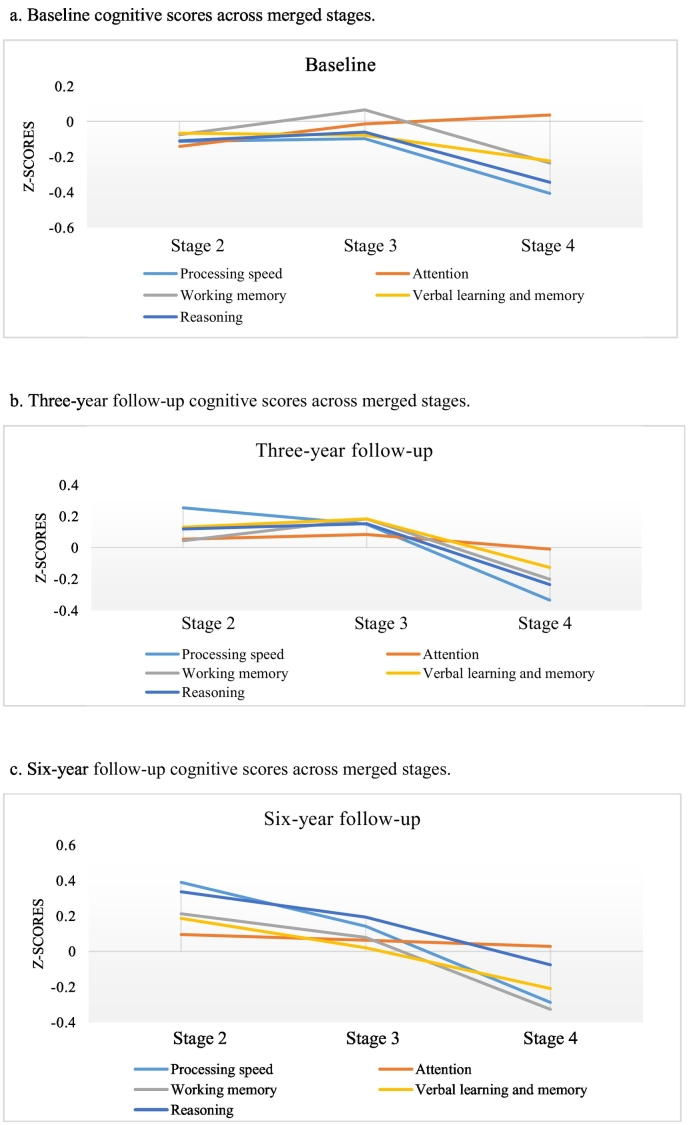
Findings showed that higher stages of illness were significantly associated with lower processing speed (F = 3.688, = 0.025) and deficits in working memory (F = 6.365, = 0.002) across assessments. No associations between cognitive parameters at baseline and stage-transition at three- and six-year follow-up were found.
We conclude that processing speed and working memory were modestly associated with higher stages of illness in schizophrenia spectrum disorders, thereby slightly improving its clinical validity. However, associations were small and we found no evidence for predictive validity.
临床分期已被开发用于捕捉精神分裂症谱系障碍中的巨大异质性。将认知表现纳入分期模型可能会提高其临床有效性。此外,认知功能可以预测跨阶段的转变。然而,目前关于认知与临床分期之间关联的证据并不一致。因此,我们旨在评估在大量精神分裂症谱系障碍患者样本中认知参数是否与临床阶段相关,并确定在基线时与三年和六年随访时的阶段转变相关的认知标志物。
我们将Fusar - Poli等人(2017年)的分期模型应用于927名非情感性精神障碍患者,在基线、三年和六年随访时进行评估。使用标准测试组合评估认知表现。使用广义线性混合模型分析认知表现与随访时的分期和阶段转变之间的关联。
研究结果表明,在各项评估中,疾病的更高阶段与更低的处理速度(F = 3.688,P = 0.025)和工作记忆缺陷(F = 6.365,P = 0.002)显著相关。在基线时的认知参数与三年和六年随访时的阶段转变之间未发现关联。
我们得出结论,处理速度和工作记忆与精神分裂症谱系障碍中更高的疾病阶段有适度关联,从而略微提高了其临床有效性。然而,关联较小,且我们没有发现预测有效性的证据。