Unit of Infectious and Tropical Diseases, Department of Clinical and Experimental Sciences, University of Brescia and ASST Spedali Civili Hospital, Brescia, Italy.
Unit of Biostatistics and Bioinformatics, Department of Molecular and Translational Medicine, University of Brescia, Brescia, Italy.
AIDS Behav. 2022 Sep;26(9):2920-2930. doi: 10.1007/s10461-022-03638-0. Epub 2022 Mar 6.
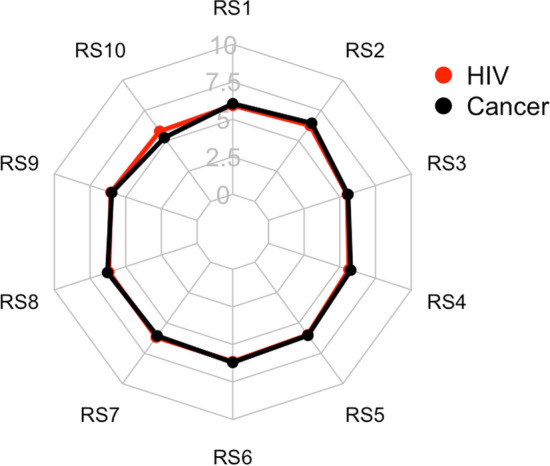
People living with chronic disease (PLWCD) are the frailest category, both for the risk of severe COVID-19 illness and for the impact on the care continuum. Aim of this study was to analyze coping strategies and resilience in people living with HIV (PLWH) compared to people living with oncological diseases (PLWOD) during COVID-19 pandemic. We administrated an anonymous questionnaire, which explored the emotional experience, the demographic factors linked to a COVID-19-related stress syndrome, the patient's perception about the adequacy of clinical undertaking from the hospital and the resilience. We analyzed 324 questionnaires. There were no significant differences in prevalence of psychological distress among the whole cohort; however, PLWOD were calmer, less troubled, and more serene than PLWH. Moreover, PLWH smoked more, ate more, and gained more weight than PLWOD. Most patients didn't feel lonely and continued to take pleasure from their activities. No differences in resilience were found between the groups. In the whole cohort lower levels of resilience were found in patients that were unemployed, with history of psychological disorders and in those who experienced more feelings of anger, anxiety and concern. In our study, patients seemed to preserve their well-being, and to activate adaptive coping during the pandemic.
患有慢性疾病(PLWCD)的人是最脆弱的群体,无论是感染 COVID-19 重症的风险,还是对护理连续性的影响。本研究旨在分析 COVID-19 大流行期间与患有肿瘤疾病(PLWOD)的人相比,艾滋病毒感染者(PLWH)的应对策略和韧性。我们进行了一项匿名问卷调查,探讨了情感体验、与 COVID-19 相关应激综合征相关的人口统计学因素、患者对医院临床工作的充分性的感知以及韧性。我们分析了 324 份问卷。在整个队列中,心理困扰的患病率没有显著差异;然而,PLWOD 比 PLWH 更平静、更少困扰、更平静。此外,PLWH 比 PLWOD 吸烟更多、吃得更多、体重增加更多。大多数患者并不感到孤独,仍然从他们的活动中获得乐趣。两组之间的韧性没有差异。在整个队列中,失业、有心理障碍病史以及感到更多愤怒、焦虑和担忧的患者,其韧性水平较低。在我们的研究中,患者在大流行期间似乎保持了他们的幸福感,并激活了适应性应对策略。