Department of Infectious Diseases, University of Brescia, Brescia, Italy.
Division of Infectious Diseases, ASST Spedali Civili, Brescia, Italy.
AIDS Res Ther. 2020 Oct 4;17(1):59. doi: 10.1186/s12981-020-00314-y.
During the COVID-19 pandemic, hospitals faced increasing pressure, where people living with HIV risked to either acquire SARS-CoV-2 and to interrupt the HIV continuum of care.
This is a retrospective, observational study. We compared the numbers of medical visits performed, antiretroviral drugs dispensed and the number of new HIV diagnosis and of hospitalizations in a cohort of people living with HIV (PLWH) followed by the Spedali Civili of Brescia between the bimester of the COVID-19 pandemic peak and the bimester of October-November 2019. Data were retrieved from administrative files and from paper and electronic clinical charts. Categorical variables were described using frequencies and percentages, while continuous variables were described using mean, median, and interquartile range (IQR) values. Means for continuous variables were compared using Student's t-tests and the Mann-Whitney test. Proportions for categorical variables were compared using the χ test.
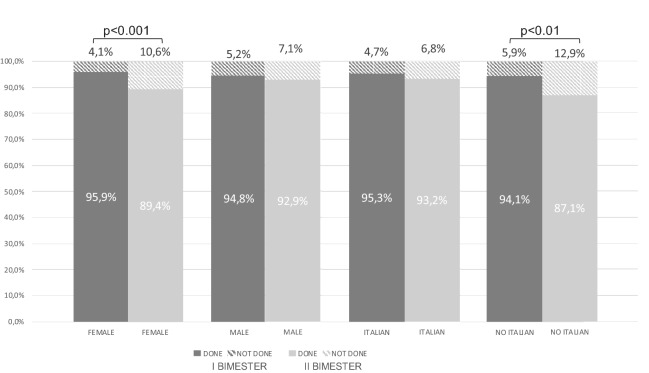
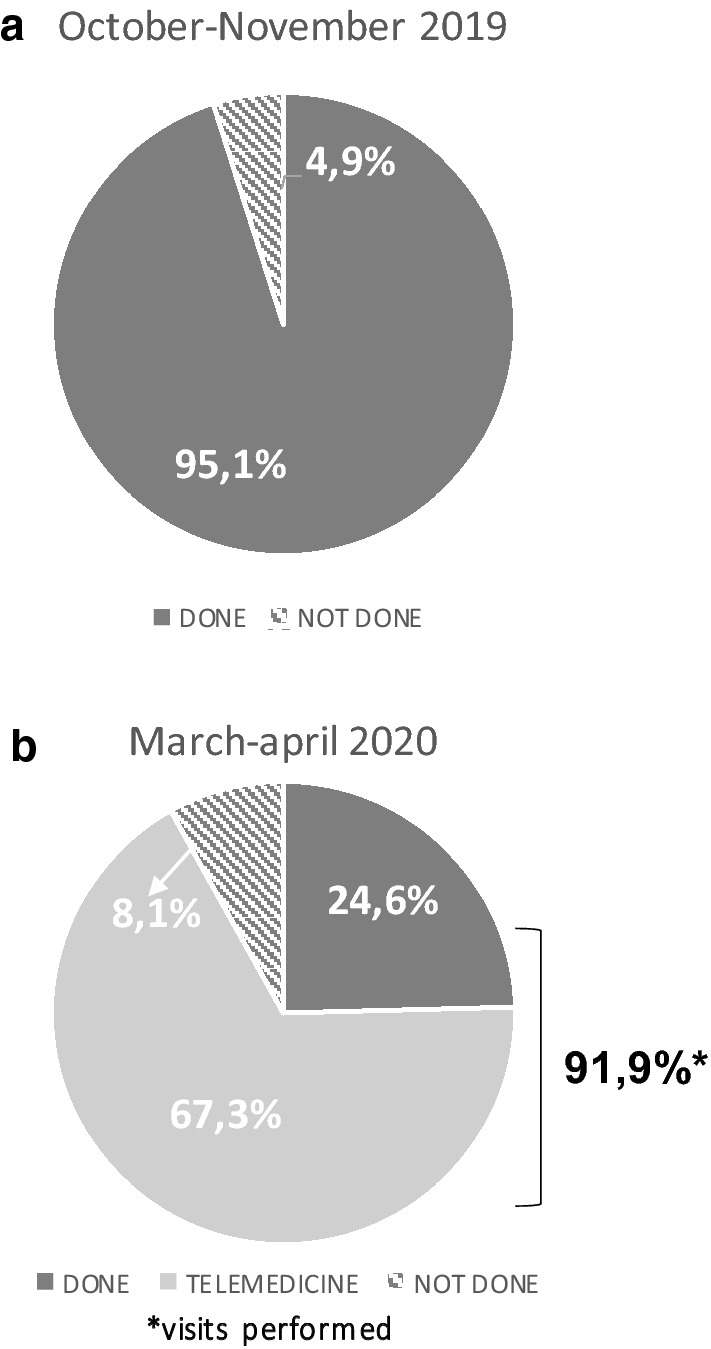
As of December 31st, 2019, a total of 3875 PLWH were followed in our clinic. Mean age was 51.4 ± 13 years old, where 28% were females and 18.8% non-Italian. Overall, 98.9% were on ART (n = 3834), 93% were viro-suppressed. A total of 1217 and 1162 patients had their visit scheduled at our out-patient HIV clinic during the two bimesters of 2019 and 2020, respectively. Comparing the two periods, we observed a raise of missed visits from 5 to 8% (p < 0.01), a reduction in the number of new HIV diagnosis from 6.4 in 2019 to 2.5 per month in 2020 (p = 0.01), a drop in ART dispensation and an increase of hospitalized HIV patients due to COVID-19. ART regimens including protease inhibitors (PIs) had a smaller average drop than ART not including PIs (16.6 vs 21.6%, p < 0.05). Whether this may be due to the perception of a possible efficacy of PIs on COVID19 is not known.
Our experience highlights the importance of a resilient healthcare system and the need to implement new strategies in order to guarantee the continuum of HIV care even in the context of emergency.
在 COVID-19 大流行期间,医院面临着越来越大的压力,艾滋病毒感染者既面临着感染 SARS-CoV-2 的风险,也面临着中断艾滋病毒护理连续性的风险。
这是一项回顾性、观察性研究。我们比较了在 Brescia Spedali Civili 接受艾滋病毒感染者(PLWH)随访的队列中,在 COVID-19 大流行高峰期的 bimester 和 2019 年 10 月至 11 月的 bimester 期间,进行的医疗就诊次数、抗逆转录病毒药物的配发以及新的 HIV 诊断和住院治疗的数量。数据从行政档案和纸质及电子临床图表中检索。分类变量采用频率和百分比表示,连续变量采用均值、中位数和四分位数范围(IQR)值表示。连续变量的均值采用学生 t 检验和曼-惠特尼检验进行比较。分类变量的比例采用卡方检验进行比较。
截至 2019 年 12 月 31 日,我们诊所共随访了 3875 名 PLWH。平均年龄为 51.4±13 岁,其中 28%为女性,18.8%为非意大利人。总体而言,98.9%的患者正在接受抗逆转录病毒治疗(n=3834),93%的患者病毒得到抑制。在 2019 年和 2020 年的两个 bimester 中,分别有 1217 名和 1162 名患者在我们的门诊艾滋病毒诊所预约就诊。与这两个时期相比,我们观察到错过就诊的人数从 5%增加到 8%(p<0.01),新的 HIV 诊断数量从 2019 年的每月 6.4 例减少到 2020 年的每月 2.5 例(p=0.01),抗逆转录病毒药物的配发减少,因 COVID-19 而住院的艾滋病毒患者增加。包含蛋白酶抑制剂(PI)的抗逆转录病毒药物方案的平均降幅小于不包含 PI 的方案(16.6%对 21.6%,p<0.05)。这是否是由于人们认为 PI 可能对 COVID19 有效尚不清楚。
我们的经验强调了有弹性的医疗保健系统的重要性,需要实施新的策略,以确保即使在紧急情况下,艾滋病毒护理的连续性也能得到保证。