Herhaus Benedict, Kalin Adrian, Gouveris Haralampos, Petrowski Katja
Medical Psychology and Medical Sociology, University Medical Center of the Johannes Gutenberg University Mainz, Mainz, Germany.
Sleep Medicine Center and Department of Otolaryngology, University Medical Center of the Johannes Gutenberg University Mainz, Mainz, Germany.
Front Physiol. 2022 Feb 17;13:821741. doi: 10.3389/fphys.2022.821741. eCollection 2022.
Restorative sleep is associated with increased autonomous parasympathetic nervous system activity that might be improved by heart rate variability-biofeedback (HRV-BF) training. Hence the aim of this study was to investigate the effect of a four-week mobile HRV-BF intervention on the sleep quality and HRV of healthy adults.
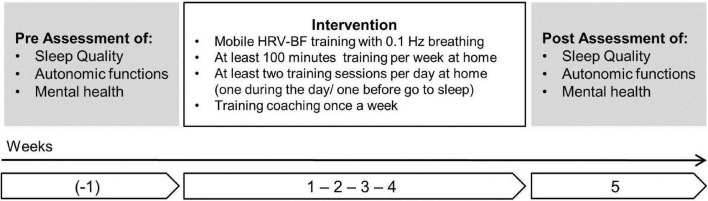
In a prospective study, 26 healthy participants (11 females; mean age: 26.04 ± 4.52 years; mean body mass index: 23.76 ± 3.91 kg/m) performed mobile HRV-BF training with 0.1 Hz breathing over four weeks, while sleep quality, actigraphy and HRV were measured before and after the intervention.
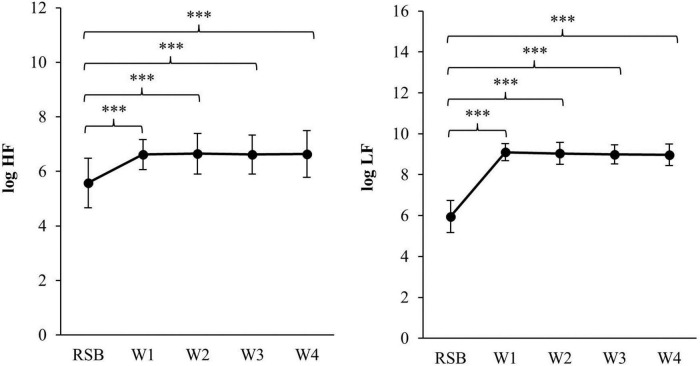
Mobile HRV-BF training with 0.1 Hz breathing improved the subjective sleep quality in healthy adults [(24) = 4.9127, ≤ 0.001, = 0.99] as measured by the Pittsburgh Sleep Quality Index. In addition, mobile HRV-BF training with 0.1 Hz breathing was associated with an increase in the time and frequency domain parameters SDNN, Total Power and LF after four weeks of intervention. No effect was found on actigraphy metrics.
Mobile HRV-BF intervention with 0.1 Hz breathing increased the reported subjective sleep quality and may enhance the vagal activity in healthy young adults. HRV-BF training emerges as a promising tool for improving sleep quality and sleep-related symptom severity by means of normalizing an impaired autonomic imbalance during sleep.
恢复性睡眠与自主副交感神经系统活动增加有关,心率变异性生物反馈(HRV-BF)训练可能会改善这种情况。因此,本研究的目的是调查为期四周的移动HRV-BF干预对健康成年人睡眠质量和HRV的影响。
在一项前瞻性研究中,26名健康参与者(11名女性;平均年龄:26.04±4.52岁;平均体重指数:23.76±3.91kg/m)进行了为期四周的0.1Hz呼吸移动HRV-BF训练,同时在干预前后测量睡眠质量、活动记录仪和HRV。
通过匹兹堡睡眠质量指数测量,0.1Hz呼吸的移动HRV-BF训练改善了健康成年人的主观睡眠质量[(24)=4.9127,≤0.001,=0.99]。此外,干预四周后,0.1Hz呼吸的移动HRV-BF训练与时间和频域参数SDNN、总功率和低频的增加有关。未发现对活动记录仪指标有影响。
0.1Hz呼吸的移动HRV-BF干预提高了报告的主观睡眠质量,并可能增强健康年轻人的迷走神经活动。HRV-BF训练成为一种有前景的工具,可通过使睡眠期间受损的自主神经失衡正常化来改善睡眠质量和与睡眠相关的症状严重程度。