Chu Cong-Qiu
Division of Arthritis and Rheumatic Diseases, Oregon Health & Science University, Section of Rheumatology, VA Portland Health Care System, Portland, OR, United States.
Front Med (Lausanne). 2022 Feb 17;9:846300. doi: 10.3389/fmed.2022.846300. eCollection 2022.
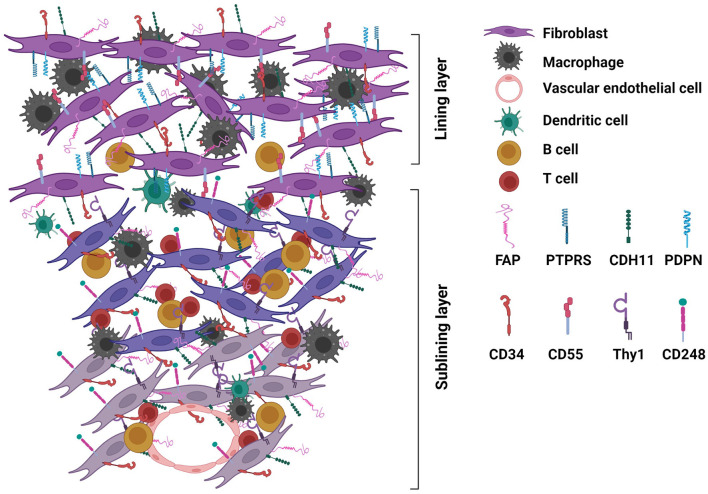
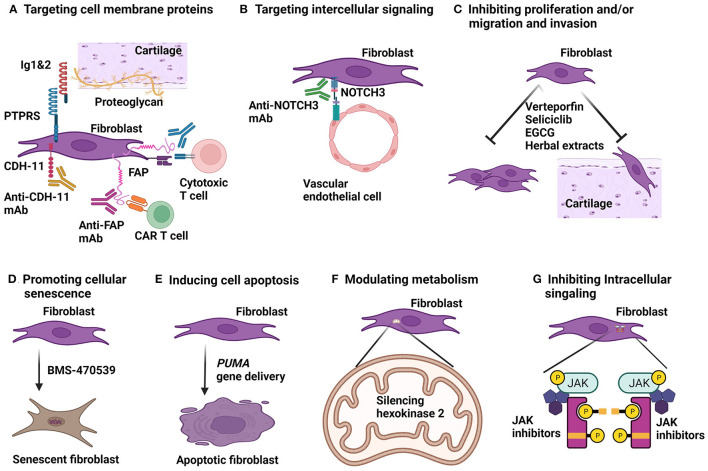
Synovial fibroblasts of rheumatoid arthritis (RA) play a critical role in perpetuation of chronic inflammation by interaction with immune and inflammatory cells and in cartilage and bone invasion, but current therapies for RA are not directly targeted fibroblasts. Selectively fibroblast targeted therapy has been hampered because of lack of fibroblast specific molecular signature. Recent advancement in technology enabled us to gain insightful information concerning RA synovial fibroblast subpopulations and functions. Exploring fibroblast targeted therapies have been focused on inducing cell death via fibroblast associated proteins; interrupting fibroblast binding to matrix protein; blocking intercellular signaling between fibroblasts and endothelial cells; inhibiting fibroblast proliferation and invasion; promoting cell apoptosis and inducing cellular senescence, and modulating fibroblast glucose metabolism. Translation into clinical studies of these fibroblast targeted strategies is required for evaluation for their clinical application, in particular for combination therapy with current immune component targeted therapies. Here, several strategies of fibroblast targeted therapy are highlighted.
类风湿关节炎(RA)的滑膜成纤维细胞通过与免疫和炎症细胞相互作用以及在软骨和骨侵袭中,在慢性炎症的持续存在中起关键作用,但目前针对RA的疗法并非直接靶向成纤维细胞。由于缺乏成纤维细胞特异性分子特征,选择性成纤维细胞靶向治疗受到阻碍。技术上的最新进展使我们能够获得有关RA滑膜成纤维细胞亚群和功能的深入信息。探索成纤维细胞靶向治疗一直集中在通过成纤维细胞相关蛋白诱导细胞死亡;中断成纤维细胞与基质蛋白的结合;阻断成纤维细胞与内皮细胞之间的细胞间信号传导;抑制成纤维细胞增殖和侵袭;促进细胞凋亡和诱导细胞衰老,以及调节成纤维细胞葡萄糖代谢。将这些成纤维细胞靶向策略转化为临床研究对于评估其临床应用是必要的,特别是与当前免疫成分靶向疗法的联合治疗。在此,突出了几种成纤维细胞靶向治疗策略。