Ginsburg Carren, Collinson Mark A, Gómez-Olivé F Xavier, Harawa Sadson, Pheiffer Chantel F, White Michael J
Medical Research Council/Wits Rural Public Health and Health Transitions Research Unit (Agincourt), School of Public Health, Faculty of Health Sciences, University of the Witwatersrand, Johannesburg, South Africa.
Department of Science and Innovation/ Medical Research Council, South African Population Research Infrastructure Network, South Africa.
SSM Popul Health. 2022 Feb 17;17:101049. doi: 10.1016/j.ssmph.2022.101049. eCollection 2022 Mar.
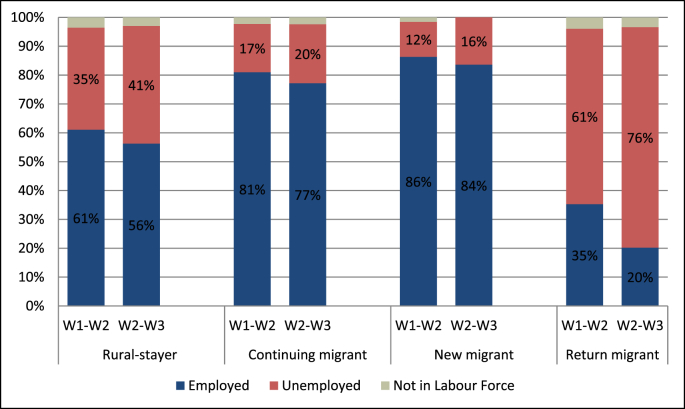
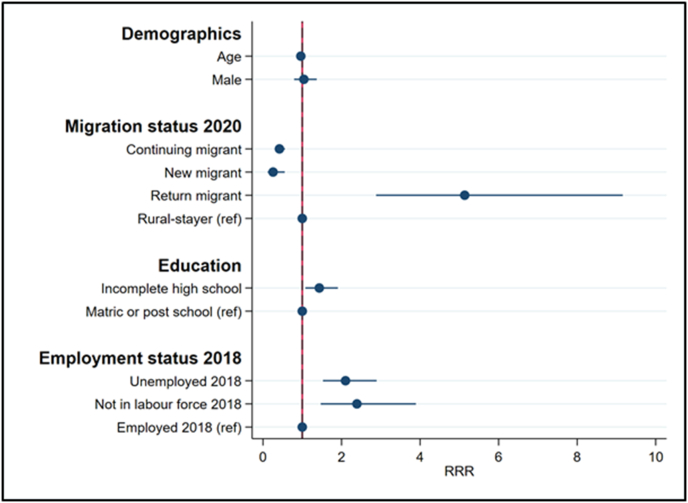
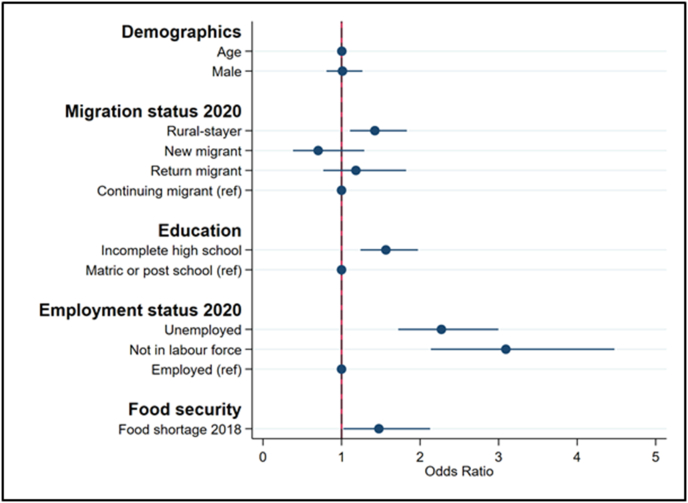
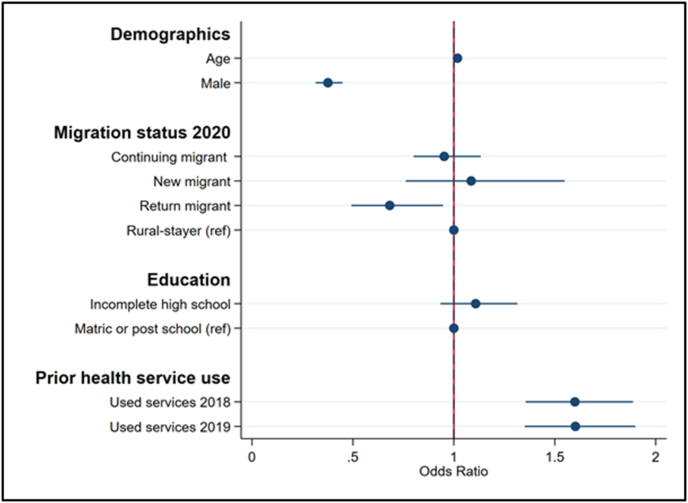
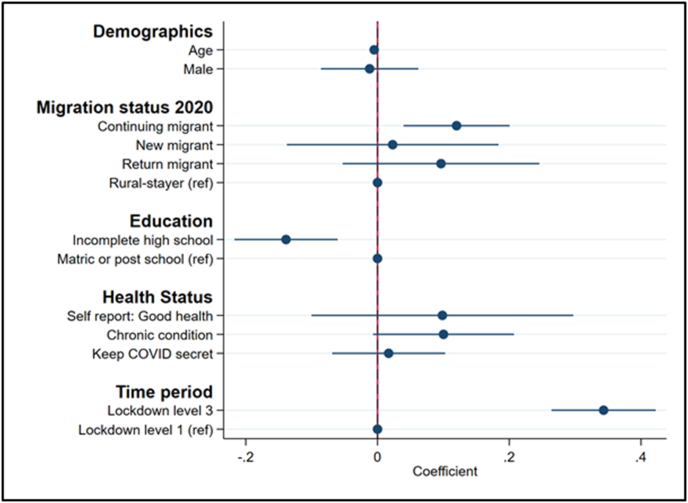
South Africa has a large temporary migrant population with people commonly moving to metropolitan areas to access employment, while maintaining links with their rural origin households. The COVID-19 pandemic has impacted patterns of movement, livelihoods and health seeking, and the effects on internal, temporary migrants are unclear. Using longitudinal data spanning 2018 to 2020, this paper employs descriptive statistics and regression analyses to assess the impacts of COVID-19 on a cohort of 2971 persons aged 18-40 at baseline, both residents and migrants, from a rural district in South Africa's northeast. In contrast with 2018-2019, in 2020 the share of rural residents initiating a migration decreased by 11 percentage points (p<0.001), while the share of temporary migrants returning to origin households increased by 5 percentage points (p<0.001). Study participants who were continuing migrants reported fewer job losses in comparison with rural-stayers, while 76% of return migrants who were employed in 2019 were no longer employed in 2020. Further, among those who did not experience food shortages in 2019, rural-stayers had 1.42 times the odds of continuing migrants of suffering shortages in 2020. In 2020 health service use in the cohort decreased overall, with return migrants having still lower odds of utilising health services. The results highlight the differential geographic and socioeconomic manifestations of the pandemic, with worsening socioeconomic circumstances observed for rural-staying (disproportionately female) and returning populations, while continuing migrants fared relatively better. It is vital that a COVID-19 response considers the potentially heterogeneous impact of the pandemic on mobile and stable populations. Policy responses may include targeting migrants at their destinations in health promotion of COVID-19 messaging, and strengthening health care and social support in origin communities in recognition that these areas receive return migrants into their catchment population.
南非有大量临时移民人口,人们通常前往大都市地区寻找工作,同时与他们农村原籍家庭保持联系。新冠疫情影响了人们的流动模式、生计和寻求医疗的方式,而其对国内临时移民的影响尚不清楚。本文利用2018年至2020年的纵向数据,采用描述性统计和回归分析方法,评估新冠疫情对南非东北部一个农村地区2971名基线年龄在18至40岁的人群(包括居民和移民)的影响。与2018 - 2019年相比,2020年开始迁移的农村居民比例下降了11个百分点(p<0.001),而返回原籍家庭的临时移民比例增加了5个百分点(p<0.001)。与农村留守者相比,仍在迁移的研究参与者报告的失业情况较少,而2019年有工作的返乡移民中,76%在2020年不再有工作。此外,在2019年没有经历粮食短缺的人群中,农村留守者在2020年面临粮食短缺的几率是仍在迁移者的1.42倍。2020年,该队列总体上医疗服务使用减少,返乡移民使用医疗服务的几率更低。结果突出了疫情在地理和社会经济方面的不同表现,农村留守者(女性比例过高)和返乡人群的社会经济状况恶化,而仍在迁移的人群情况相对较好。至关重要的是,应对新冠疫情的措施要考虑到疫情对流动人群和稳定人群可能产生的不同影响。政策应对措施可能包括在新冠疫情信息的健康宣传中针对目的地的移民,以及加强原籍社区的医疗保健和社会支持,因为认识到这些地区接收返乡移民进入其服务人群。