Medical Research Council/Wits Rural Public Health and Health Transitions Research Unit (Agincourt), School of Public Health, Faculty of Health Sciences, University of the Witwatersrand, 27 St Andrews Road, Parktown, Johannesburg, 2193, South Africa.
Department of Science and Innovation/ Medical Research Council, South African Population Research Infrastructure Network, Johannesburg, South Africa.
BMC Public Health. 2021 Mar 20;21(1):554. doi: 10.1186/s12889-021-10590-6.
In South Africa, human geographic mobility is high as people engage in both permanent and temporary relocation, predominantly from rural to urban areas. Such mobility can compromise healthcare access and utilisation. The objective of this paper is to explore healthcare utilisation and its determinants in a cohort of internal migrants and permanent residents (non-migrants) originating from the Agincourt sub-district in South Africa's rural northeast.
A 5-year cohort study of 3800 individuals aged 18 to 40 commenced in 2017. Baseline data have been collected from 1764 Agincourt residents and 1334 temporary, mostly urban-based, migrants, and are analysed using bivariate analyses, logistic and multinomial regression models, and propensity score matching analysis.
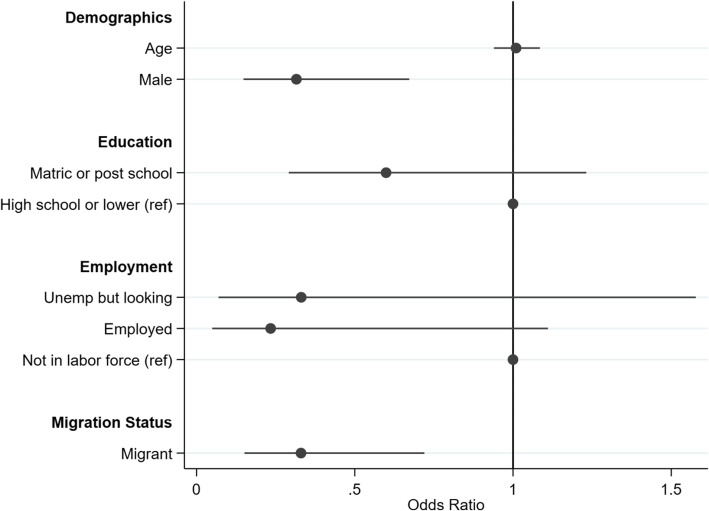
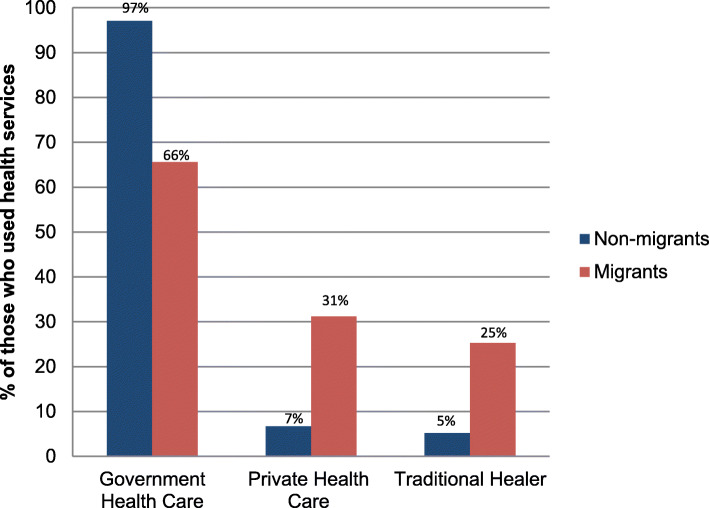
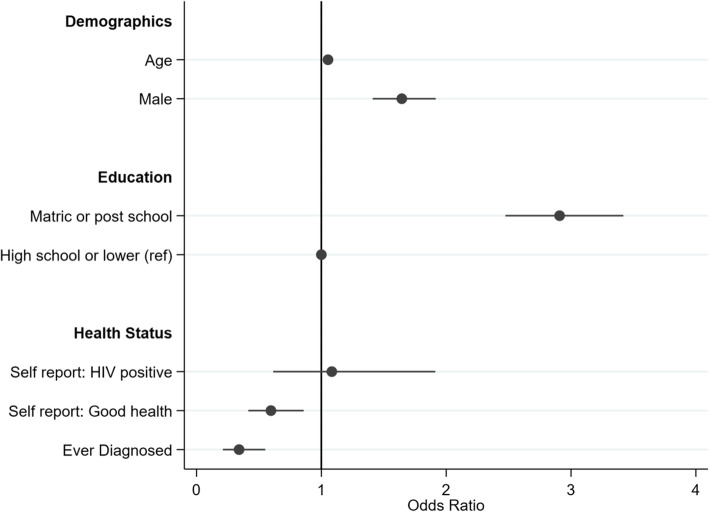
Health service utilisation differs sharply by migrant status and sex. Among those with a chronic condition, migrants had 0.33 times the odds of non-migrants to have consulted a health service in the preceding year, and males had 0.32 times the odds of females of having used health services. Of those who utilised services, migration status was further associated with the type of healthcare utilised, with 97% of non-migrant rural residents having accessed government facilities, while large proportions of migrants (31%) utilised private health services or consulted traditional healers (25%) in migrant destinations. The multinomial logistic regression analysis indicated that, in the presence of controls, migrants had 8.12 the relative risk of non-migrants for utilising private healthcare (versus the government-services-only reference category), and 2.40 the relative risk of non-migrants for using a combination of public and private sector facilities. These findings of differential utilisation hold under statistical adjustment for relevant controls and for underlying propensity to migrate.
Migrants and non-migrants in the study population in South Africa were found to utilise health services differently, both in overall use and in the type of healthcare consulted. The study helps improve upon the limited stock of knowledge on how migrants interface with healthcare systems in low and middle-income country settings. Findings can assist in guiding policies and programmes to be directed more effectively to the populations most in need, and to drive locally adapted approaches to universal health coverage.
在南非,人口的地理流动性很高,人们既进行永久性迁移,也进行临时性迁移,主要是从农村到城市地区。这种流动性可能会影响医疗保健的可及性和利用。本文的目的是探讨来自南非东北部农村地区 Agincourt 分区的一组内部移民和常住居民(非移民)的医疗保健利用情况及其决定因素。
2017 年开始了一项针对 3800 名年龄在 18 至 40 岁的个体的 5 年队列研究。从 1764 名 Agincourt 居民和 1334 名临时移民(主要是城市移民)中收集了基线数据,并使用双变量分析、逻辑和多项回归模型以及倾向得分匹配分析进行了分析。
医疗服务的利用情况因移民身份和性别而有很大差异。在患有慢性病的人群中,移民在过去一年中咨询医疗服务的可能性是非移民的 0.33 倍,男性咨询医疗服务的可能性是非女性的 0.32 倍。在使用服务的人群中,移民身份与所使用的医疗保健类型进一步相关,97%的农村非移民使用政府设施,而大量移民(31%)使用私人医疗服务或在移民目的地咨询传统治疗师(25%)。多项逻辑回归分析表明,在存在控制的情况下,移民使用私人医疗保健的相对风险是非移民的 8.12 倍(相对于仅使用政府服务的参考类别),使用公私部门联合设施的相对风险是非移民的 2.40 倍。这些差异利用的发现在对相关控制和潜在迁移倾向进行统计调整后仍然成立。
本研究发现,南非研究人群中的移民和非移民在整体使用和咨询的医疗保健类型方面存在不同的医疗服务利用情况。该研究有助于增加关于移民在中低收入国家医疗保健系统中如何互动的有限知识储备。研究结果可以帮助指导更有效地针对最需要的人群制定政策和方案,并推动针对全民健康覆盖的本地化适应方法。