Department of Biosciences, University of Exeter, Stocker Road, Exeter, EX4 4QD, UK.
Department of Biological Sciences, University of Calgary, Calgary, AB, T2N 1N4, Canada.
Heredity (Edinb). 2022 Apr;128(4):250-260. doi: 10.1038/s41437-022-00512-6. Epub 2022 Mar 8.
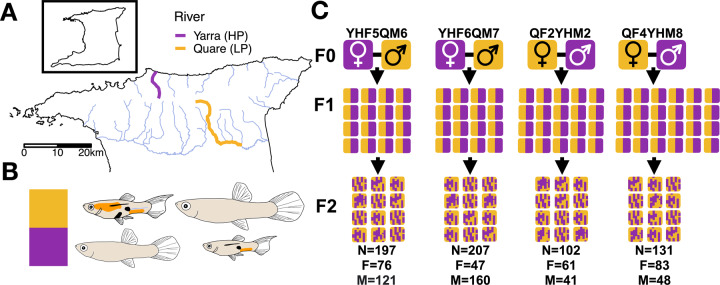
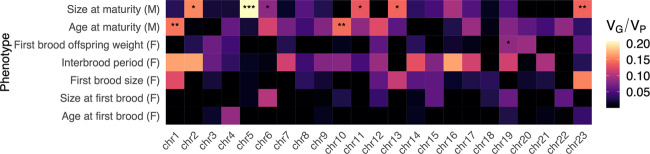
The genetic basis of traits shapes and constrains how adaptation proceeds in nature; rapid adaptation can proceed using stores of polygenic standing genetic variation or hard selective sweeps, and increasing polygenicity fuels genetic redundancy, reducing gene re-use (genetic convergence). Guppy life history traits evolve rapidly and convergently among natural high- and low-predation environments in northern Trinidad. This system has been studied extensively at the phenotypic level, but little is known about the underlying genetic architecture. Here, we use four independent F2 QTL crosses to examine the genetic basis of seven (five female, two male) guppy life history phenotypes and discuss how these genetic architectures may facilitate or constrain rapid adaptation and convergence. We use RAD-sequencing data (16,539 SNPs) from 370 male and 267 female F2 individuals. We perform linkage mapping, estimates of genome-wide and per-chromosome heritability (multi-locus associations), and QTL mapping (single-locus associations). Our results are consistent with architectures of many loci of small-effect for male age and size at maturity and female interbrood period. Male trait associations are clustered on specific chromosomes, but female interbrood period exhibits a weak genome-wide signal suggesting a potentially highly polygenic component. Offspring weight and female size at maturity are also associated with a single significant QTL each. These results suggest rapid, repeatable phenotypic evolution of guppies may be facilitated by polygenic trait architectures, but subsequent genetic redundancy may limit gene re-use across populations, in agreement with an absence of strong signatures of genetic convergence from recent analyses of wild guppies.
性状的遗传基础塑造并限制了自然中适应性的进展方式;快速适应性可以通过储存多基因的遗传变异或硬性选择来实现,而增加多基因性则会增加遗传冗余,减少基因再利用(遗传趋同)。在特立尼达北部的高捕食和低捕食环境中,孔雀鱼的生活史性状迅速且趋同进化。这个系统在表型水平上已经被广泛研究,但对其潜在的遗传结构知之甚少。在这里,我们使用四个独立的 F2 QTL 杂交来研究七个(五个雌性,两个雄性)孔雀鱼生活史表型的遗传基础,并讨论这些遗传结构如何促进或限制快速适应和趋同。我们使用来自 370 只雄性和 267 只雌性 F2 个体的 RAD 测序数据(16539 个 SNP)。我们进行连锁作图、全基因组和每条染色体遗传力(多基因关联)的估计,以及 QTL 作图(单基因关联)。我们的结果与许多小效应基因座的雄性年龄和成熟时大小以及雌性繁殖间隔的遗传结构一致。雄性性状关联集中在特定的染色体上,但雌性繁殖间隔表现出微弱的全基因组信号,表明其潜在的高度多基因成分。后代体重和雌性成熟时的大小也与每个特征各有一个显著的 QTL 相关。这些结果表明,孔雀鱼快速、可重复的表型进化可能是由多基因性状结构所促进的,但随后的遗传冗余可能会限制基因在不同种群中的再利用,这与最近对野生孔雀鱼的分析中缺乏强烈的遗传趋同信号是一致的。