Hamatani Sayo, Matsumoto Kazuki, Takahashi Jumpei, Shiko Yuki, Ozawa Yoshihito, Niitsu Tomihisa, Hirano Yoshiyuki, Shimizu Eiji
Research Center for Child Mental Development, Chiba University, Japan.
Learning and Behavior Science, Linköping University, Sweden.
Internet Interv. 2022 Feb 14;27:100504. doi: 10.1016/j.invent.2022.100504. eCollection 2022 Mar.
The objective of the present study was to investigate the feasibility of guided internet cognitive behavioral therapy (ICBT) for anorexia nervosa.
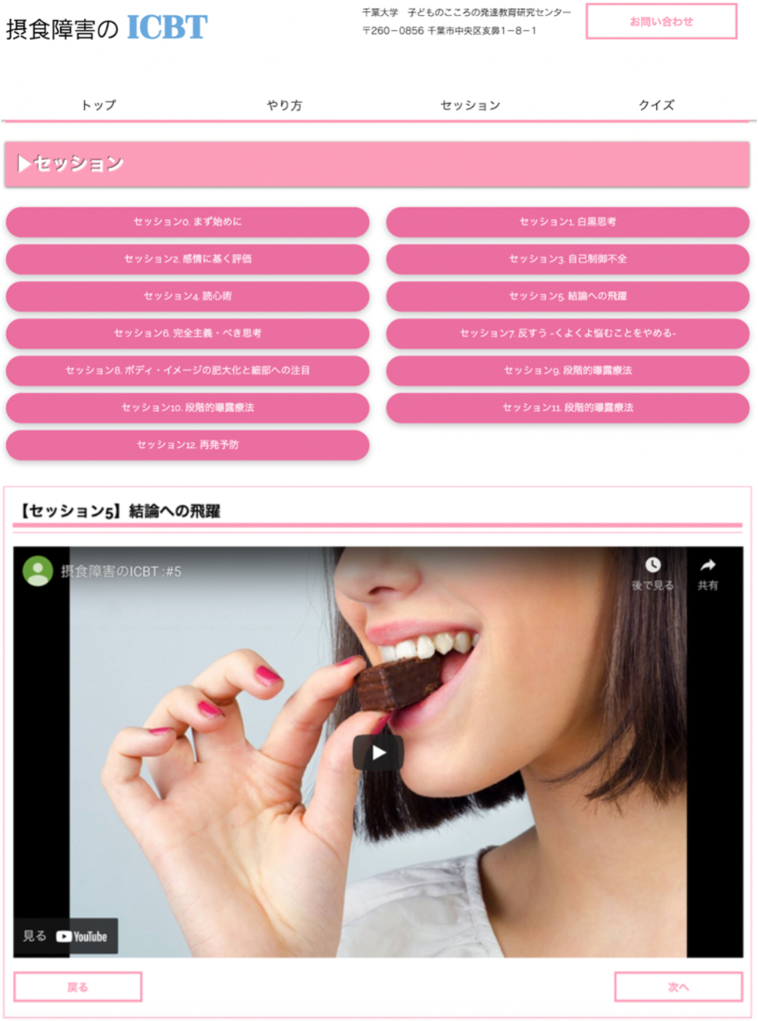
We conducted a prospective single-arm study between January 2020 and March 2021. The intervention was built using videos, web programs, and chat tools. The intervention program was largely based on metacognitive training. Participants performed the self-help program once a week for 12 consecutive weeks. The primary outcome was the global Eating Disorder Examination Questionnaire (EDE-Q) score. Secondary outcomes included clinical symptoms of eating disorders, metacognitive function, body mass index, depression, and generalized anxiety. The main statistical analysis examined whether the EDE-Q score and other outcomes at the end of the intervention differed from the baseline.
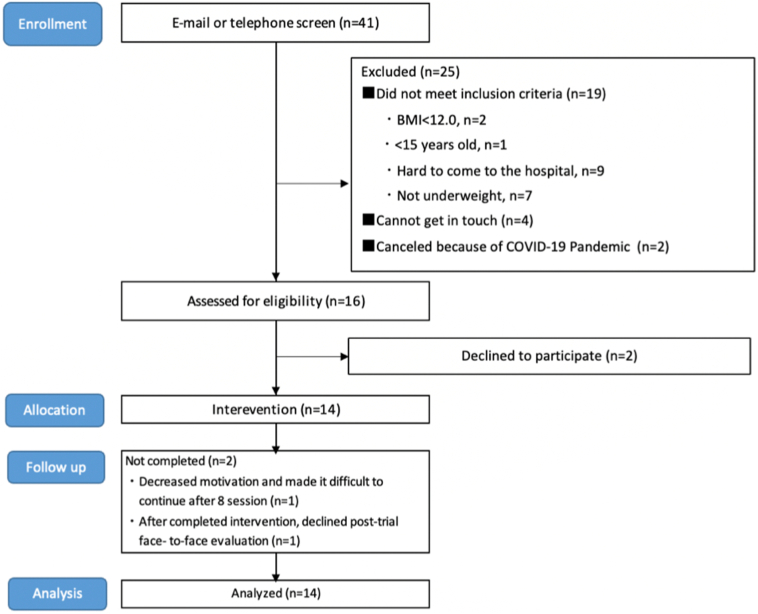
Fourteen participants underwent the trial treatment, and 13 completed the intervention. There was a significant reduction in the global EDE-Q score from 3.48 ( = 1.4) to 2.54 ( = 1.5, = 0.02, Cohen's = 0.75) from baseline to post-intervention. Some EDE-Q subscales and body checking questionnaire scale demonstrated statistically significant improvements, with moderate to large effect sizes. Although there was no significant improvement in body mass index, metacognitive function, or depressive symptoms, there was a significant improvement in the severity of generalized anxiety ( = -4.0, = 0.01, Cohen's = 0.95). No adverse events were observed.
Our findings suggest that guided ICBT for anorexia nervosa is well accepted by female patients and practical as a telemedicine approach that improves symptoms. In the future, tightly controlled randomized controlled trials should be conducted for efficacy verification.
本研究旨在探讨指导性互联网认知行为疗法(ICBT)治疗神经性厌食症的可行性。
我们在2020年1月至2021年3月期间进行了一项前瞻性单臂研究。干预措施通过视频、网络程序和聊天工具构建。干预方案主要基于元认知训练。参与者连续12周每周进行一次自助方案。主要结局是全球饮食失调检查问卷(EDE-Q)评分。次要结局包括饮食失调的临床症状、元认知功能、体重指数、抑郁和广泛性焦虑。主要统计分析检验了干预结束时的EDE-Q评分和其他结局与基线是否存在差异。
14名参与者接受了试验治疗,13名完成了干预。从基线到干预后,全球EDE-Q评分从3.48(标准差=1.4)显著降至2.54(标准差=1.5,P=0.02,科恩d=0.75)。一些EDE-Q子量表和身体检查问卷量表显示出具有统计学意义的改善,效应量为中度至大。虽然体重指数、元认知功能或抑郁症状没有显著改善,但广泛性焦虑的严重程度有显著改善(P=-4.0,P=0.01,科恩d=0.95)。未观察到不良事件。
我们的研究结果表明,针对神经性厌食症的指导性ICBT被女性患者广泛接受,作为一种改善症状的远程医疗方法切实可行。未来,应进行严格对照的随机对照试验以验证疗效。