Kataoka Hiroshi, Yoshida Rie, Iwasa Naomi, Sato Masayo, Manabe Shun, Kawachi Keiko, Makabe Shiho, Akihisa Taro, Ushio Yusuke, Teraoka Atsuko, Tsuchiya Ken, Nitta Kosaku, Mochizuki Toshio
Department of Nephrology, Tokyo Women's Medical University, Tokyo, Japan.
Clinical Research Division for Polycystic Kidney Disease, Department of Nephrology, Tokyo Women's Medical University, Tokyo, Japan.
Kidney Int Rep. 2021 Dec 13;7(3):537-546. doi: 10.1016/j.ekir.2021.12.012. eCollection 2022 Mar.
Valid prediction models or predictors of disease progression in children and young patients with autosomal dominant polycystic kidney disease (ADPKD) are lacking. Although total kidney volume (TKV) and Mayo imaging classification are generally used to predict disease progression in patients with ADPKD, it remains unclear whether germline mutation types are associated with these factors. We therefore investigated the association between mutation type and TKV and Mayo imaging classification among patients with ADPKD.
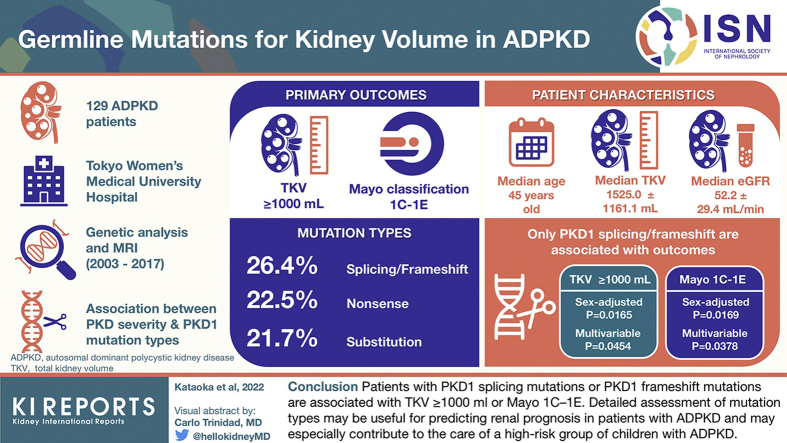
A total of 129 patients with ADPKD who underwent genetic analyses were enrolled in the study. The associations between the severity of PKD (TKV ≥ 1000 ml and Mayo classes 1C-1E) and the mutation types (nonsense mutation, frameshift or splicing mutation, and substitution) were evaluated.
Among the mutation types, only splicing/frameshift mutation had significant associations with TKV ≥ 1000 ml in sex-adjusted and multivariable logistic analyses. Similarly, only the splicing/frameshift mutation was significantly associated with Mayo 1C-1E in sex-adjusted and multivariable logistic analyses. nonsense mutation, substitution, or mutation position had no significant association with TKV ≥ 1000 ml or Mayo 1C-1E.
Kidney cyst severity differs according to the mutation types in Patients with splicing mutations or frameshift mutations are associated with TKV ≥ 1000 ml or Mayo 1C-1E. Detailed assessment of mutation types may be useful for predicting renal prognosis in patients with ADPKD and may especially contribute to the care of a high-risk group of children with ADPKD.
目前缺乏针对常染色体显性多囊肾病(ADPKD)儿童及年轻患者疾病进展的有效预测模型或预测指标。尽管总肾体积(TKV)和梅奥影像分类通常用于预测ADPKD患者的疾病进展,但种系突变类型是否与这些因素相关仍不清楚。因此,我们研究了ADPKD患者中突变类型与TKV及梅奥影像分类之间的关联。
共有129例接受基因分析的ADPKD患者纳入本研究。评估了PKD严重程度(TKV≥1000 ml和梅奥分类1C - 1E)与突变类型(无义突变、移码或剪接突变以及替换)之间的关联。
在突变类型中,在性别调整和多变量逻辑分析中,只有剪接/移码突变与TKV≥1000 ml有显著关联。同样,在性别调整和多变量逻辑分析中,只有剪接/移码突变与梅奥1C - 1E有显著关联。无义突变、替换或突变位置与TKV≥1000 ml或梅奥1C - 1E无显著关联。
ADPKD患者的肾囊肿严重程度因突变类型而异。有剪接突变或移码突变的患者与TKV≥1000 ml或梅奥1C - 1E相关。详细评估突变类型可能有助于预测ADPKD患者的肾脏预后,尤其可能有助于对ADPKD高危儿童群体的护理。