Key Laboratory of Plant Hormones and Development Regulation of Chongqing, School of Life Sciences, Chongqing University, Chongqing, China.
Department of Horticulture and Landscape Architecture, Oklahoma State University, Stillwater, OK, USA.
Plant Biotechnol J. 2022 Jun;20(6):1213-1225. doi: 10.1111/pbi.13804. Epub 2022 Mar 15.
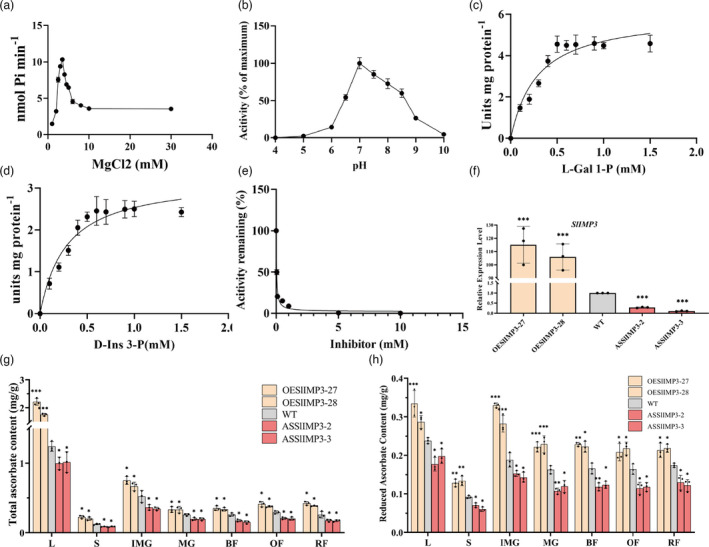
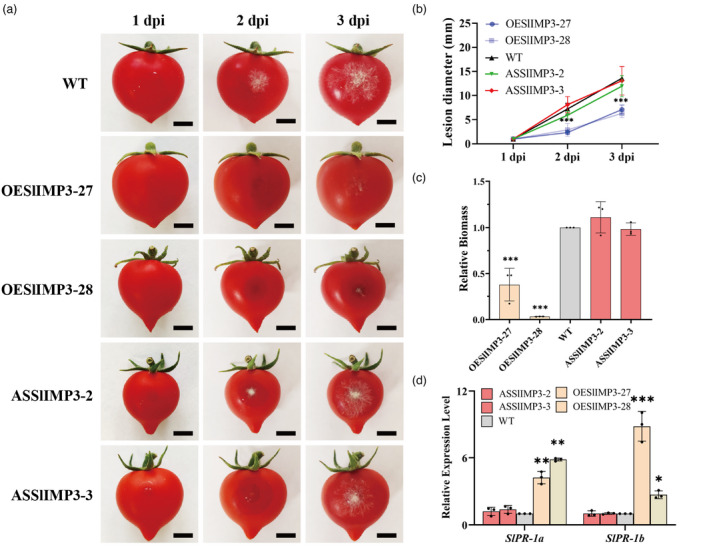
Postharvest deterioration is among the major challenges for the fruit industry. Regulation of the fruit softening rate is an effective strategy for extending shelf-life and reducing the economic losses due postharvest deterioration. The tomato myoinositol monophosphatase 3 gene SlIMP3, which showed highest expression level in fruit, was expressed and purified. SlIMP3 demonstrated high affinity with the L-Gal 1-P and D-Ins 3-P, and acted as a bifunctional enzyme in the biosynthesis of AsA and myoinositol. Overexpression of SlIMP3 not only improved AsA and myoinositol content, but also increased cell wall thickness, improved fruit firmness, delayed fruit softening, decreased water loss, and extended shelf-life. Overexpression of SlIMP3 also increased uronic acid, rhamnose, xylose, mannose, and galactose content in cell wall of fruit. Treating fruit with myoinositol obtained similar fruit phenotypes of SlIMP3-overexpressed fruit, with increased cell wall thickness and delayed fruit softening. Meanwhile, overexpression of SlIMP3 conferred tomato fruit tolerance to Botrytis cinerea. The function of SlIMP3 in cell wall biogenesis and fruit softening were also verified using another tomato species, Ailsa Craig (AC). Overexpression of SlDHAR in fruit increased AsA content, but did not affect the cell wall thickness or fruit firmness and softening. The results support a critical role for SlIMP3 in AsA biosynthesis and cell wall biogenesis, and provide a new method of delaying tomato fruit softening, and insight into the link between AsA and cell wall metabolism.
采后劣变是水果产业面临的主要挑战之一。调控果实软化速率是延长货架期和减少采后劣变经济损失的有效策略。在果实中表达量最高的番茄肌醇单磷酸酶 3 基因 SlIMP3 被表达和纯化。SlIMP3 对 L-Gal 1-P 和 D-Ins 3-P 具有高亲和力,并在抗坏血酸和肌醇的生物合成中起双功能酶的作用。SlIMP3 的过表达不仅提高了抗坏血酸和肌醇的含量,还增加了细胞壁的厚度,提高了果实硬度,延迟了果实软化,减少了水分损失,延长了货架期。SlIMP3 的过表达还增加了细胞壁中糖醛酸、鼠李糖、木糖、甘露糖和半乳糖的含量。用肌醇处理果实可获得与 SlIMP3 过表达果实相似的果实表型,增加了细胞壁的厚度,延迟了果实软化。同时,SlIMP3 的过表达赋予了番茄果实对灰葡萄孢的耐受性。在另一个番茄品种 Ailsa Craig(AC)中也验证了 SlIMP3 在细胞壁生物合成和果实软化中的功能。果实中 SlDHAR 的过表达增加了抗坏血酸的含量,但不影响细胞壁的厚度或果实的硬度和软化。这些结果支持了 SlIMP3 在抗坏血酸生物合成和细胞壁生物合成中的关键作用,并为延迟番茄果实软化提供了一种新方法,同时也深入了解了抗坏血酸和细胞壁代谢之间的联系。