Department of Neuroscience, Physiology, and Behavioral Sciences; School of Medicine; St George's University; Grenada, West Indies.
Windward Islands Research and Education Foundation; St. George's University; Grenada, West Indies.
PLoS Negl Trop Dis. 2022 Mar 8;16(3):e0010263. doi: 10.1371/journal.pntd.0010263. eCollection 2022 Mar.
While microcephaly is a significant adverse outcome of prenatal exposure to the Zika virus (ZIKV), subtle malformations of cortical development (MCD) have been observed in Zika-exposed children (ZEC), including delays in language, cognition, and motor domains, and visual acuity deficits. Interventions within the first 1,000 days of life can significantly improve developmental outcomes. This study examined a 12-week Responsive Caregiving Intervention on neurodevelopmental outcomes in 24-30-month-old ZEC.
METHODOLOGY/PRINCIPAL FINDINGS: A randomized controlled trial was implemented in Grenada, West Indies using an existing ZIKV cohort surveillance study. When children in that study turned 24 months, baseline child neurodevelopmental measures and caregiver interviews were administered. Caregivers who agreed to participate in the 12-week Responsive Caregiving Intervention, implemented when children were 24-30 months of age, were randomly assigned to the Intervention or Waitlist Control group. Children in both groups were re-assessed on the neurodevelopmental measures post-intervention.
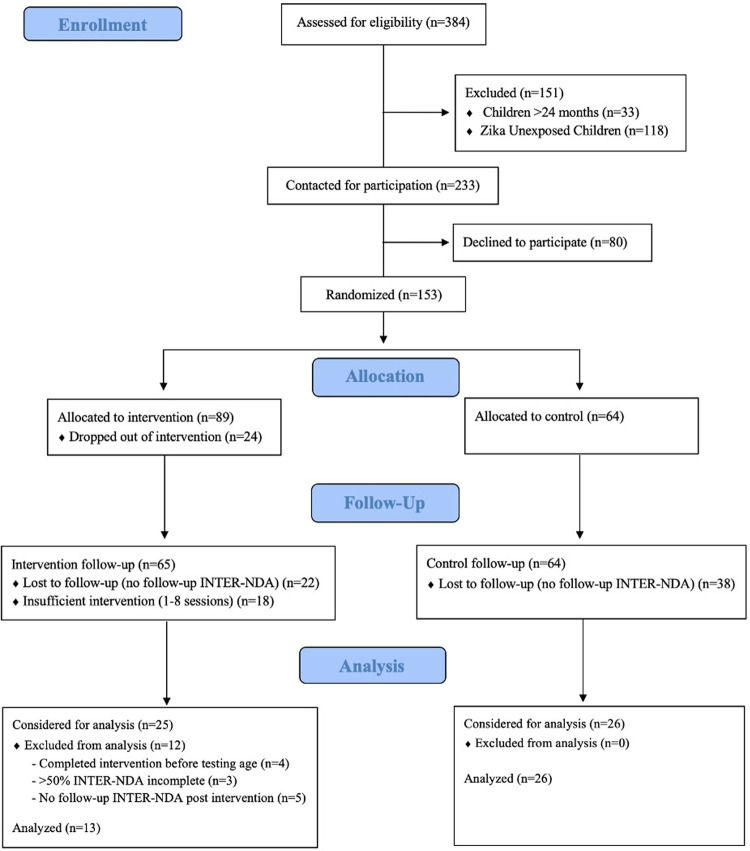
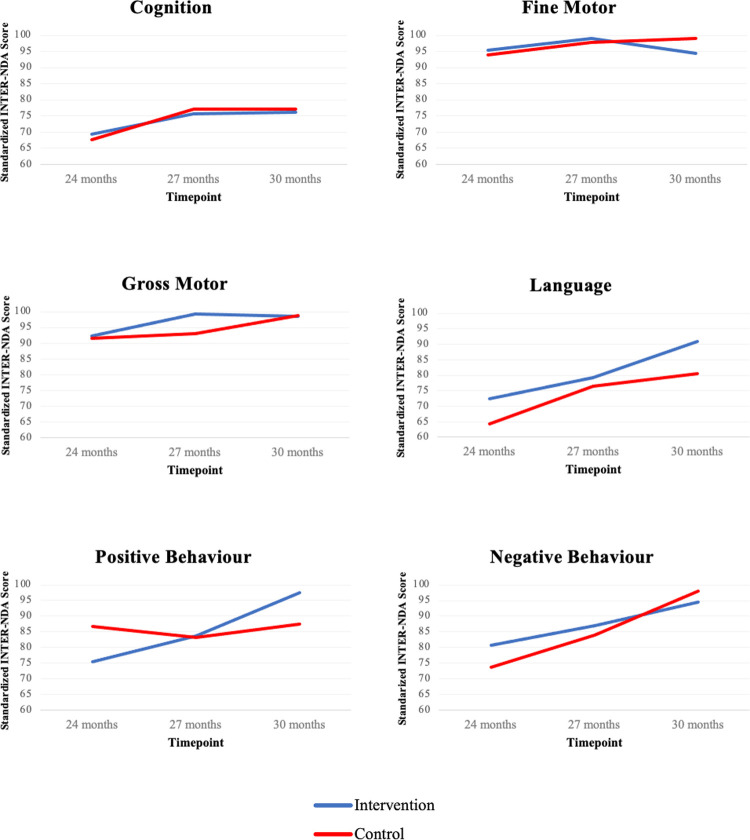
CONCLUSIONS/SIGNIFICANCE: 233 children from the ZIKV surveillance study met inclusion criteria, of which n = 80 declined participation, n = 42 did not complete the Intervention, and n = 72 missed follow-up assessments given strict timelines in the study design. The final sample for analysis was N = 13 children in the Intervention group and N = 26 children in the Control group. A GEE model analysis showed significantly higher language (p = 0.021) and positive behaviour (p = 0.005) scores for children in the Intervention group compared to the Control group. The Intervention had a medium effect on child language (d = 0.66) and a large effect on positive behaviour (d = 0.83). A 12-week Responsive Caregiving Intervention Programme significantly improves language and positive behaviour scores in 30-month-old normocephalic children who were exposed to ZIKV in utero. The programme provides an option for mothers of ZIKV-exposed children who are seeking an evidence-based neurodevelopmental intervention regardless of known impact of the virus on cortical formation.
The study was registered with clinicaltrials.gov (NCT04697147).
尽管小头畸形是 Zika 病毒(ZIKV)产前暴露的重要不良后果,但在 Zika 暴露儿童(ZEC)中已观察到皮质发育微小畸形(MCD),包括语言、认知和运动领域的延迟以及视力缺陷。生命最初的 1000 天内的干预可以显著改善发育结果。本研究检查了一项针对 24-30 个月大的 ZEC 的为期 12 周的反应性育儿干预对神经发育结果的影响。
方法/主要发现:这项随机对照试验在西印度群岛的格林纳达实施,使用现有的 ZIKV 队列监测研究。当该研究中的儿童满 24 个月时,进行基线儿童神经发育测量和照顾者访谈。同意参加 24-30 个月时实施的 12 周反应性育儿干预的照顾者被随机分配到干预组或候补控制组。两组儿童在干预后均重新进行神经发育测量。
结论/意义:来自 ZIKV 监测研究的 233 名儿童符合纳入标准,其中 n = 80 人拒绝参与,n = 42 人未完成干预,n = 72 人因研究设计中的严格时间安排而错过随访评估。分析的最终样本为干预组 N = 13 名儿童和对照组 N = 26 名儿童。GEE 模型分析显示,与对照组相比,干预组儿童的语言(p = 0.021)和积极行为(p = 0.005)评分显著更高。该干预对儿童语言(d = 0.66)有中等影响,对积极行为(d = 0.83)有较大影响。为期 12 周的反应性育儿干预方案可显著提高在子宫内接触 ZIKV 的 30 月龄正常头围儿童的语言和积极行为评分。该方案为寻求基于证据的神经发育干预的 ZIKV 暴露儿童的母亲提供了一种选择,无论病毒对皮质形成的影响如何。
该研究在 clinicaltrials.gov 上注册(NCT04697147)。