Department of Health Promotion, School of Public Health, Sackler Faculty of Medicine, Tel Aviv University, Tel Aviv, Israel.
Minerva Center for the Interdisciplinary Study of End of Life, Tel Aviv University, Tel Aviv, Israel.
Gerontology. 2022;68(7):808-816. doi: 10.1159/000521146. Epub 2022 Mar 8.
The first cases of COVID-19 in Israel were reported in February 2020. Family visits were prohibited from March 10, 2020, and then allowed on a limited basis on April 20, 2020. This article examines how COVID-19 impacted long-term care residents and their family members from the perspective of long-term care facility (LTCF) administrative staff.
An online survey was sent to Israeli LTCF administrators between mid-July and mid-October 2020, resulting in 52 completed questionnaires. Quantitative analysis involved descriptive statistics using SPSS, with differences compared via t tests, ANOVA, and χ2 tests. Qualitative analysis involved thematic analysis of responses to open-ended questions.
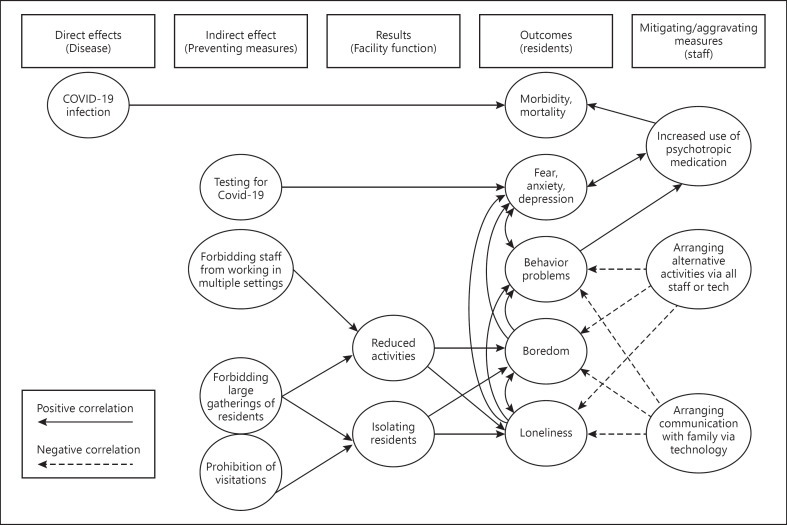
COVID-19 was reported to have multiple types of negative impact on residents, including direct effects on morbidity and mortality as well as indirect effects manifested as negative reactions to measures aimed at limiting infection, including isolation from relatives, decreased activities for residents, and COVID-19 testing. The impact of isolation on LTCF residents was reported as negative or very negative by over three-quarters of the respondents. Behavioral problems among residents increased in 32% of the facilities. The qualitative results suggested that adverse effects on residents and family members were partially mitigated by the use of communication technologies.
DISCUSSION/CONCLUSION: The interplay of multiple factors affected LTCF residents against the backdrop of COVID-19 restrictions. The emergence of mitigating factors which provide solutions to some of the challenges has the potential of improving quality of care for LTCF residents as the pandemic continues and thereafter.
以色列于 2020 年 2 月报告了首例 COVID-19 病例。自 2020 年 3 月 10 日起禁止家庭探访,随后于 2020 年 4 月 20 日有限制地允许探访。本文从长期护理机构(LTCF)管理人员的角度,研究了 COVID-19 对长期护理居民及其家庭成员的影响。
2020 年 7 月中旬至 10 月中旬,向以色列 LTCF 管理人员发送了在线调查,共收到 52 份完整的问卷。使用 SPSS 进行定量分析,包括描述性统计,通过 t 检验、方差分析和 χ2 检验进行差异比较。对开放式问题的回答进行定性分析,采用主题分析法。
据报道,COVID-19 对居民产生了多种负面影响,包括对发病率和死亡率的直接影响,以及对旨在限制感染的措施的间接反应,包括与亲属隔离、居民活动减少和 COVID-19 检测。超过四分之三的受访者报告称,隔离对 LTCF 居民的影响是负面的或非常负面的。32%的机构中居民的行为问题增加。定性结果表明,部分通过使用通信技术减轻了对居民和家庭成员的不利影响。
讨论/结论:在 COVID-19 限制措施下,多种因素相互作用影响了 LTCF 居民。一些缓解因素的出现为一些挑战提供了解决方案,这有可能在大流行持续和之后提高 LTCF 居民的护理质量。