The Walter and Eliza Hall Institute of Medical Research, Parkville, Victoria, 3052, Australia.
Department of Medical Biology, University of Melbourne, Parkville, Victoria, 3010, Australia.
BMC Med. 2022 Mar 9;20(1):89. doi: 10.1186/s12916-022-02281-9.
Plasmodium vivax (P. vivax) is the dominant Plasmodium spp. causing the disease malaria in low-transmission regions outside of Africa. These regions often feature high proportions of asymptomatic patients with sub-microscopic parasitaemia and relapses. Naturally acquired antibody responses are induced after Plasmodium infection, providing partial protection against high parasitaemia and clinical episodes. However, previous work has failed to address the presence and maintenance of such antibody responses to P. vivax particularly in low-transmission regions.
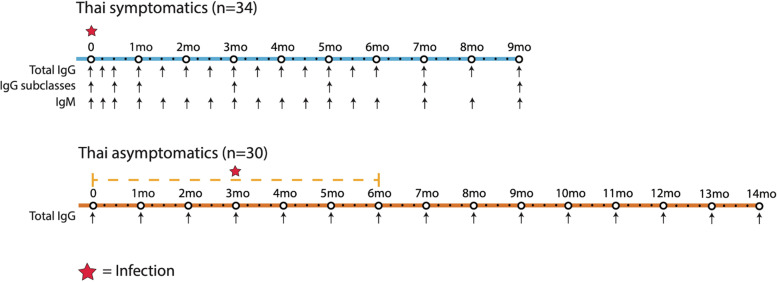
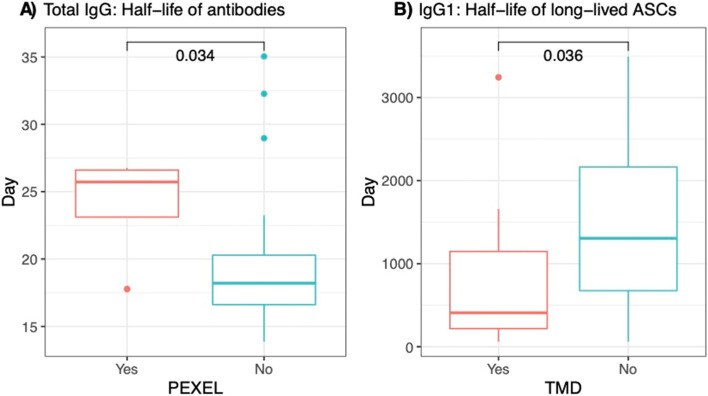
We followed 34 patients in western Thailand after symptomatic P. vivax infections to monitor antibody kinetics over 9 months, during which no recurrent infections occurred. We assessed total IgG, IgG subclass and IgM levels to up to 52 P. vivax proteins every 2-4 weeks using a multiplexed Luminex® assay and identified protein-specific variation in antibody longevity. Mathematical modelling was used to generate the estimated half-life of antibodies, long-, and short-lived antibody-secreting cells.
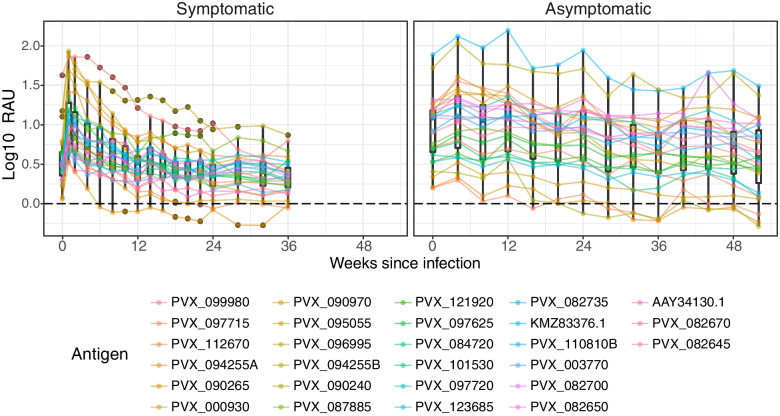
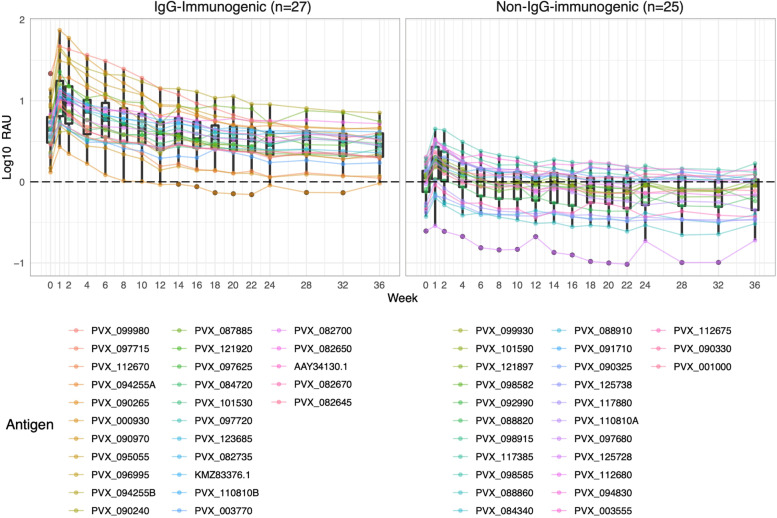
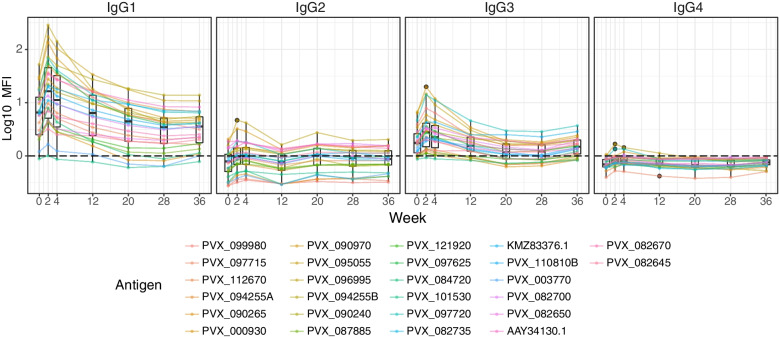
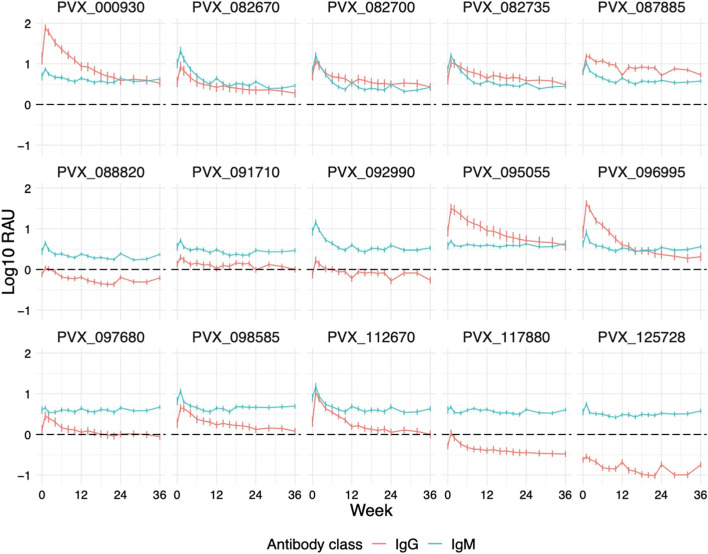
Generally, an increase in antibody level was observed within 1-week post symptomatic infection, followed by an exponential decay of different rates. We observed mostly IgG1 dominance and IgG3 sub-dominance in this population. IgM responses followed similar kinetic patterns to IgG, with some proteins unexpectedly inducing long-lived IgM responses. We also monitored antibody responses against 27 IgG-immunogenic antigens in 30 asymptomatic individuals from a similar region. Our results demonstrate that most antigens induced robust and long-lived total IgG responses following asymptomatic infections in the absence of (detected) boosting infections.
Our work provides new insights into the development and maintenance of naturally acquired immunity to P. vivax and will guide the potential use of serology to indicate immune status and/or identify populations at risk.
在非洲以外的低传播地区,间日疟原虫(P. vivax)是引起疟疾的主要疟原虫。这些地区通常有很大比例的无症状患者伴有亚显微寄生虫血症和复发。感染疟原虫后会产生自然获得的抗体反应,对高寄生虫血症和临床发作提供部分保护。然而,以前的工作未能解决在低传播地区特别是针对间日疟原虫的这种抗体反应的存在和维持问题。
我们对泰国西部的 34 名有症状的间日疟原虫感染者进行了随访,在 9 个月的时间内监测抗体动力学,在此期间没有发生复发性感染。我们使用多重 Luminex®分析检测了多达 52 种间日疟原虫蛋白的总 IgG、IgG 亚类和 IgM 水平,每 2-4 周检测一次,并确定了抗体寿命的蛋白特异性变化。数学模型用于生成抗体、长寿命和短寿命抗体分泌细胞的估计半衰期。
一般来说,在有症状感染后 1 周内观察到抗体水平增加,随后以不同的速度呈指数衰减。我们在该人群中观察到 IgG1 优势和 IgG3 亚优势。IgM 反应呈现出与 IgG 相似的动力学模式,一些蛋白质出人意料地诱导了长寿命的 IgM 反应。我们还在来自类似地区的 30 名无症状个体中监测了针对 27 种 IgG 免疫原性抗原的抗体反应。我们的结果表明,在没有(检测到的)增强感染的情况下,大多数抗原在无症状感染后会引起强烈和持久的总 IgG 反应。
我们的工作为间日疟原虫自然获得性免疫的发展和维持提供了新的见解,并将指导血清学的潜在应用,以指示免疫状态和/或识别处于危险中的人群。