• 文献检索
  • 文档翻译
  • 深度研究
  • 学术资讯
  • Suppr Zotero 插件Zotero 插件
  • 邀请有礼
  • 套餐&价格
  • 历史记录
应用&插件
Suppr Zotero 插件Zotero 插件浏览器插件Mac 客户端Windows 客户端微信小程序
定价
高级版会员购买积分包购买API积分包
服务
文献检索文档翻译深度研究API 文档MCP 服务
关于我们
关于 Suppr公司介绍联系我们用户协议隐私条款
关注我们

Suppr 超能文献

核心技术专利:CN118964589B侵权必究
粤ICP备2023148730 号-1Suppr @ 2026

文献检索

告别复杂PubMed语法,用中文像聊天一样搜索,搜遍4000万医学文献。AI智能推荐,让科研检索更轻松。

立即免费搜索

文件翻译

保留排版,准确专业,支持PDF/Word/PPT等文件格式,支持 12+语言互译。

免费翻译文档

深度研究

AI帮你快速写综述,25分钟生成高质量综述,智能提取关键信息,辅助科研写作。

立即免费体验

通过风险适应性分层治疗撤药预防幼年特发性关节炎疾病发作:来自 PREVENT-JIA 试验的结果。

Prevention of disease flares by risk-adapted stratification of therapy withdrawal in juvenile idiopathic arthritis: results from the PREVENT-JIA trial.

机构信息

Interdisciplinary Center of Clinical Research, University of Münster, Munster, Germany.

Institute of Biostatistics and Clinical Research, University of Muenster, Muenster, Germany.

出版信息

Ann Rheum Dis. 2022 Jul;81(7):990-997. doi: 10.1136/annrheumdis-2021-222029. Epub 2022 Mar 8.

DOI:10.1136/annrheumdis-2021-222029
PMID:35260388
原文链接:https://pmc.ncbi.nlm.nih.gov/articles/PMC9209679/
Abstract

OBJECTIVES

To investigate the ability of high-sensitivity C-reactive protein (hsCRP) and S100A12 to serve as predictive biomarkers of successful drug withdrawal in children with clinical remission of juvenile idiopathic arthritis (JIA).

METHODS

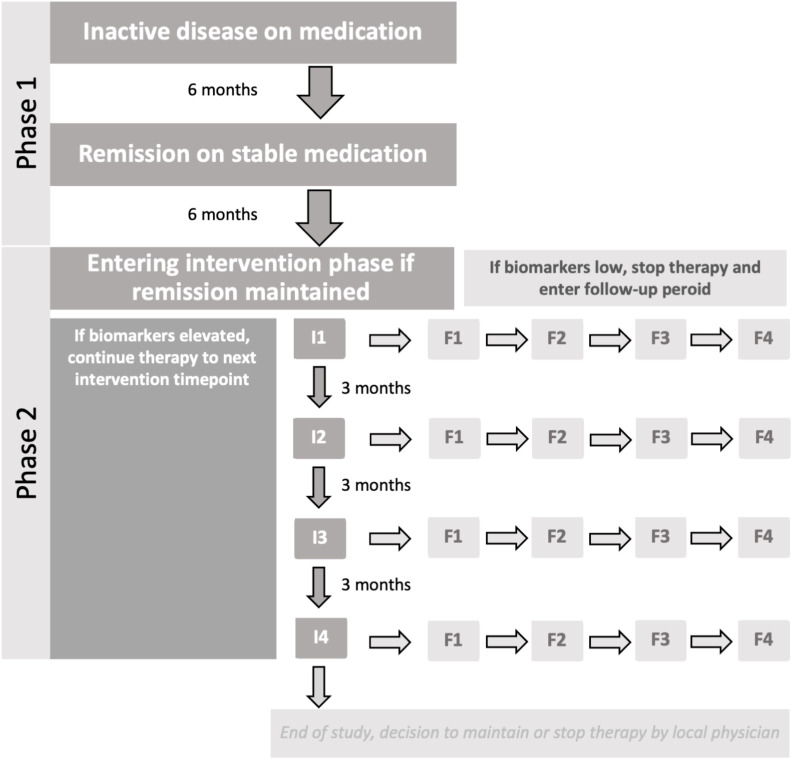
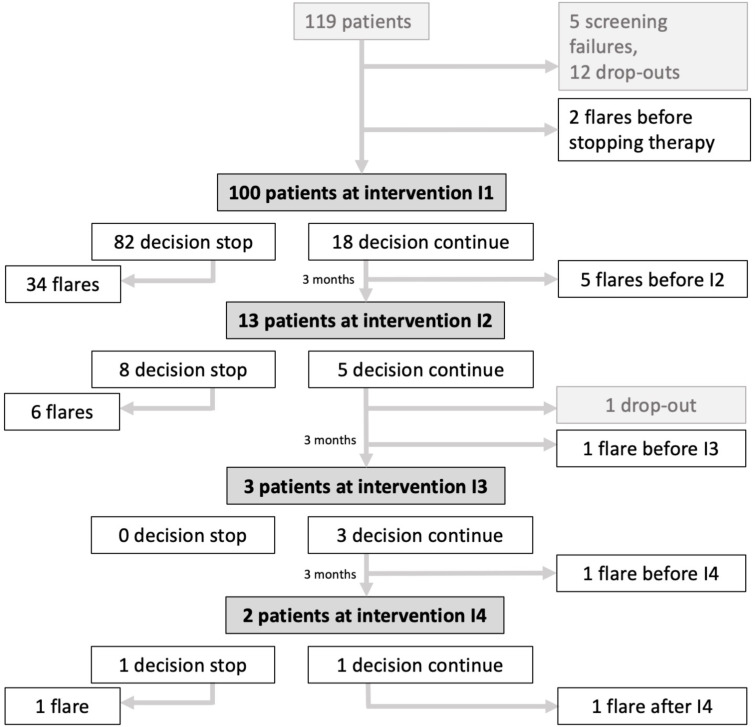
This multicentre trial (PREVENT-JIA) enrolled 119 patients with JIA in clinical remission, and 100 patients reached the intervention phase in which the decision whether to continue or stop treatment was based on S100A12 and hsCRP levels. Patients were monitored for 12 months after stopping medication for flares of disease. Results were compared with withdrawal of therapy without biomarker-based stratification in patients from the German Biologika in der Kinderrheumatologie (BiKeR) pharmacovigilance registry.

RESULTS

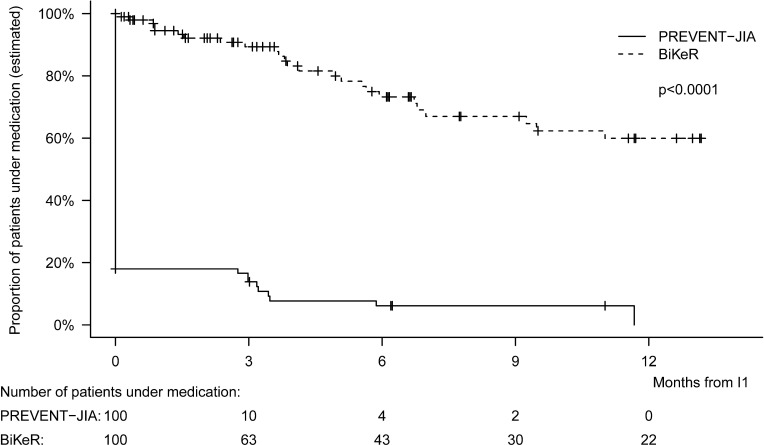
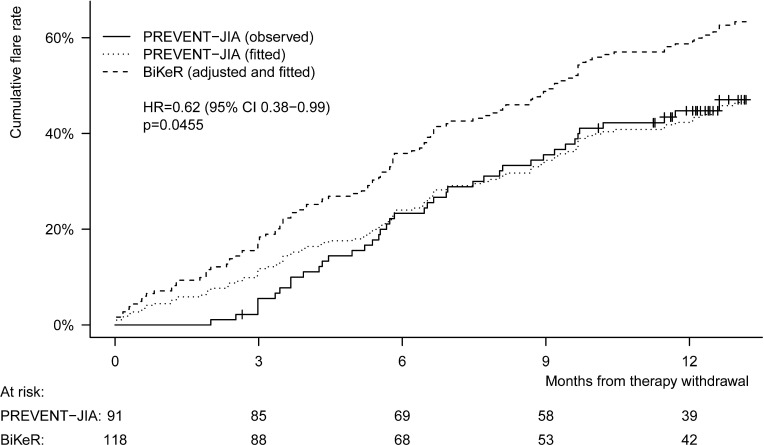
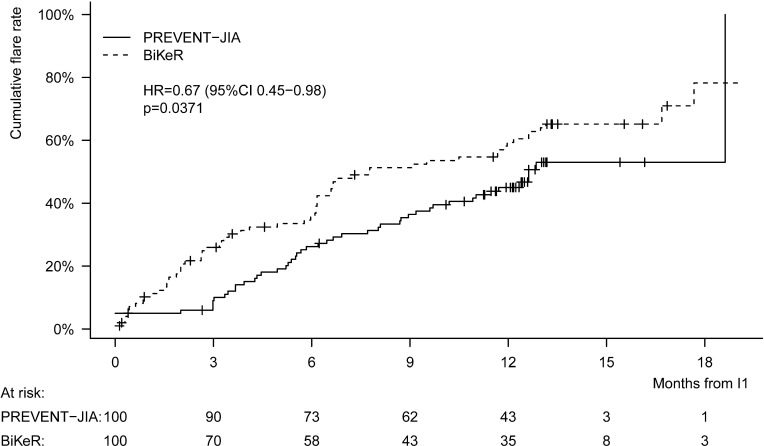
In the PREVENT-JIA group, 49 patients had a flare, and 45% of patients stopping medication showed flares within the following 12 months. All patients (n=8) continuing therapy due to permanently elevated S100A12/hsCRP at more than one visit flared during the observation phase. In the BiKeR control group, the total flare rate was 62%, with 60% flaring after stopping medication. The primary outcome, time from therapy withdrawal to first flare (cumulative flare rate after therapy withdrawal), showed a significant difference in favour of the PREVENT-JIA group (p=0.046; HR 0.62, 95% CI 0.38 to 0.99). As additional finding, patients in the PREVENT-JIA trial stopped therapy significantly earlier.

CONCLUSION

Biomarker-guided strategies of therapy withdrawal are feasible in clinical practice. This study demonstrates that using predictive markers of subclinical inflammation is a promising tool in the decision-making process of therapy withdrawal, which translates into direct benefit for patients.

TRIAL REGISTRATION NUMBER

ISRCTN69963079.

摘要

目的

探讨高敏 C 反应蛋白(hsCRP)和 S100A12 在儿童幼年特发性关节炎(JIA)临床缓解期成功停药中的预测生物标志物作用。

方法

这项多中心试验(PREVENT-JIA)纳入了 119 例临床缓解的 JIA 患儿,其中 100 例患儿进入干预阶段,是否继续或停止治疗取决于 S100A12 和 hsCRP 水平。停止药物治疗后,患者监测 12 个月以观察疾病复发情况。结果与德国儿童风湿病生物制剂监测登记处(BiKeR)无生物标志物分层的停药治疗患者进行比较。

结果

在 PREVENT-JIA 组中,有 49 例患者出现复发,45%的停药患者在接下来的 12 个月内出现复发。所有因 S100A12/hsCRP 持续升高(就诊时至少一次高于正常)而持续治疗的患者(n=8)在观察阶段均出现复发。在 BiKeR 对照组中,总复发率为 62%,停药后 60%的患者复发。主要结局是从停药到首次复发的时间(停药后复发累积率),PREVENT-JIA 组有显著差异(p=0.046;HR 0.62,95%CI 0.38 至 0.99)。作为附加发现,PREVENT-JIA 试验中的患者更早停止了治疗。

结论

基于生物标志物的停药策略在临床实践中是可行的。本研究表明,使用亚临床炎症的预测标志物是停药决策过程中的一种有前途的工具,可为患者带来直接获益。

临床试验注册号

ISRCTN69963079。

https://cdn.ncbi.nlm.nih.gov/pmc/blobs/9acc/9209679/bfecfd18566c/annrheumdis-2021-222029f05.jpg
https://cdn.ncbi.nlm.nih.gov/pmc/blobs/9acc/9209679/2bb1e61a6ecf/annrheumdis-2021-222029f01.jpg
https://cdn.ncbi.nlm.nih.gov/pmc/blobs/9acc/9209679/007641fc33b2/annrheumdis-2021-222029f02.jpg
https://cdn.ncbi.nlm.nih.gov/pmc/blobs/9acc/9209679/426668282ced/annrheumdis-2021-222029f03.jpg
https://cdn.ncbi.nlm.nih.gov/pmc/blobs/9acc/9209679/2c8cc6ed87b6/annrheumdis-2021-222029f04.jpg
https://cdn.ncbi.nlm.nih.gov/pmc/blobs/9acc/9209679/bfecfd18566c/annrheumdis-2021-222029f05.jpg
https://cdn.ncbi.nlm.nih.gov/pmc/blobs/9acc/9209679/2bb1e61a6ecf/annrheumdis-2021-222029f01.jpg
https://cdn.ncbi.nlm.nih.gov/pmc/blobs/9acc/9209679/007641fc33b2/annrheumdis-2021-222029f02.jpg
https://cdn.ncbi.nlm.nih.gov/pmc/blobs/9acc/9209679/426668282ced/annrheumdis-2021-222029f03.jpg
https://cdn.ncbi.nlm.nih.gov/pmc/blobs/9acc/9209679/2c8cc6ed87b6/annrheumdis-2021-222029f04.jpg
https://cdn.ncbi.nlm.nih.gov/pmc/blobs/9acc/9209679/bfecfd18566c/annrheumdis-2021-222029f05.jpg

相似文献

1
Prevention of disease flares by risk-adapted stratification of therapy withdrawal in juvenile idiopathic arthritis: results from the PREVENT-JIA trial.通过风险适应性分层治疗撤药预防幼年特发性关节炎疾病发作:来自 PREVENT-JIA 试验的结果。
Ann Rheum Dis. 2022 Jul;81(7):990-997. doi: 10.1136/annrheumdis-2021-222029. Epub 2022 Mar 8.
2
Phagocyte-specific S100 proteins and high-sensitivity C reactive protein as biomarkers for a risk-adapted treatment to maintain remission in juvenile idiopathic arthritis: a comparative study.吞噬细胞特异性 S100 蛋白和高敏 C 反应蛋白作为风险适应治疗以维持青少年特发性关节炎缓解的生物标志物:一项比较研究。
Ann Rheum Dis. 2012 Dec;71(12):1991-7. doi: 10.1136/annrheumdis-2012-201329. Epub 2012 Jun 11.
3
Serum S100A8/A9 and S100A12 Levels in Children With Polyarticular Forms of Juvenile Idiopathic Arthritis: Relationship to Maintenance of Clinically Inactive Disease During Anti-Tumor Necrosis Factor Therapy and Occurrence of Disease Flare After Discontinuation of Therapy.血清 S100A8/A9 和 S100A12 水平在儿童多关节型幼年特发性关节炎中的变化:与抗 TNF 治疗期间临床缓解疾病的维持和治疗停药后疾病复发的关系。
Arthritis Rheumatol. 2019 Mar;71(3):451-459. doi: 10.1002/art.40727. Epub 2019 Jan 24.
4
Use of MRP8/14 in clinical practice as a predictor of outcome after methotrexate withdrawal in patients with juvenile idiopathic arthritis.将 MRP8/14 用于临床实践中,作为预测幼年特发性关节炎患者停用甲氨蝶呤后结局的指标。
Clin Rheumatol. 2022 Sep;41(9):2825-2830. doi: 10.1007/s10067-022-06165-4. Epub 2022 Apr 29.
5
Methotrexate withdrawal at 6 vs 12 months in juvenile idiopathic arthritis in remission: a randomized clinical trial.缓解期幼年特发性关节炎中 6 个月与 12 个月时停用甲氨蝶呤:一项随机临床试验。
JAMA. 2010 Apr 7;303(13):1266-73. doi: 10.1001/jama.2010.375.
6
Treatment Withdrawal Following Remission in Juvenile Idiopathic Arthritis: A Systematic Review of the Literature.缓解后治疗撤停在幼年特发性关节炎中的应用:文献系统性综述。
Paediatr Drugs. 2019 Dec;21(6):469-492. doi: 10.1007/s40272-019-00362-6.
7
Predictors of Flare Following Etanercept Withdrawal in Patients with Rheumatoid Factor-negative Juvenile Idiopathic Arthritis Who Reached Remission while Taking Medication.预测类风湿因子阴性幼年特发性关节炎患者在药物治疗达到缓解后停用依那西普后复发的因素。
J Rheumatol. 2018 Jul;45(7):956-961. doi: 10.3899/jrheum.170794. Epub 2018 May 1.
8
S100 proteins as potential predictive biomarkers of abatacept response in polyarticular juvenile idiopathic arthritis.S100 蛋白作为阿巴西普治疗多发性幼年特发性关节炎反应的潜在预测性生物标志物。
Arthritis Res Ther. 2024 Jun 25;26(1):125. doi: 10.1186/s13075-024-03347-0.
9
Baricitinib in juvenile idiopathic arthritis: an international, phase 3, randomised, double-blind, placebo-controlled, withdrawal, efficacy, and safety trial.巴瑞替尼治疗幼年特发性关节炎:一项国际、3 期、随机、双盲、安慰剂对照、停药、疗效和安全性试验。
Lancet. 2023 Aug 12;402(10401):555-570. doi: 10.1016/S0140-6736(23)00921-2. Epub 2023 Jul 6.
10
Subcutaneous golimumab for children with active polyarticular-course juvenile idiopathic arthritis: results of a multicentre, double-blind, randomised-withdrawal trial.皮下注射戈利木单抗治疗多关节型幼年特发性关节炎患儿:一项多中心、双盲、随机撤药试验的结果
Ann Rheum Dis. 2018 Jan;77(1):21-29. doi: 10.1136/annrheumdis-2016-210456. Epub 2017 May 15.

引用本文的文献

1
Update on Biologic Therapy in Juvenile Idiopathic Arthritis: A Five-year Narrative Review.青少年特发性关节炎生物治疗的最新进展:一项为期五年的叙述性综述
Biologics. 2025 Jul 23;19:425-441. doi: 10.2147/BTT.S486359. eCollection 2025.
2
Transcriptional Profiling of Tofacitinib Treatment in Juvenile Idiopathic Arthritis: Implications for Treatment Response Prediction.托法替布治疗幼年特发性关节炎的转录谱分析:对治疗反应预测的意义
Arthritis Care Res (Hoboken). 2025 Apr;77(4):513-521. doi: 10.1002/acr.25459. Epub 2024 Nov 27.
3
Inflammatory biomarkers predicting long-term remission and active disease in juvenile idiopathic arthritis: a population-based study of the Nordic JIA cohort.

本文引用的文献

1
"Every Little Furrow of Her Brow Makes Me Want To Stop": An Interpretative Phenomenologic Analysis of Mothers' Experiences With Juvenile Idiopathic Arthritis Treatments.“她眉头的每一丝皱纹都让我想停下来”:对母亲经历幼年特发性关节炎治疗的现象学分析。
Arthritis Care Res (Hoboken). 2022 Nov;74(11):1761-1769. doi: 10.1002/acr.24735. Epub 2022 Jul 22.
2
Re-treatment with etanercept is as effective as the initial firstline treatment in patients with juvenile idiopathic arthritis.依那西普治疗复发性幼年特发性关节炎与初始一线治疗同样有效。
Arthritis Res Ther. 2021 Apr 16;23(1):118. doi: 10.1186/s13075-021-02492-0.
3
炎症生物标志物预测青少年特发性关节炎的长期缓解和活动性疾病:北欧 JIA 队列的一项基于人群的研究。
RMD Open. 2024 Sep 5;10(3):e004317. doi: 10.1136/rmdopen-2024-004317.
4
Biomarker Changes in Response to Tofacitinib Treatment in Patients With Polyarticular-Course Juvenile Idiopathic Arthritis.托法替尼治疗多关节病程幼年特发性关节炎患者的生物标志物变化。
Arthritis Care Res (Hoboken). 2024 Dec;76(12):1723-1732. doi: 10.1002/acr.25417. Epub 2024 Sep 17.
5
S100 proteins as potential predictive biomarkers of abatacept response in polyarticular juvenile idiopathic arthritis.S100 蛋白作为阿巴西普治疗多发性幼年特发性关节炎反应的潜在预测性生物标志物。
Arthritis Res Ther. 2024 Jun 25;26(1):125. doi: 10.1186/s13075-024-03347-0.
6
Serum and salivary inflammatory biomarkers in juvenile idiopathic arthritis-an explorative cross-sectional study.血清和唾液炎症生物标志物在青少年特发性关节炎中的研究-一项探索性横断面研究。
Pediatr Rheumatol Online J. 2024 Mar 9;22(1):36. doi: 10.1186/s12969-024-00972-6.
7
Anti-tumor necrosis factor (aTNF) weaning strategy in juvenile idiopathic arthritis (JIA): does duration matter?青少年特发性关节炎(JIA)中的抗肿瘤坏死因子(aTNF)撤药策略:持续时间重要吗?
Clin Rheumatol. 2024 May;43(5):1723-1733. doi: 10.1007/s10067-024-06928-1. Epub 2024 Mar 5.
8
Treatment of non-systemic juvenile idiopathic arthritis.非系统性幼年特发性关节炎的治疗。
Nat Rev Rheumatol. 2024 Mar;20(3):170-181. doi: 10.1038/s41584-024-01079-8. Epub 2024 Feb 6.
9
Quantifying hospital-associated costs, and accompanying travel costs and productivity losses, before and after withdrawing TNF-α inhibitors in juvenile idiopathic arthritis.定量评估青少年特发性关节炎患者停用 TNF-α 抑制剂前后的医院相关费用,以及伴随的旅行费用和生产力损失。
Rheumatology (Oxford). 2024 Sep 1;63(SI2):SI143-SI151. doi: 10.1093/rheumatology/kead688.
10
Treatment of systemic juvenile idiopathic arthritis.全身性幼年特发性关节炎的治疗。
Nat Rev Rheumatol. 2023 Dec;19(12):778-789. doi: 10.1038/s41584-023-01042-z. Epub 2023 Nov 3.
Long-term safety and effectiveness of etanercept in JIA: an 18-year experience from the BiKeR registry.
JIA 中依那西普的长期安全性和有效性:来自 BiKeR 注册研究的 18 年经验。
Arthritis Res Ther. 2020 Oct 29;22(1):258. doi: 10.1186/s13075-020-02326-5.
4
Update on the treatment of nonsystemic juvenile idiopathic arthritis including treatment-to-target: is (drug-free) inactive disease already possible?儿童特发性关节炎(包括治疗目标)治疗进展:是否(无需药物)即可实现无疾病活动?
Curr Opin Rheumatol. 2020 Sep;32(5):403-413. doi: 10.1097/BOR.0000000000000727.
5
Biologic Therapies in Polyarticular Juvenile Idiopathic Arthritis. Comparison of Long-Term Safety Data from the German BIKER Registry.多关节型幼年特发性关节炎的生物疗法。德国BIKER注册中心长期安全性数据比较。
ACR Open Rheumatol. 2020 Jan;2(1):37-47. doi: 10.1002/acr2.11091. Epub 2019 Nov 24.
6
Validation of prediction models of severe disease course and non-achievement of remission in juvenile idiopathic arthritis part 2: results of the Nordic model in the Canadian cohort.幼年特发性关节炎严重疾病进程和未缓解预测模型的验证第 2 部分:加拿大队列中北欧模型的结果。
Arthritis Res Ther. 2020 Jan 15;22(1):10. doi: 10.1186/s13075-019-2091-8.
7
Making Decisions About Stopping Medicines for Well-Controlled Juvenile Idiopathic Arthritis: A Mixed-Methods Study of Patients and Caregivers.关于停止治疗控制良好的青少年特发性关节炎药物的决策:一项患者和照护者的混合方法研究。
Arthritis Care Res (Hoboken). 2021 Mar;73(3):374-385. doi: 10.1002/acr.24129.
8
Validation of prediction models of severe disease course and non-achievement of remission in juvenile idiopathic arthritis: part 1-results of the Canadian model in the Nordic cohort.幼年特发性关节炎严重病程和缓解不达标的预测模型验证:第 1 部分-加拿大模型在北欧队列中的结果。
Arthritis Res Ther. 2019 Dec 5;21(1):270. doi: 10.1186/s13075-019-2060-2.
9
Treatment Withdrawal Following Remission in Juvenile Idiopathic Arthritis: A Systematic Review of the Literature.缓解后治疗撤停在幼年特发性关节炎中的应用:文献系统性综述。
Paediatr Drugs. 2019 Dec;21(6):469-492. doi: 10.1007/s40272-019-00362-6.
10
Immunome perturbation is present in patients with juvenile idiopathic arthritis who are in remission and will relapse upon anti-TNFα withdrawal.免疫组学紊乱存在于处于缓解期的幼年特发性关节炎患者中,在停用抗 TNF-α 后会复发。
Ann Rheum Dis. 2019 Dec;78(12):1712-1721. doi: 10.1136/annrheumdis-2019-216059. Epub 2019 Sep 20.