Ophthalmology Unit, Fondazione Policlinico Universitario "A. Gemelli" IRCCS/Universita' Cattolica del S. Cuore, Rome, Italy.
UOC Genetica Medica, Fondazione Policlinico Universitario "A. Gemelli" IRCCS & Istituto di Medicina Genomica, Universita' Cattolica del S. Cuore, Rome, Italy.
Sci Rep. 2022 Mar 8;12(1):3774. doi: 10.1038/s41598-022-07618-1.
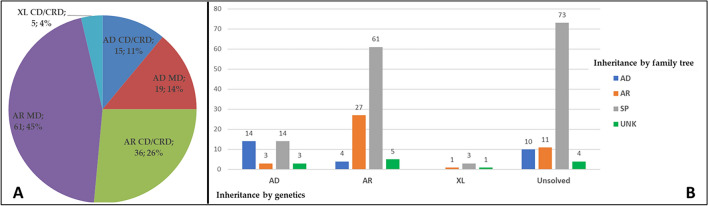
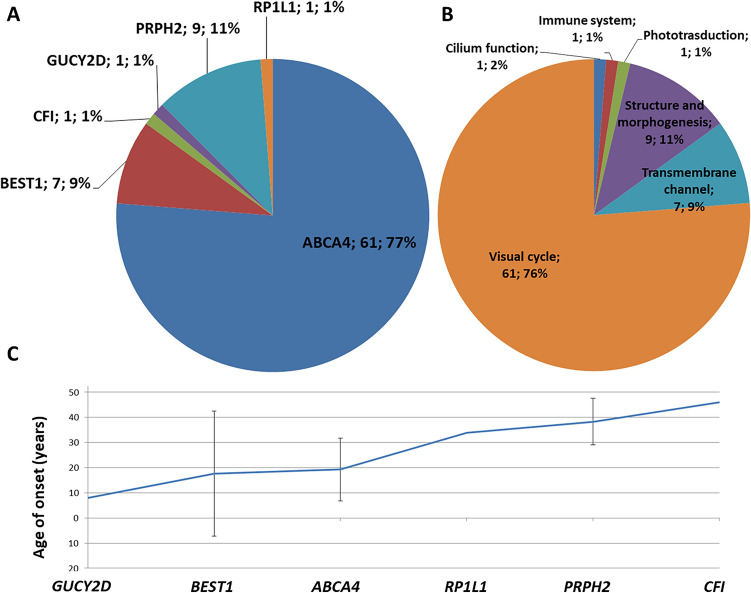
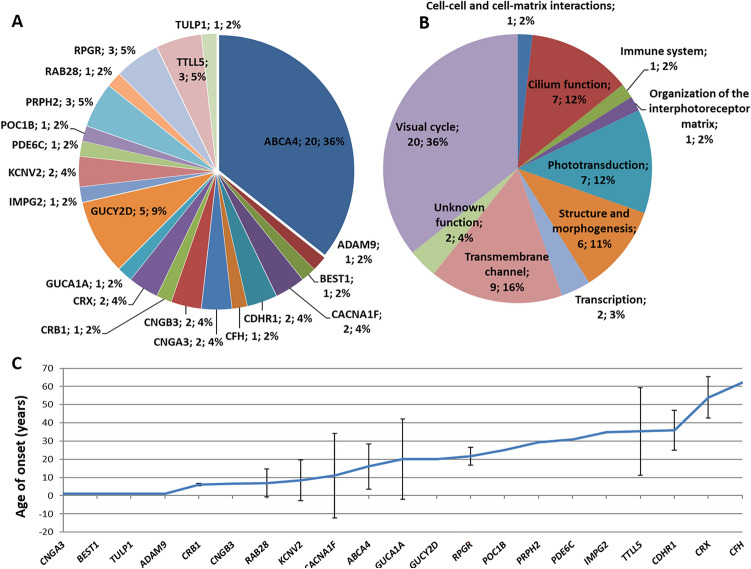
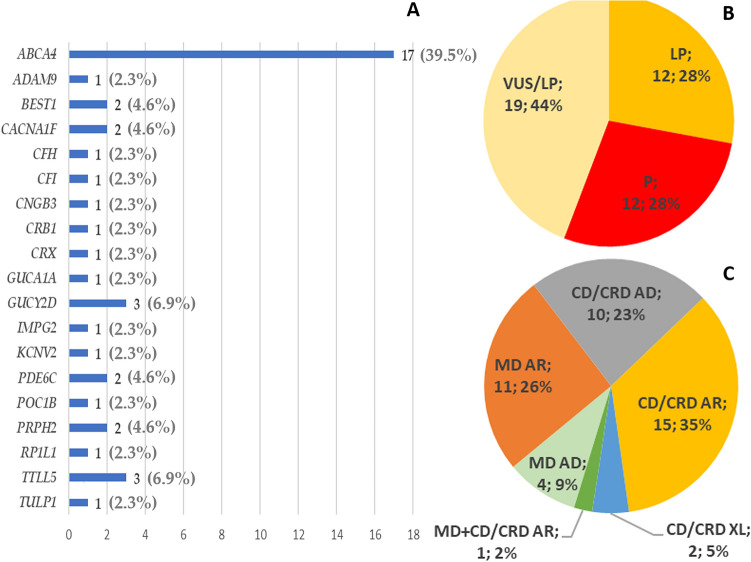
Two-hundred and thirty-four Italian patients with a clinical diagnosis of macular, cone and cone-rod dystrophies (MD, CD, and CRD) were examined using next-generation sequencing (NGS) and gene sequencing panels targeting a specific set of genes, Sanger sequencing and-when necessary-multiplex ligation-dependent probe amplification (MLPA) to diagnose the molecular cause of the aforementioned diseases. When possible, segregation analysis was performed in order to confirm unsolved cases. Each patient's retinal phenotypic characteristics were determined using focal and full-field ERGs, perimetry, spectral domain optical coherence tomography and fundus autofluorescence. We identified 236 potentially causative variants in 136 patients representing the 58.1% of the total cohort, 43 of which were unpublished. After stratifying the patients according to their clinical suspicion, the diagnostic yield was 62.5% and 53.8% for patients with MD and for those with CD/CRD, respectively. The mode of inheritance of all cases confirmed by genetic analysis was 70% autosomal recessive, 26% dominant, and 4% X-linked. The main cause (59%) of both MD and CD/CRD cases was the presence of variants in the ABCA4 gene, followed by variants in PRPH2 (9%) and BEST1 (6%). A careful morpho-functional evaluation of the phenotype, together with genetic counselling, resulted in an acceptable diagnostic yield in a large cohort of Italian patients. Our study emphasizes the role of targeted NGS to diagnose MDs, CDs, and CRDs, as well as the clinical usefulness of segregation analysis for patients with unsolved diagnosis.
234 名意大利患者被诊断为黄斑、锥细胞和锥杆细胞营养不良(MD、CD 和 CRD),使用下一代测序(NGS)和针对特定基因集的基因测序面板、Sanger 测序以及必要时的多重连接依赖性探针扩增(MLPA)来诊断上述疾病的分子病因。在可能的情况下,进行分离分析以确认未解决的病例。使用焦点和全视野 ERG、视野检查、光谱域光学相干断层扫描和眼底自发荧光来确定每位患者的视网膜表型特征。我们在 136 名患者中发现了 236 个潜在的致病变体,占总队列的 58.1%,其中 43 个是未发表的。根据患者的临床怀疑程度对患者进行分层后,MD 患者的诊断率为 62.5%,CD/CRD 患者的诊断率为 53.8%。所有通过遗传分析确认的病例的遗传模式为 70%常染色体隐性遗传、26%显性遗传和 4%X 连锁遗传。所有 MD 和 CD/CRD 病例的主要病因(59%)是 ABCA4 基因的变异,其次是 PRPH2(9%)和 BEST1(6%)的变异。对表型进行仔细的形态功能评估,结合遗传咨询,可在意大利患者的大队列中获得可接受的诊断率。我们的研究强调了靶向 NGS 诊断 MD、CD 和 CRD 的作用,以及分离分析对于未解决诊断的患者的临床实用性。