Khera Rohan, Mortazavi Bobak J, Sangha Veer, Warner Frederick, Patrick Young H, Ross Joseph S, Shah Nilay D, Theel Elitza S, Jenkinson William G, Knepper Camille, Wang Karen, Peaper David, Martinello Richard A, Brandt Cynthia A, Lin Zhenqiu, Ko Albert I, Krumholz Harlan M, Pollock Benjamin D, Schulz Wade L
Section of Cardiovascular Medicine, Department of Internal Medicine, Yale School of Medicine, New Haven, CT, USA.
Center for Outcomes Research and Evaluation, Yale-New Haven Hospital, New Haven, CT, USA.
NPJ Digit Med. 2022 Mar 8;5(1):27. doi: 10.1038/s41746-022-00570-4.
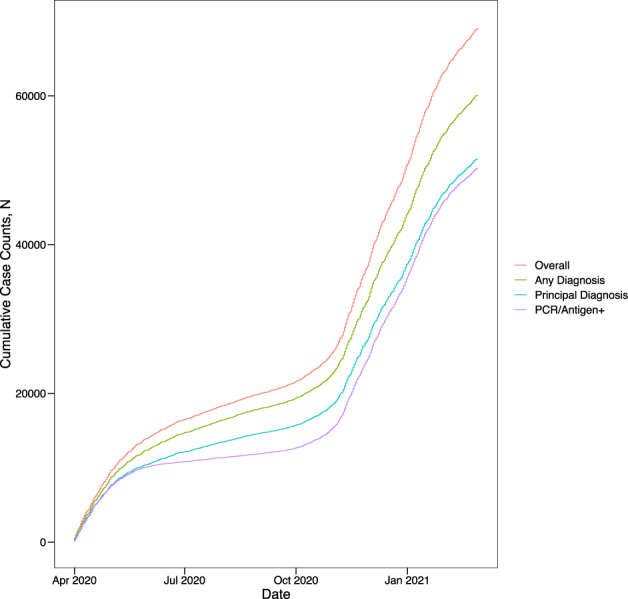
Diagnosis codes are used to study SARS-CoV2 infections and COVID-19 hospitalizations in administrative and electronic health record (EHR) data. Using EHR data (April 2020-March 2021) at the Yale-New Haven Health System and the three hospital systems of the Mayo Clinic, computable phenotype definitions based on ICD-10 diagnosis of COVID-19 (U07.1) were evaluated against positive SARS-CoV-2 PCR or antigen tests. We included 69,423 patients at Yale and 75,748 at Mayo Clinic with either a diagnosis code or a positive SARS-CoV-2 test. The precision and recall of a COVID-19 diagnosis for a positive test were 68.8% and 83.3%, respectively, at Yale, with higher precision (95%) and lower recall (63.5%) at Mayo Clinic, varying between 59.2% in Rochester to 97.3% in Arizona. For hospitalizations with a principal COVID-19 diagnosis, 94.8% at Yale and 80.5% at Mayo Clinic had an associated positive laboratory test, with secondary diagnosis of COVID-19 identifying additional patients. These patients had a twofold higher inhospital mortality than based on principal diagnosis. Standardization of coding practices is needed before the use of diagnosis codes in clinical research and epidemiological surveillance of COVID-19.
诊断代码用于在行政和电子健康记录(EHR)数据中研究SARS-CoV2感染和COVID-19住院情况。利用耶鲁-纽黑文医疗系统以及梅奥诊所的三个医院系统的EHR数据(2020年4月至2021年3月),基于ICD-10中COVID-19诊断(U07.1)的可计算表型定义与SARS-CoV-2 PCR或抗原检测阳性结果进行了评估。我们纳入了耶鲁大学的69423名患者和梅奥诊所的75748名患者,这些患者要么有诊断代码,要么SARS-CoV-2检测呈阳性。耶鲁大学检测呈阳性时COVID-19诊断的精确率和召回率分别为68.8%和83.3%,梅奥诊所的精确率较高(95%),召回率较低(63.5%),在罗切斯特为59.2%,在亚利桑那州为97.3%。对于主要诊断为COVID-19的住院患者,耶鲁大学有94.8%,梅奥诊所有80.5%有相关的实验室检测阳性结果,COVID-19的次要诊断识别出了更多患者。这些患者的院内死亡率比基于主要诊断的情况高出两倍。在将诊断代码用于COVID-19的临床研究和流行病学监测之前,需要对编码实践进行标准化。