Department of Psychology, Brock University, St. Catharines, Ontario, Canada.
PLoS One. 2022 Mar 9;17(3):e0264031. doi: 10.1371/journal.pone.0264031. eCollection 2022.
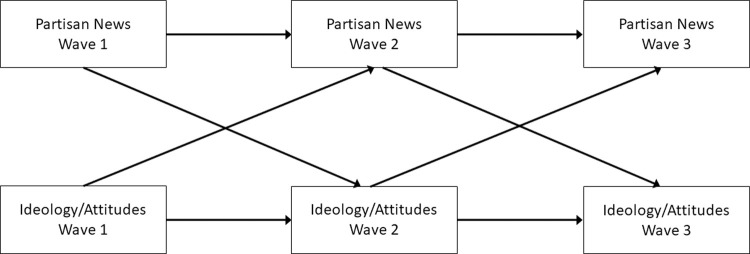
In the present project we assessed whether partisan news affects consumers' views on polarizing issues. In Study 1 nationally representative cross-sectional data (N = 4249) reveals that right-leaning news consumption is associated with more right-leaning attitudes, and left-leaning news consumption is associated with more left-leaning attitudes. Additional three-wave longitudinal data (N = 484) in Study 2 reveals that right-leaning news is positively (and left-leaning news is negatively) associated with right-leaning issue stances three months later, even after controlling for prior issue stances. In a third (supplemental) study (N = 305), random assignment to right-leaning (but not left-leaning) news (vs. control) experimentally fostered more right-leaning stances, regardless of participants' previously held political ideology. These findings suggest that partisan news, and particularly right-leaning news, can polarize consumers in their sociopolitical positions, sharpen political divides, and shape public policy.
在本研究中,我们评估了党派新闻是否会影响消费者对两极化问题的看法。在研究 1 中,全国代表性横断面数据(N = 4249)表明,右翼新闻消费与更右翼的态度相关,而左翼新闻消费与更左翼的态度相关。在研究 2 中,另外三个波的纵向数据(N = 484)表明,右翼新闻积极(而左翼新闻消极)与三个月后右翼问题立场相关,即使在控制先前的问题立场后也是如此。在第三个(补充)研究(N = 305)中,随机分配到右翼(而非左翼)新闻(与对照组相比)实验性地培养了更右翼的立场,而不论参与者先前持有的政治意识形态如何。这些发现表明,党派新闻,特别是右翼新闻,可能会使消费者在其社会政治立场上两极分化,加剧政治分歧,并塑造公共政策。