Nuffield Department of Medicine, University of Oxford, Oxford, UK.
Future of Humanity Institute, University of Oxford, Oxford, UK.
Gene Ther. 2023 May;30(5):407-410. doi: 10.1038/s41434-021-00312-3. Epub 2022 Mar 10.
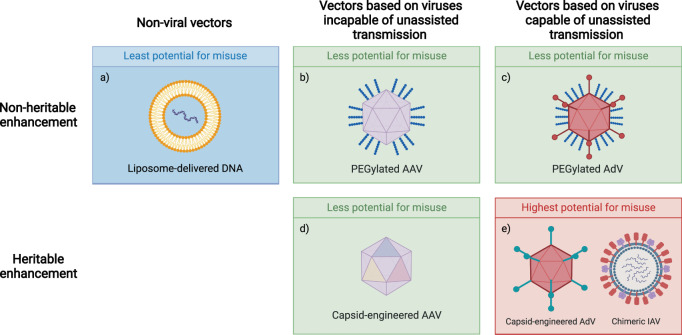
Optimizing viral vectors and their properties will be important for improving the effectiveness and safety of clinical gene therapy. However, such research may generate dual-use insights relevant to the enhancement of pandemic pathogens. In particular, reliable and generalizable methods of immune evasion could increase viral fitness sufficient to cause a new pandemic. High potential for misuse is associated with (1) the development of universal genetic elements for immune modulation, (2) specific insights on capsid engineering for antibody evasion applicable to viruses with pandemic potential, and (3) the development of computational methods to inform capsid engineering. These risks may be mitigated by prioritizing non-viral delivery systems, pharmacological immune modulation methods, non-genetic vector surface modifications, and engineering methods specific to AAV and other viruses incapable of unassisted human-to-human transmission. We recommend that computational vector engineering and the publication of associated code and data be limited to AAV until a technical solution for preventing malicious access to viral engineering tools has been established.
优化病毒载体及其特性对于提高临床基因治疗的效果和安全性非常重要。然而,此类研究可能会产生与大流行病原体增强相关的两用见解。特别是,可靠且可推广的免疫逃避方法可以提高病毒的适应性,足以引发新的大流行。高度滥用的可能性与以下因素有关:(1)用于免疫调节的通用遗传元件的开发;(2)针对具有大流行潜力的病毒的衣壳工程的特定见解,适用于抗体逃避;(3)开发用于告知衣壳工程的计算方法。通过优先考虑非病毒递送系统、药理学免疫调节方法、非遗传载体表面修饰以及针对 AAV 和其他无法独立在人与人之间传播的病毒的特定工程方法,可以减轻这些风险。我们建议在建立防止恶意访问病毒工程工具的技术解决方案之前,将计算载体工程和相关代码及数据的发布限制在 AAV 上。