Mehta Yatin, Sutar Anand R, Zirpe Kapil, Kothari Jay Narendra, Alapati Chakravarthi, Pathak Manu, Nagvekar Vasant C, Mehta Kapil Dev, Debnath Khokan
Department of Medanta Institute of Critical Care and Anesthesiology, Medanta - The Medicity, Gurgaon, Haryana, India.
Department of Critical Care, Apollo Hospital, Bengaluru, Karnataka, India.
Int J Appl Basic Med Res. 2022 Jan-Mar;12(1):30-36. doi: 10.4103/ijabmr.ijabmr_602_21. Epub 2022 Jan 31.
Levonadifloxacin is a novel broad-spectrum antibiotic belonging to the benzoquinolizine subclass of quinolones. It is available in intravenous as well as oral formulation for the treatment of infections caused by common Gram-positive bacterial pathogens including methicillin-resistant (MRSA).
This study retrospectively assessed the real-world safety and efficacy of levonadifloxacin (oral and/or IV) in the treatment of 1229 patients across various clinical conditions. Study outcomes were clinical and microbiological success at the end of therapy.
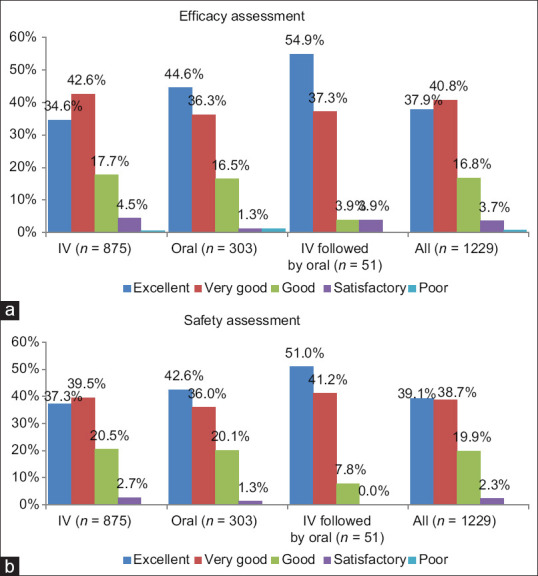
The mean duration of levonadifloxacin therapy was 7.2 days, with a time to clinical improvement averaging at 4 days. Three hundred and three patients received oral therapy, 875 received IV, and 51 received a combination of IV followed by oral therapy. Patients were prescribed levonadifloxacin for skin and soft-tissue infections, diabetic foot infections, septicemia, catheter-related bloodstream infections, bone and joint infections, febrile neutropenia, and respiratory infections including COVID-19 pneumonia. High clinical success rates of 98.3%, 93.7%, and 96.1% with oral, IV, and IV followed by oral levonadifloxacin, respectively, were obtained. Only 11 mild adverse events were reported in 9 patients which included constipation, diarrhea, hyperglycemia, nausea, fatigue, and vomiting. Overall, 96.3% and 97.3% of investigators rated the efficacy and safety of levonadifloxacin as "good to excellent."
An excellent safety and efficacy profile of levonadifloxacin was observed in this study making it a suitable treatment option for management of various bacterial infections, including those caused by resistant Gram-positive pathogens such as MRSA and quinolone-resistant .
左那氟沙星是一种新型广谱抗生素,属于喹诺酮类的苯并喹嗪子类。它有静脉注射和口服制剂,用于治疗由常见革兰氏阳性细菌病原体引起的感染,包括耐甲氧西林金黄色葡萄球菌(MRSA)。
本研究回顾性评估了左那氟沙星(口服和/或静脉注射)在治疗1229例不同临床病症患者中的真实安全性和有效性。研究结果为治疗结束时的临床和微生物学成功。
左那氟沙星治疗的平均持续时间为7.2天,临床改善时间平均为4天。303例患者接受口服治疗,875例接受静脉注射,51例接受静脉注射后口服的联合治疗。患者被开左那氟沙星用于治疗皮肤和软组织感染、糖尿病足感染、败血症、导管相关血流感染、骨和关节感染、发热性中性粒细胞减少症以及包括新冠肺炎肺炎在内的呼吸道感染。口服、静脉注射以及静脉注射后口服左那氟沙星的临床成功率分别为98.3%、93.7%和96.1%。仅9例患者报告了11起轻度不良事件,包括便秘、腹泻、高血糖、恶心、疲劳和呕吐。总体而言,96.3%和97.3%的研究者将左那氟沙星的有效性和安全性评为“良好至优秀”。
本研究观察到左那氟沙星具有出色的安全性和有效性,使其成为治疗各种细菌感染的合适选择,包括由耐甲氧西林金黄色葡萄球菌和耐喹诺酮等耐药革兰氏阳性病原体引起的感染。