Feng Qi, Kim Jean H, Omiyale Wemimo, Bešević Jelena, Conroy Megan, May Margaret, Yang Zuyao, Wong Samuel Yeung-Shan, Tsoi Kelvin Kam-Fai, Allen Naomi, Lacey Ben
Nuffield Department of Population Health (NDPH), University of Oxford, Oxford, United Kingdom.
JC School of Public Health and Primary Care, The Chinese University of Hong Kong, Shatin, Hong Kong SAR, China.
Front Nutr. 2022 Feb 21;9:831470. doi: 10.3389/fnut.2022.831470. eCollection 2022.
Higher levels of vegetable consumption have been associated with a lower risk of cardiovascular disease (CVD), but the independent effect of raw and cooked vegetable consumption remains unclear.
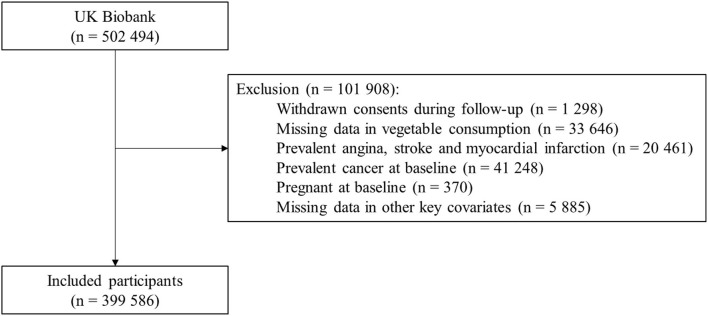
From the UK Biobank cohort, 399,586 participants without prior CVD were included in the analysis. Raw and cooked vegetable intakes were measured with a validated dietary questionnaire at baseline. Multivariable Cox regression was used to estimate the associations between vegetable intake and CVD incidence and mortality, adjusted for socioeconomic status, health status, and lifestyle factors. The potential effect of residual confounding was assessed by calculating the percentage reduction in the likelihood ratio (LR) statistics after adjustment for the confounders.
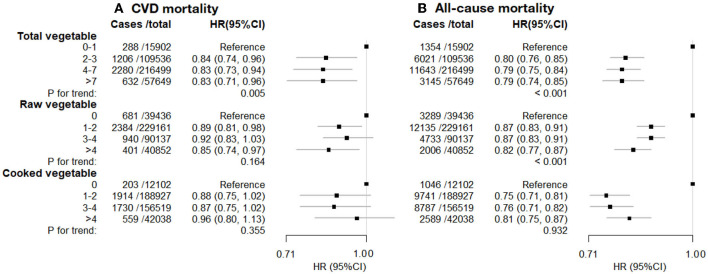
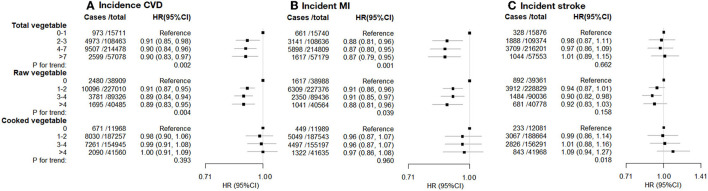
The mean age was 56 years and 55% were women. Mean intakes of raw and cooked vegetables were 2.3 and 2.8 tablespoons/day, respectively. During 12 years of follow-up, 18,052 major CVD events and 4,406 CVD deaths occurred. Raw vegetable intake was inversely associated with both CVD incidence (adjusted hazard ratio (HR) [95% CI] for the highest vs. lowest intake: 0.89 [0.83-0.95]) and CVD mortality (0.85 [0.74-0.97]), while cooked vegetable intake was not (1.00 [0.91-1.09] and 0.96 [0.80-1.13], respectively). Adjustment for potential confounders reduced the LR statistics for the associations of raw vegetables with CVD incidence and mortality by 82 and 87%, respectively.
Higher intakes of raw, but not cooked, vegetables were associated with lower CVD risk. Residual confounding is likely to account for much, if not all, of the observed associations. This study suggests the need to reappraise the evidence on the burden of CVD disease attributable to low vegetable intake in the high-income populations.
较高的蔬菜摄入量与较低的心血管疾病(CVD)风险相关,但生蔬菜和熟蔬菜摄入的独立影响仍不明确。
从英国生物银行队列中,纳入399,586名无既往CVD的参与者进行分析。在基线时使用经过验证的饮食问卷测量生蔬菜和熟蔬菜的摄入量。采用多变量Cox回归估计蔬菜摄入量与CVD发病率和死亡率之间的关联,并对社会经济状况、健康状况和生活方式因素进行了调整。通过计算调整混杂因素后似然比(LR)统计量的降低百分比,评估残余混杂的潜在影响。
平均年龄为56岁,55%为女性。生蔬菜和熟蔬菜的平均摄入量分别为每天2.3汤匙和2.8汤匙。在12年的随访期间,发生了18,052例主要CVD事件和4,406例CVD死亡。生蔬菜摄入量与CVD发病率(最高摄入量与最低摄入量的调整风险比(HR)[95%CI]:0.89[0.83 - 0.95])和CVD死亡率(0.85[0.74 - 0.97])均呈负相关,而熟蔬菜摄入量则不然(分别为1.00[0.91 - 1.09]和0.96[0.80 - 1.13])。对潜在混杂因素的调整分别使生蔬菜与CVD发病率和死亡率关联的LR统计量降低了82%和87%。
较高的生蔬菜摄入量而非熟蔬菜摄入量与较低的CVD风险相关。残余混杂可能是观察到的关联的大部分(如果不是全部)原因。本研究表明,有必要重新评估高收入人群中因蔬菜摄入量低而导致的CVD疾病负担的证据。