Martínez-Roca Alejandro, Giner-Calabuig Mar, Murcia Oscar, Castillejo Adela, Soto José Luis, García-Heredia Anabel, Jover Rodrigo
Servicio de Medicina Digestiva, Hospital General Universitario de Alicante, Instituto de Investigación Sanitaria, ISABIAL, Universidad Miguel Hernández, 03010 Alicante, Spain.
Digestive Disease Department, University of Yale, New Heaven, CT 06520, USA.
Cancers (Basel). 2022 Feb 22;14(5):1115. doi: 10.3390/cancers14051115.
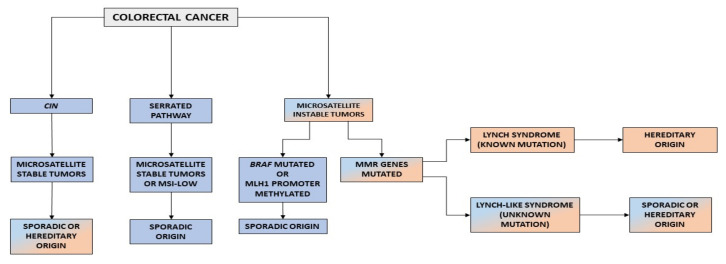
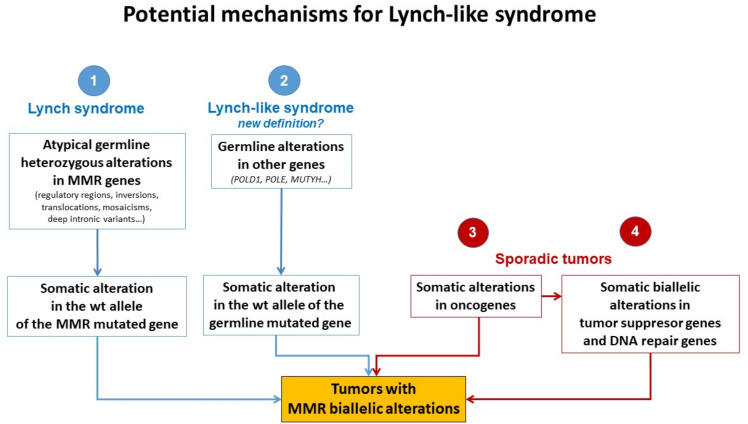
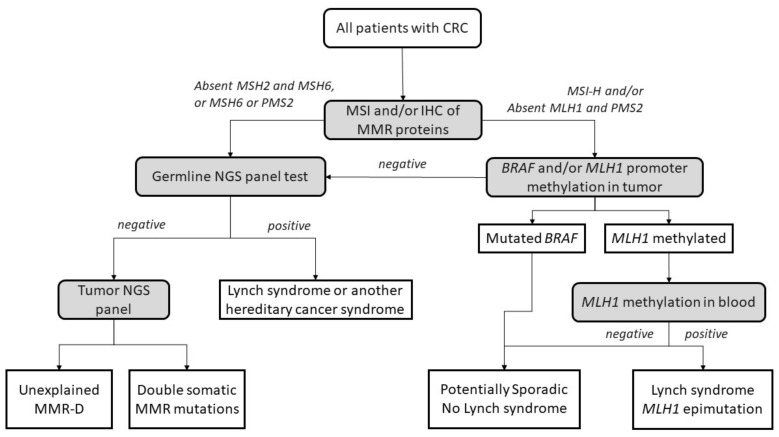
Lynch syndrome is an autosomal dominant disorder caused by germline mutations in DNA mismatch repair (MMR) system genes, such as , , , or . It is the most common hereditary colorectal cancer syndrome. Screening is regularly performed by using microsatellite instability (MSI) or immunohistochemistry for the MMR proteins in tumor samples. However, in a proportion of cases, MSI is found or MMR immunohistochemistry is impaired in the absence of a germline mutation in MMR genes, mutation, or hypermethylation. These cases are defined as Lynch-like syndrome. Patients with Lynch-like syndrome represent a mixture of truly hereditary and sporadic cases, with a risk of colorectal cancer in first-degree relatives that is between the risk of Lynch syndrome in families and relatives of sporadic colon cancer cases. Although multiple approaches have been suggested to distinguish between hereditary and sporadic cases, a homogeneous testing protocol and consensus on the adequate classification of these patients is still lacking. For this reason, management of Lynch-like syndrome and prevention of cancer in these families is clinically challenging. This review explains the concept of Lynch-like syndrome, potential mechanisms for its development, and methods for adequately distinguishing between sporadic and hereditary cases of this entity.
林奇综合征是一种常染色体显性疾病,由DNA错配修复(MMR)系统基因(如 、 、 或 )的种系突变引起。它是最常见的遗传性结直肠癌综合征。通常通过检测肿瘤样本中的微卫星不稳定性(MSI)或MMR蛋白的免疫组化来进行筛查。然而,在一部分病例中,在MMR基因不存在种系突变、 突变或 高甲基化的情况下,会发现MSI或MMR免疫组化出现异常。这些病例被定义为林奇样综合征。林奇样综合征患者包括真正的遗传性病例和散发性病例,其一级亲属患结直肠癌的风险介于林奇综合征家族和散发性结肠癌病例亲属的风险之间。尽管已经提出了多种方法来区分遗传性和散发性病例,但仍缺乏统一的检测方案以及关于这些患者适当分类的共识。因此,林奇样综合征的管理以及这些家族中癌症的预防在临床上具有挑战性。本综述解释了林奇样综合征的概念、其发生的潜在机制以及充分区分该实体散发性和遗传性病例的方法。