Golubicki Mariano, Díaz-Gay Marcos, Bonjoch Laia, Franch-Expósito Sebastià, Muñoz Jenifer, Cuatrecasas Miriam, Ocaña Teresa, Iseas Soledad, Mendez Guillermo, Carballido Marcela, Robbio Juan, Cisterna Daniel, Roca Enrique, Castells Antoni, Balaguer Francesc, Castellví-Bel Sergi, Antelo Marina
Oncology Section, Hospital of Gastroenterology "Dr. C. B. Udaondo", Buenos Aires C1264, Argentina.
Molecular Biology Lab, Hospital of Gastroenterology "Dr. C. B. Udaondo", Buenos Aires C1264, Argentina.
Cancers (Basel). 2021 Mar 12;13(6):1259. doi: 10.3390/cancers13061259.
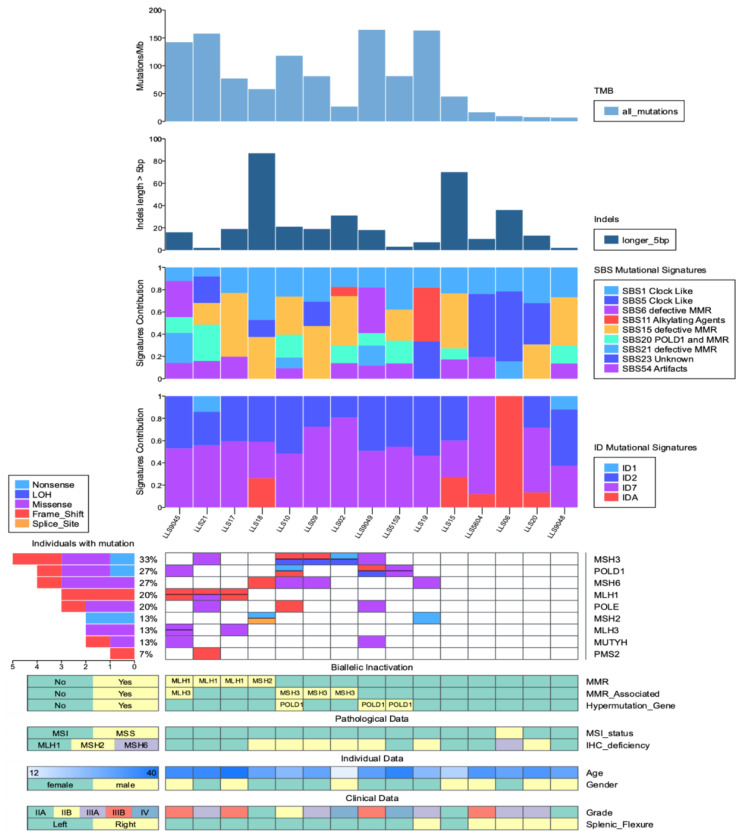
Lynch-like syndrome (LLS) is an increasingly common clinical challenge with an underlying molecular basis mostly unknown. To shed light onto it, we focused on a very young LLS early-onset colorectal cancer (CRC) cohort (diagnosis ≤ 40 y.o.), performing germline and tumor whole-exome sequencing (WES) of 15 patients, and additionally analyzing their corresponding tumor mutational burden (TMB) and mutational signatures. We identified four cases (27%) with double somatic putative variants in mismatch repair (MMR) core genes, as well as three additional cases (20%) with double somatic alterations in tumors with unexplained MSH2/MSH6 loss of expression, and two cases (13%) with potential biallelic alterations. Average TMB was significantly higher for LLS cases with double somatic alterations. Lastly, nine predicted deleterious variants in genes involved in the DNA repair functions and/or previously associated with CRC were found in nine probands, four of which also showed MMR biallelic somatic inactivation. In conclusion, we contribute new insights into LLS CRC, postulating and double somatic alterations as an underlying cause of a microsatellite instability (MSI) phenotype, proposing intrinsic biological differences between LLS with and without somatic alterations, and suggesting new predisposing candidate genes in this scenario.
林奇样综合征(LLS)是一个日益常见的临床挑战,其潜在分子基础大多未知。为了阐明这一问题,我们聚焦于一个非常年轻的LLS早发性结直肠癌(CRC)队列(诊断年龄≤40岁),对15例患者进行了种系和肿瘤全外显子测序(WES),并额外分析了他们相应的肿瘤突变负担(TMB)和突变特征。我们鉴定出4例(27%)在错配修复(MMR)核心基因中有双体细胞推定变异的病例,以及另外3例(20%)在MSH2/MSH6表达不明原因缺失的肿瘤中有双体细胞改变的病例,还有2例(13%)有潜在的双等位基因改变。有双体细胞改变的LLS病例的平均TMB显著更高。最后,在9名先证者中发现了9个参与DNA修复功能和/或先前与CRC相关的基因中的预测有害变异,其中4例还表现出MMR双等位基因体细胞失活。总之,我们为LLS CRC提供了新的见解,推测双体细胞改变是微卫星不稳定性(MSI)表型的潜在原因,提出有和没有体细胞改变的LLS之间存在内在生物学差异,并在这种情况下提出了新的易感候选基因。