Sun Sibo, Liu Yiqian, Eisfeld Ann-Kathrin, Zhen Fuxi, Jin Shidai, Gao Wen, Yu Tongfu, Chen Liang, Wang Wei, Chen Wei, Yuan Mingming, Chen Rongrong, He Kai, Guo Renhua
Department of Oncology, The First Affiliated Hospital of Nanjing Medical University, Nanjing, China.
Departments of Internal Medicine and Pathology, The Ohio State University Wexner Medical Center, Columbus, OH, United States.
Front Oncol. 2019 Jun 26;9:550. doi: 10.3389/fonc.2019.00550. eCollection 2019.
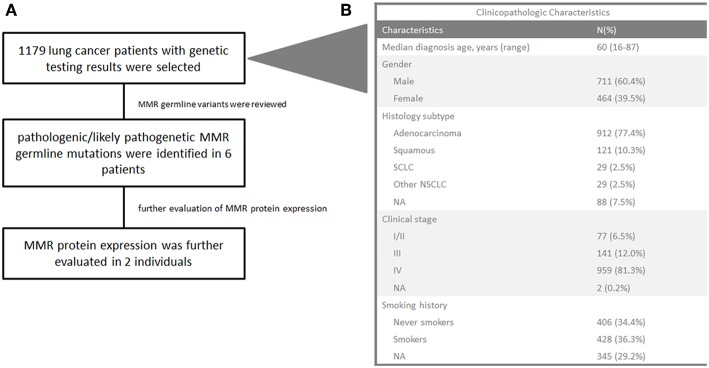
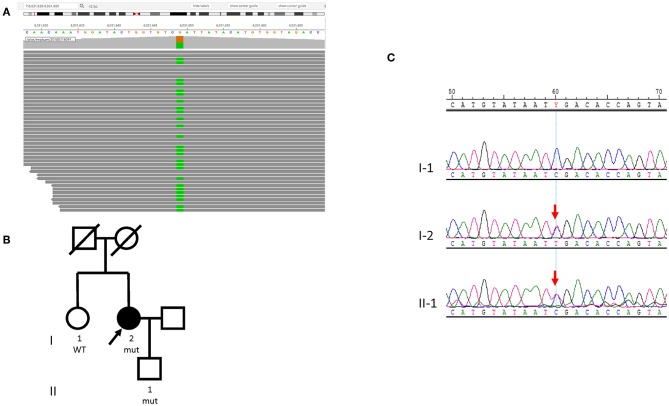
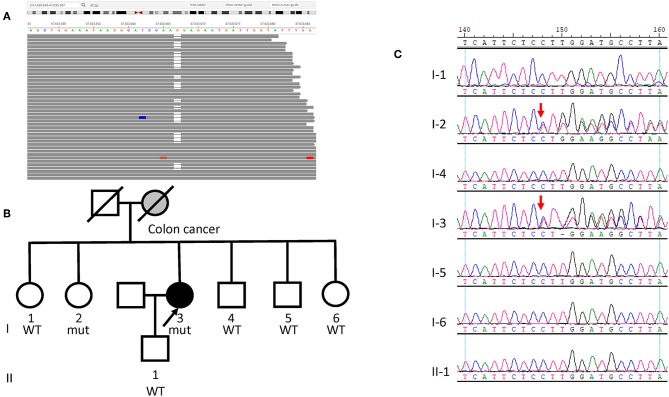
Paired tumor-normal targeted next-generation sequencing (NGS) is primarily used to identify actionable somatic mutations, but can also detect germline variants including pathogenic germline mutations in DNA mismatch repair (MMR) genes that underlie Lynch syndrome. In the present study we examined paired NGS data from lung cancer patients to identify germline mutations in MMR genes. As lung cancer is not one of the recognized Lynch syndrome-associated neoplasms, we also investigated whether these lung cancer cases are due to Lynch syndrome or are instead sporadic cancers occurring in Lynch syndrome patients. A retrospective study of 1,179 lung cancer patients with available paired NGS data was performed to identify germline mutations in the MMR genes , and , and evaluate tumor mutation burden (TMB). Microsatellite instability (MSI) testing was done on select cases with MMR gene mutations by either NGS or PCR/capillary electrophoresis approach. Immunohistochemistry (IHC) for MMR proteins was performed in select patients. Pathogenic or likely-pathogenic germline mutations in , or were detected in 0.5% (6/1,179) of lung cancer patients; three of the patients had a family history of colon or gastric cancer. The median age at diagnosis of these cases was 68.5 years old. None of these six patients exhibited MSI or loss of MMR protein expression. Among them, no second hit somatic mutations in MMR genes (including single-nucleotide variants, small insertions or deletions and copy number alterations) were detected, and the median TMB was 4.5 muts/MB. Subsequent genetic testing of family members identified new Lynch syndrome cases in two first-degree relatives. These data imply that lung cancers in Lynch syndrome patients are unrelated to the underlying Lynch syndrome diagnosis and occur spontaneously. Nonetheless, paired tumor-normal NGS can identify germline mutations to help reveal Lynch syndrome in cancer patients. This has important implications for cancer screening and risk reduction in these patients and their families.
配对肿瘤-正常组织靶向二代测序(NGS)主要用于识别可 actionable 的体细胞突变,但也能检测种系变异,包括导致林奇综合征的 DNA 错配修复(MMR)基因中的致病性种系突变。在本研究中,我们检查了肺癌患者的配对 NGS 数据,以识别 MMR 基因中的种系突变。由于肺癌并非公认的与林奇综合征相关的肿瘤之一,我们还研究了这些肺癌病例是由林奇综合征引起的,还是林奇综合征患者中发生的散发性癌症。对 1179 例有可用配对 NGS 数据的肺癌患者进行了回顾性研究,以识别 MMR 基因中的种系突变,并评估肿瘤突变负荷(TMB)。通过 NGS 或 PCR/毛细管电泳方法,对部分有 MMR 基因突变的病例进行了微卫星不稳定性(MSI)检测。对部分患者进行了 MMR 蛋白的免疫组织化学(IHC)检测。在 0.5%(6/1179)的肺癌患者中检测到了 、 或 的致病性或可能致病性种系突变;其中三名患者有结肠癌或胃癌家族史。这些病例的诊断中位年龄为 68.5 岁。这六名患者均未表现出 MSI 或 MMR 蛋白表达缺失。其中,未检测到 MMR 基因中的第二次打击体细胞突变(包括单核苷酸变异、小插入或缺失以及拷贝数改变),中位 TMB 为 4.5 个突变/百万碱基。对家庭成员的后续基因检测在两名一级亲属中发现了新的林奇综合征病例。这些数据表明,林奇综合征患者中的肺癌与潜在的林奇综合征诊断无关,是自发发生的。尽管如此,配对肿瘤-正常组织 NGS 可以识别种系突变,有助于揭示癌症患者中的林奇综合征。这对这些患者及其家庭的癌症筛查和风险降低具有重要意义。