Panvongsa Wittaya, Pegtel D Michiel, Voortman Jens
Cancer Center Amsterdam, Department of Medical Oncology, Amsterdam UMC, Vrije Universiteit Amsterdam, 1081 HV Amsterdam, The Netherlands.
Cancer Center Amsterdam, Department of Pathology, Amsterdam UMC, Vrije Universiteit Amsterdam, 1081 HV Amsterdam, The Netherlands.
Cancers (Basel). 2022 Feb 24;14(5):1160. doi: 10.3390/cancers14051160.
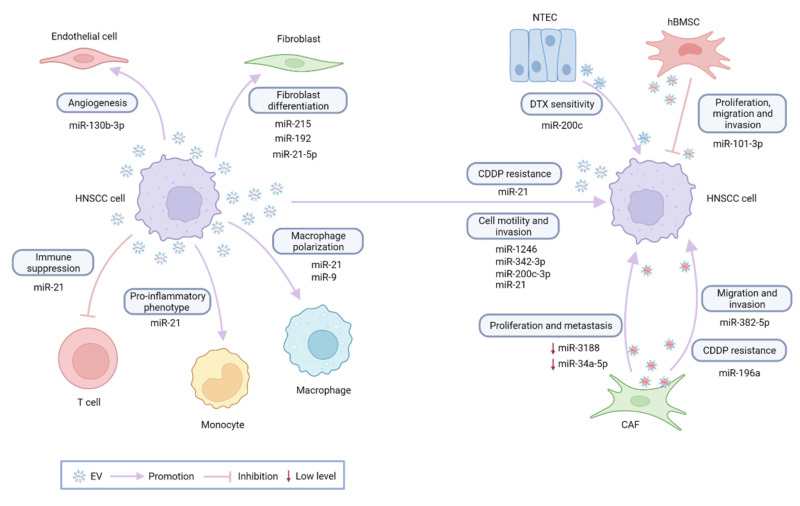
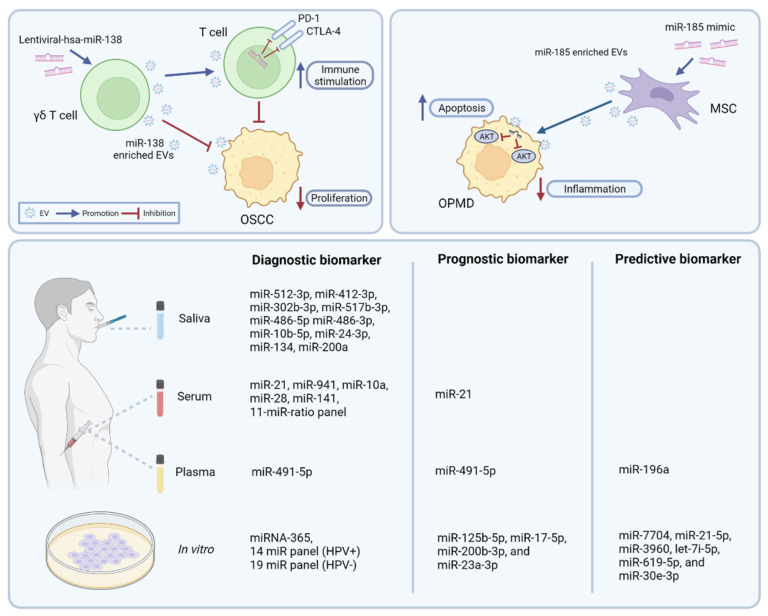
MicroRNAs (miRNAs) are a class of small non-coding RNA molecules that play a pivotal regulatory role in a broad variety of biological processes. Dysregulation of miRNAs is associated with several human diseases, particularly cancer. Extracellular vesicles (EVs) are crucial components in intercellular communication. As part of the cargo of EVs, miRNAs are involved in EV-mediated cell-to-cell interactions, including promotion or suppression of tumor development. The knowledge on the molecular mechanisms and clinical importance of EV-miRNAs in head and neck squamous cell carcinoma (HNSCC) has rapidly grown over the past years. In the present review, the current understanding regarding the effect of EV-miRNAs on HNSCC tumorigenesis is summarized, which includes effects on tumor proliferation, angiogenesis, invasion and metastasis, the tumor microenvironment, immune modulation, and treatment resistance. EV-miRNA-based biomarkers in liquid biopsies such as blood and saliva may open up new possibilities for employing EV-miRNAs for screening and early diagnostics as well as disease monitoring. Future perspectives include the promise of EV-miRNAs as a novel therapeutic target.
微小RNA(miRNA)是一类小的非编码RNA分子,在多种生物学过程中发挥关键的调节作用。miRNA的失调与多种人类疾病相关,尤其是癌症。细胞外囊泡(EV)是细胞间通讯的关键组成部分。作为EV货物的一部分,miRNA参与EV介导的细胞间相互作用,包括促进或抑制肿瘤发展。在过去几年中,关于EV-miRNA在头颈部鳞状细胞癌(HNSCC)中的分子机制和临床重要性的知识迅速增长。在本综述中,总结了目前对EV-miRNA对HNSCC肿瘤发生影响的理解,包括对肿瘤增殖、血管生成、侵袭和转移、肿瘤微环境、免疫调节和治疗耐药性的影响。血液和唾液等液体活检中基于EV-miRNA的生物标志物可能为将EV-miRNA用于筛查、早期诊断以及疾病监测开辟新的可能性。未来的前景包括EV-miRNA作为新型治疗靶点的前景。