Department of International Health, Johns Hopkins Bloomberg School of Public Health, Johns Hopkins University, 615 N Wolfe Street, Baltimore, MD 21205, USA.
Department of Nutrition and Food Sciences, University of Vermont, 109 Carrigan Drive, Burlington, VT 05405, USA.
Nutrients. 2022 Feb 26;14(5):988. doi: 10.3390/nu14050988.
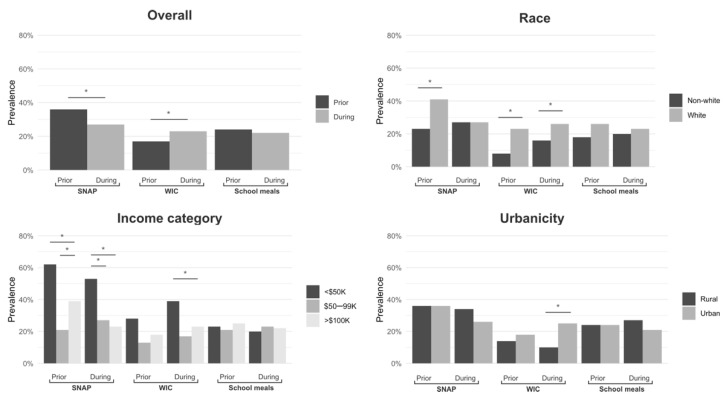
This study aims to describe differences in participation in the Supplemental Nutrition Assistance Program (SNAP), Special Supplemental Nutrition Program for Women and Children (WIC), and school meal programs by household characteristics prior to and during the pandemic, and to examine the association of program participation with food security status and food pantry use. We analyze secondary data ( = 470) from an online survey collected in July/August 2020 using weighted multiple logistic regression models. Participation in SNAP declined among households with children in the first four months of the pandemic, while participation in WIC increased slightly, and participation in school meals remained unchanged. There were significant differences in SNAP, WIC, and school meal programs use by race/ethnicity, income, and urbanicity before and during the pandemic. Food insecurity prevalence was higher among SNAP participants at both periods but the gap between participants and non-participants was smaller during the pandemic. Pantry use and food insecurity rates were consistently higher among federal nutrition assistance program participants, possibly suggesting unmet food needs. These results highlight the need for increased program benefits and improved access to food, particularly during periods of hardship.
本研究旨在描述在疫情前后,根据家庭特征,参与补充营养援助计划(SNAP)、妇女和儿童特别补充营养计划(WIC)和学校膳食计划的差异,并研究参与这些计划与粮食安全状况和食品储藏室使用之间的关联。我们分析了 2020 年 7 月/8 月通过在线调查收集的二次数据(n=470),使用加权多逻辑回归模型。在疫情的前四个月,有儿童的家庭参与 SNAP 的比例下降,而参与 WIC 的比例略有增加,参与学校膳食计划的比例保持不变。在疫情前后,种族/族裔、收入和城市状况等因素对 SNAP、WIC 和学校膳食计划的使用存在显著差异。在这两个时期,SNAP 参与者的粮食不安全发生率都较高,但参与者和非参与者之间的差距在疫情期间较小。食品储藏室的使用和粮食不安全率在联邦营养援助计划参与者中一直较高,这可能表明存在未满足的粮食需求。这些结果强调了增加计划福利和改善食品获取的必要性,特别是在困难时期。