
超声塑化条件下聚合物-金属界面摩擦特性的联合原子分子动力学研究。
Polymer-Metal Interfacial Friction Characteristics under Ultrasonic Plasticizing Conditions: A United-Atom Molecular Dynamics Study.
机构信息
State Key Laboratory of High Performance Complex Manufacturing, School of Electrical and Mechanical Engineering, Central South University, Lushan South Road 932, Changsha 410083, China.
出版信息
Int J Mol Sci. 2022 Mar 4;23(5):2829. doi: 10.3390/ijms23052829.
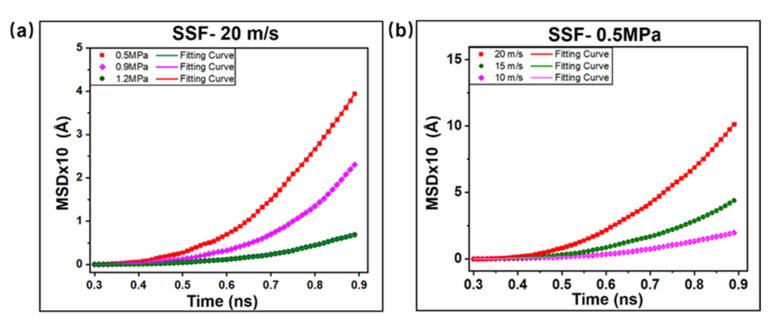
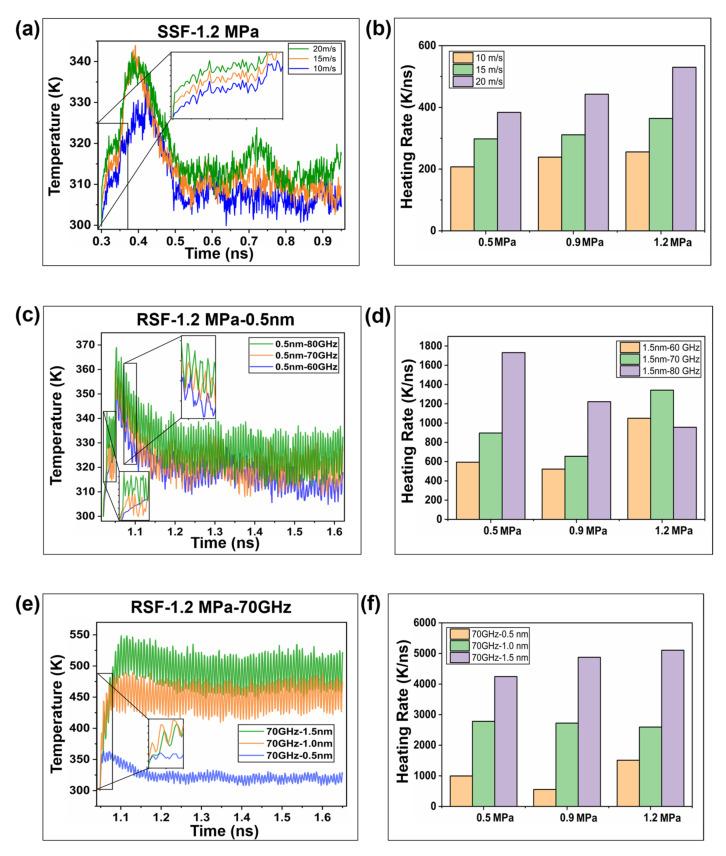
Understanding the properties of polymer-metal interfacial friction is critical for accurate prototype design and process control in polymer-based advanced manufacturing. The transient polymer-metal interfacial friction characteristics are investigated using united-atom molecular dynamics in this study, which is under the boundary conditions of single sliding friction (SSF) and reciprocating sliding friction (RSF). It reflects the polymer-metal interaction under the conditions of initial compaction and ultrasonic vibration, so that the heat generation mechanism of ultrasonic plasticization microinjection molding (UPMIM) is explored. The contact mechanics, polymer segment rearrangement, and frictional energy transfer features of polymer-metal interface friction are investigated. The results reveal that, in both SSF and RSF modes, the sliding rate has a considerable impact on the dynamic response of the interfacial friction force, where the amplitude has a response time of about 0.6 ns to the friction. The high frequency movement of the polymer segment caused by dynamic interfacial friction may result in the formation of a new coupled interface. Frictional energy transfer is mainly characterized by dihedral and kinetic energy transitions in polymer chains. Our findings also show that the ultrasonic amplitude has a greater impact on polymer-metal interfacial friction heating than the frequency, as much as it does under ultrasonic plasticizing circumstances on the homogeneous polymer-polymer interface. Even if there are differences in thermophysical properties at the heterointerface, transient heating will still cause heat accumulation at the interface with a temperature difference of around 35 K.
理解聚合物-金属界面摩擦的特性对于聚合物基先进制造中准确的原型设计和过程控制至关重要。本研究采用统一原子分子动力学研究了单滑动摩擦(SSF)和往复滑动摩擦(RSF)边界条件下的瞬态聚合物-金属界面摩擦特性。它反映了初始压实和超声振动条件下的聚合物-金属相互作用,从而探索了超声塑化微注塑成型(UPMIM)的热生成机制。研究了聚合物-金属界面摩擦的接触力学、聚合物链段重排和摩擦能量传递特征。结果表明,在 SSF 和 RSF 模式下,滑动速率对界面摩擦力的动态响应有很大影响,其振幅对摩擦的响应时间约为 0.6ns。动态界面摩擦引起的聚合物链段高频运动可能导致新的耦合界面的形成。摩擦能量传递主要表现为聚合物链中二面角和动能的转变。我们的研究结果还表明,与频率相比,超声振幅对聚合物-金属界面摩擦加热的影响更大,就像在同质聚合物-聚合物界面上的超声塑化情况下一样。即使在异质界面存在热物理性质的差异,瞬态加热仍会导致界面处的热量积累,温差约为 35K。





 Zotero 插件