Department of Laboratory Medicine, Yale School of Medicine, New Haven, Connecticut, United States of America.
Department of Immunobiology, Yale School of Medicine, New Haven, Connecticut, United States of America.
PLoS Pathog. 2022 Mar 10;18(3):e1010318. doi: 10.1371/journal.ppat.1010318. eCollection 2022 Mar.
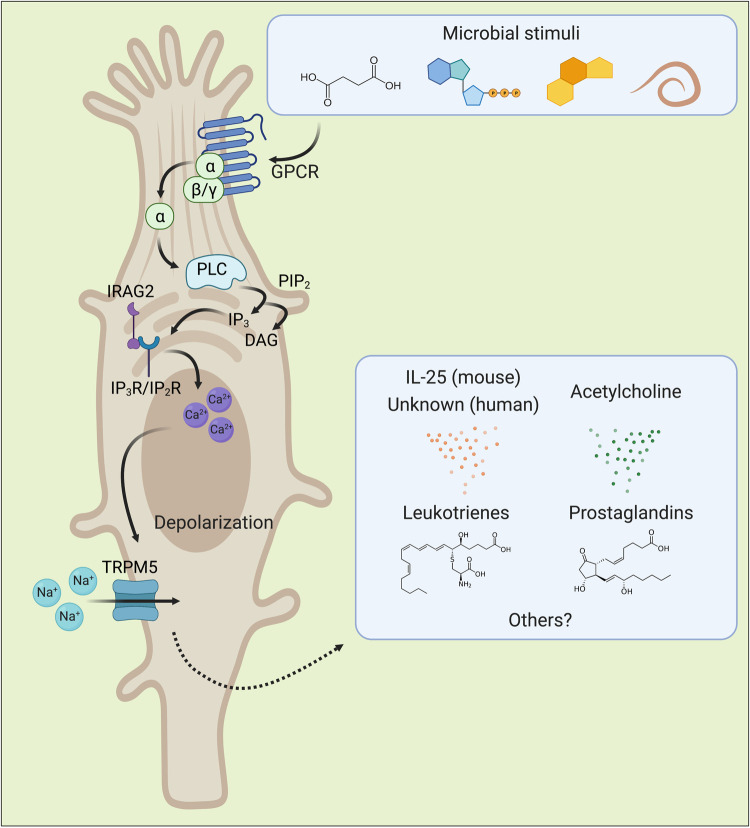
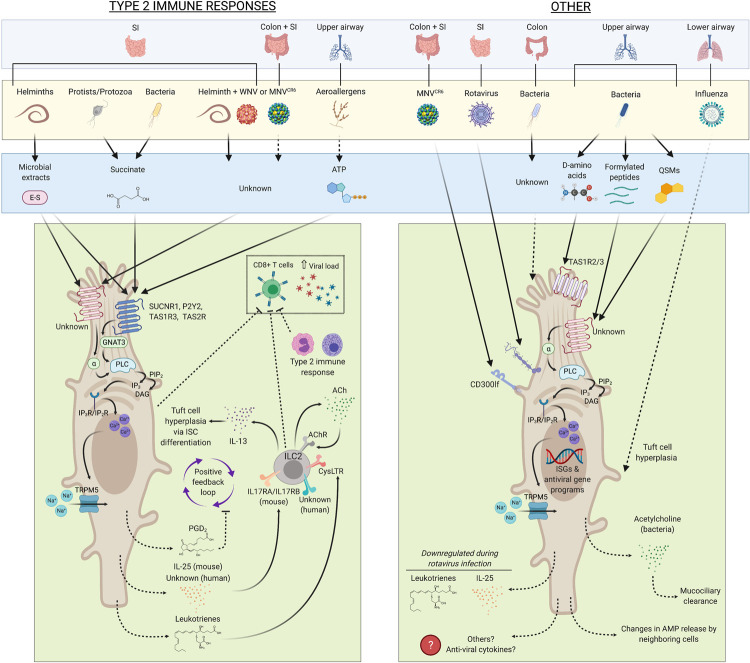
Although tuft cells were discovered over 60 years ago, their functions have long been enigmatic, especially in human health. Nonetheless, tuft cells have recently emerged as key orchestrators of the host response to diverse microbial infections in the gut and airway. While tuft cells are epithelial in origin, they exhibit functions akin to immune cells and mediate important interkingdom interactions between the host and helminths, protists, viruses, and bacteria. With broad intra- and intertissue heterogeneity, tuft cells sense and respond to microbes with exquisite specificity. Tuft cells can recognize helminth and protist infection, driving a type 2 immune response to promote parasite expulsion. Tuft cells also serve as the primary physiologic target of persistent murine norovirus (MNV) and promote immune evasion. Recently, tuft cells were also shown to be infected by rotavirus. Other viral infections, such as influenza A virus, can induce tuft cell-dependent tissue repair. In the context of coinfection, tuft cells promote neurotropic flavivirus replication by dampening antiviral adaptive immune responses. Commensal and pathogenic bacteria can regulate tuft cell abundance and function and, in turn, tuft cells are implicated in modulating bacterial infiltration and mucosal barrier integrity. However, the contribution of tuft cells to microbial sensing in humans and their resulting effector responses are poorly characterized. Herein, we aim to provide a comprehensive overview of microbial activation of tuft cells with an emphasis on tuft cell heterogeneity and differences between mouse and human tuft cell biology as it pertains to human health and disease.
尽管肠嗜碱性粒细胞(tuft cells)在 60 多年前就被发现了,但它们的功能长期以来一直是个谜,尤其是在人类健康方面。然而,肠嗜碱性粒细胞最近已成为宿主对肠道和气道中各种微生物感染的关键协调者。尽管肠嗜碱性粒细胞起源于上皮细胞,但它们具有类似于免疫细胞的功能,并介导宿主与蠕虫、原生动物、病毒和细菌之间的重要种间相互作用。肠嗜碱性粒细胞具有广泛的组织内和组织间异质性,能够以极高的特异性感知和响应微生物。肠嗜碱性粒细胞可以识别蠕虫和原生动物的感染,引发 2 型免疫反应以促进寄生虫的排出。肠嗜碱性粒细胞也是持续存在的鼠诺如病毒(MNV)的主要生理性靶标,并促进免疫逃避。最近,肠嗜碱性粒细胞也被证明会被轮状病毒感染。其他病毒感染,如甲型流感病毒,可以诱导肠嗜碱性粒细胞依赖性组织修复。在合并感染的情况下,肠嗜碱性粒细胞通过抑制抗病毒适应性免疫反应来促进神经嗜性黄病毒的复制。共生菌和病原菌可以调节肠嗜碱性粒细胞的丰度和功能,反过来,肠嗜碱性粒细胞也被认为可以调节细菌的渗透和黏膜屏障的完整性。然而,肠嗜碱性粒细胞在人类中对微生物感知的贡献及其产生的效应反应仍未得到充分描述。本文旨在全面概述微生物对肠嗜碱性粒细胞的激活作用,重点介绍肠嗜碱性粒细胞的异质性以及小鼠和人类肠嗜碱性粒细胞生物学之间的差异,这与人类健康和疾病有关。