Musée National d'Histoire Naturelle, 25 rue Munster, L-2160, Luxembourg, Luxembourg.
Groningen Institute for Evolutionary Life Sciences, University of Groningen, 9700 CC, Groningen, The Netherlands.
Heredity (Edinb). 2022 Apr;128(4):279-290. doi: 10.1038/s41437-022-00517-1. Epub 2022 Mar 10.
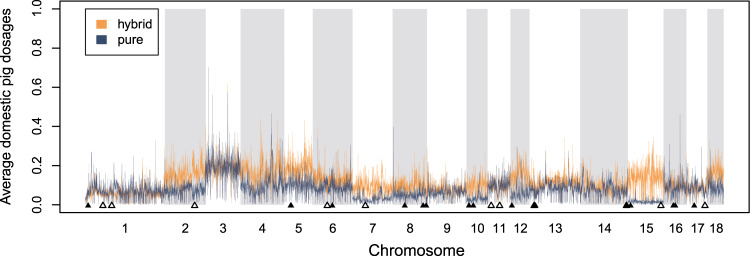
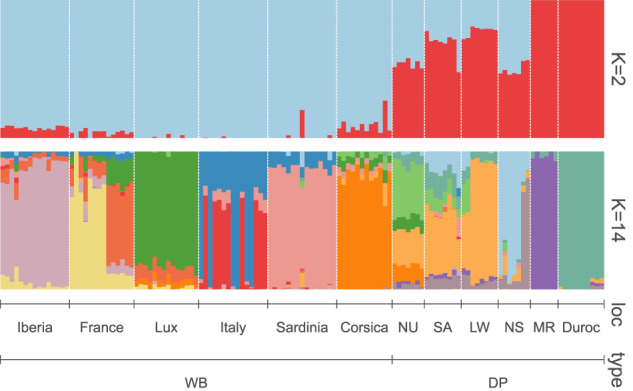
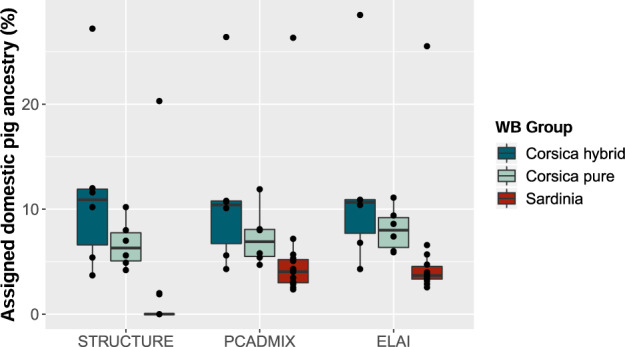
Owing to the intensified domestication process with artificial trait selection, introgressive hybridisation between domestic and wild species poses a management problem. Traditional free-range livestock husbandry, as practiced in Corsica and Sardinia, is known to facilitate hybridisation between wild boars and domestic pigs (Sus scrofa). Here, we assessed the genetic distinctness and genome-wide domestic pig ancestry levels of the Corsican wild boar subspecies S. s. meridionalis, with reference to its Sardinian conspecifics, employing a genome-wide single nucleotide polymorphism (SNP) assay and mitochondrial control region (mtCR) haplotypes. We also assessed the reliance of morphological criteria and the melanocortin-1 receptor (MC1R) coat colour gene to identify individuals with domestic introgression. While Corsican wild boars showed closest affinity to Sardinian and Italian wild boars compared to other European populations based on principal component analysis, the observation of previously undescribed mtCR haplotypes and high levels of nuclear divergence (Weir's θ > 0.14) highlighted the genetic distinctness of Corsican S. s. meridionalis. Across three complementary analyses of mixed ancestry (i.e., STRUCTURE, PCADMIX, and ELAI), proportions of domestic pig ancestry were estimated at 9.5% in Corsican wild boars, which was significantly higher than in wild boars in Sardinia, where free-range pig keeping was banned in 2012. Comparison of morphologically pure- and hybrid-looking Corsican wild boars suggested a weak correlation between morphological criteria and genome-wide domestic pig ancestry. The study highlights the usefulness of molecular markers to assess the direct impacts of management practices on gene flow between domestic and wild species.
由于人工特征选择的强化驯化过程,家养和野生物种之间的渐渗杂交带来了管理问题。传统的科西嘉和撒丁岛自由放养畜牧业,众所周知,有利于野猪和家猪(Sus scrofa)之间的杂交。在这里,我们评估了科西嘉野猪亚种 S. s. meridionalis 的遗传独特性和全基因组家猪祖先水平,参考了其撒丁岛同种动物,采用全基因组单核苷酸多态性(SNP)分析和线粒体控制区(mtCR)单倍型。我们还评估了形态标准和黑素皮质素-1 受体(MC1R)毛色基因的依赖程度,以识别具有家养渐渗的个体。虽然科西嘉野猪与撒丁岛和意大利野猪的亲缘关系最密切,与其他欧洲种群相比,基于主成分分析,但观察到以前未描述的 mtCR 单倍型和高水平的核分歧(Weir 的θ>0.14)突出了科西嘉 S. s. meridionalis 的遗传独特性。在混合血统的三项互补分析(即 STRUCTURE、PCADMIX 和 ELAI)中,科西嘉野猪的家猪祖先比例估计为 9.5%,明显高于 2012 年禁止自由放养猪的撒丁岛野猪,那里的野猪。比较形态学上纯和杂交外观的科西嘉野猪表明,形态学标准和全基因组家猪祖先之间的相关性较弱。该研究强调了分子标记在评估管理实践对家养和野生物种之间基因流动的直接影响的有用性。