Department of Entomology, Cornell University, Ithaca, NY, USA.
Department of Life Sciences, Imperial College London, Silwood Park, Ascot, UK.
Nat Ecol Evol. 2020 Oct;4(10):1358-1367. doi: 10.1038/s41559-020-1247-x. Epub 2020 Jul 20.
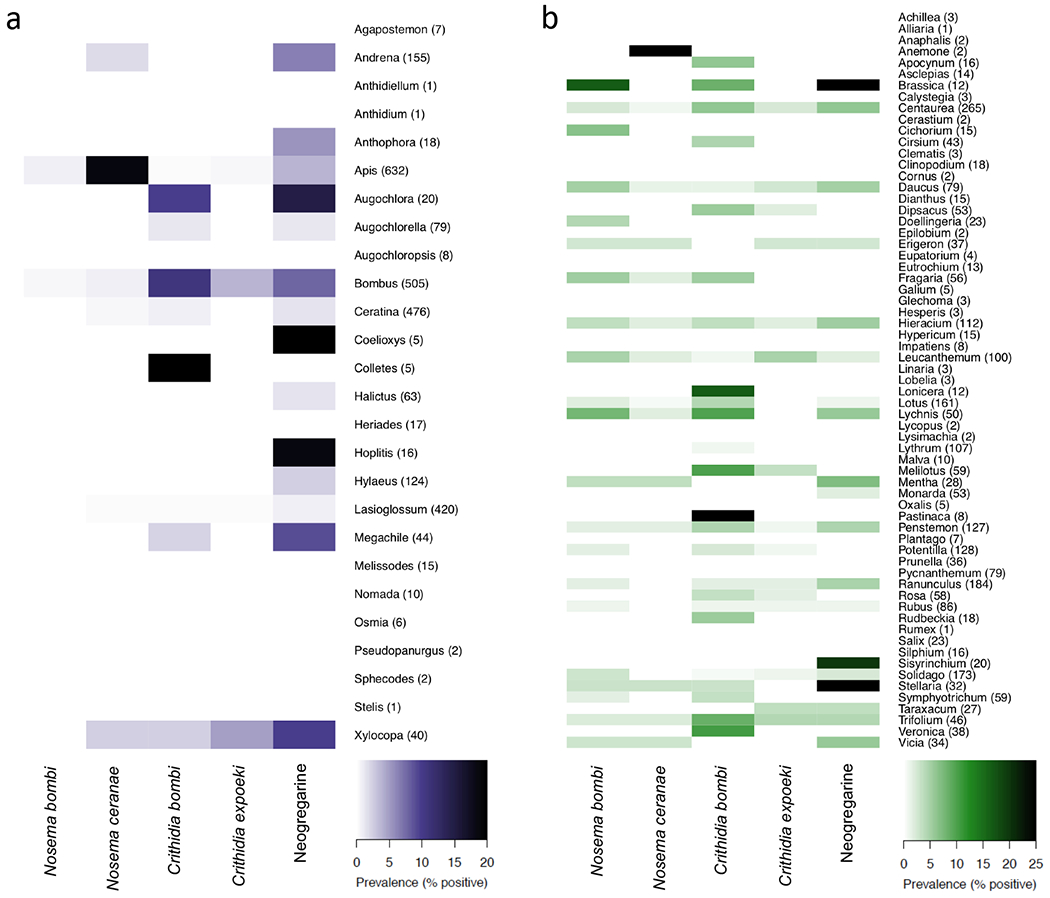
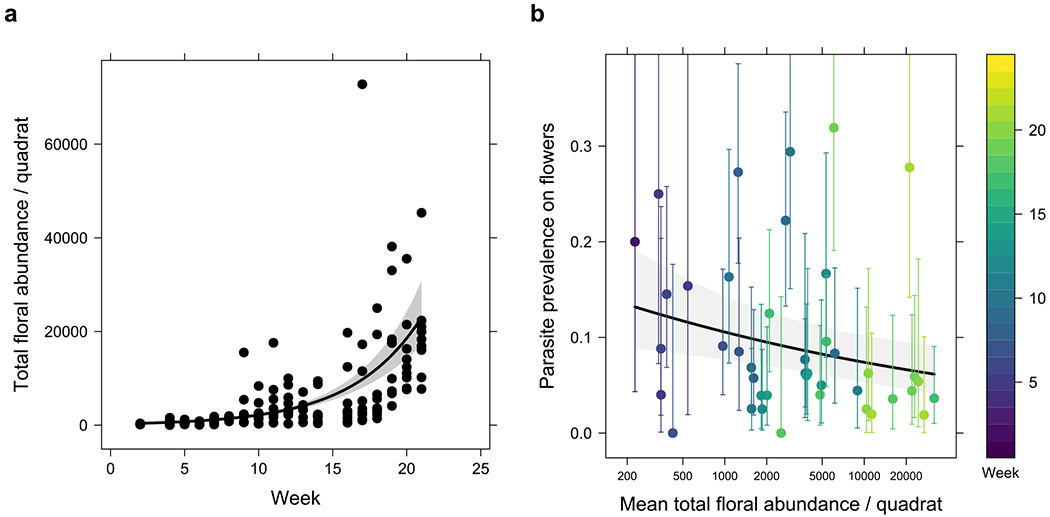
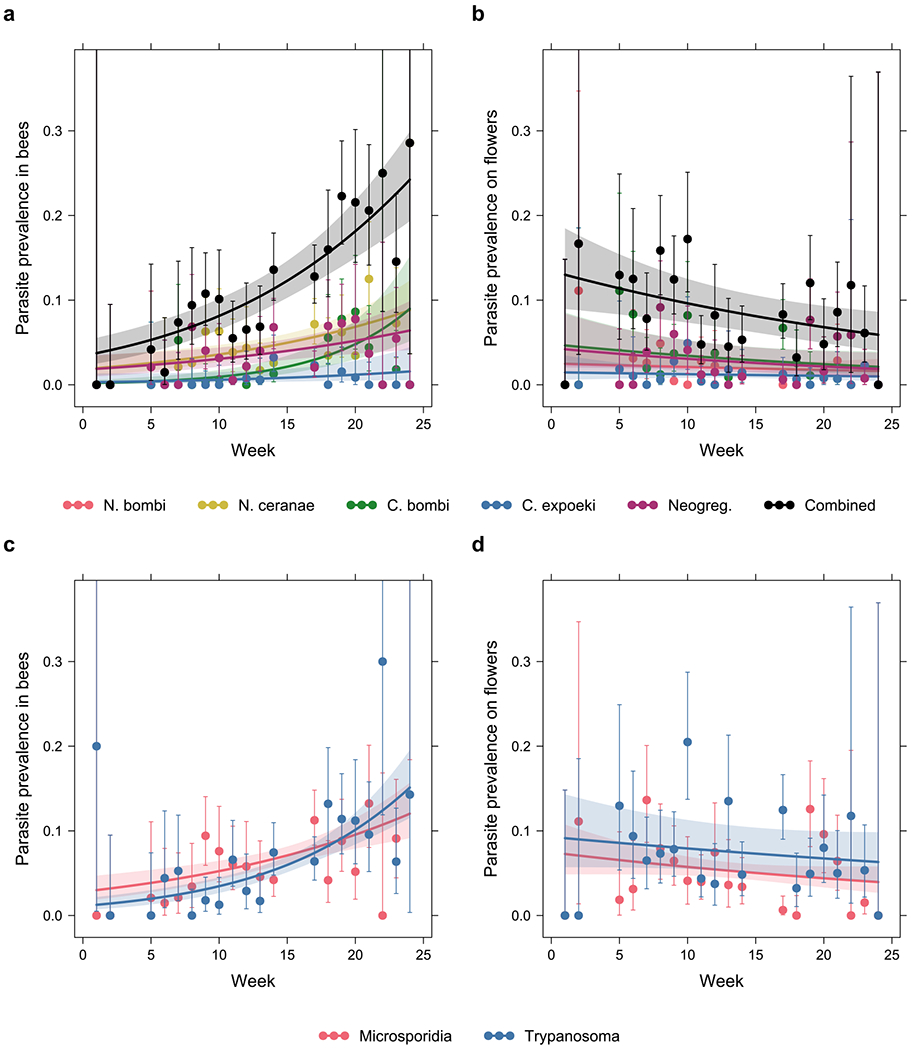
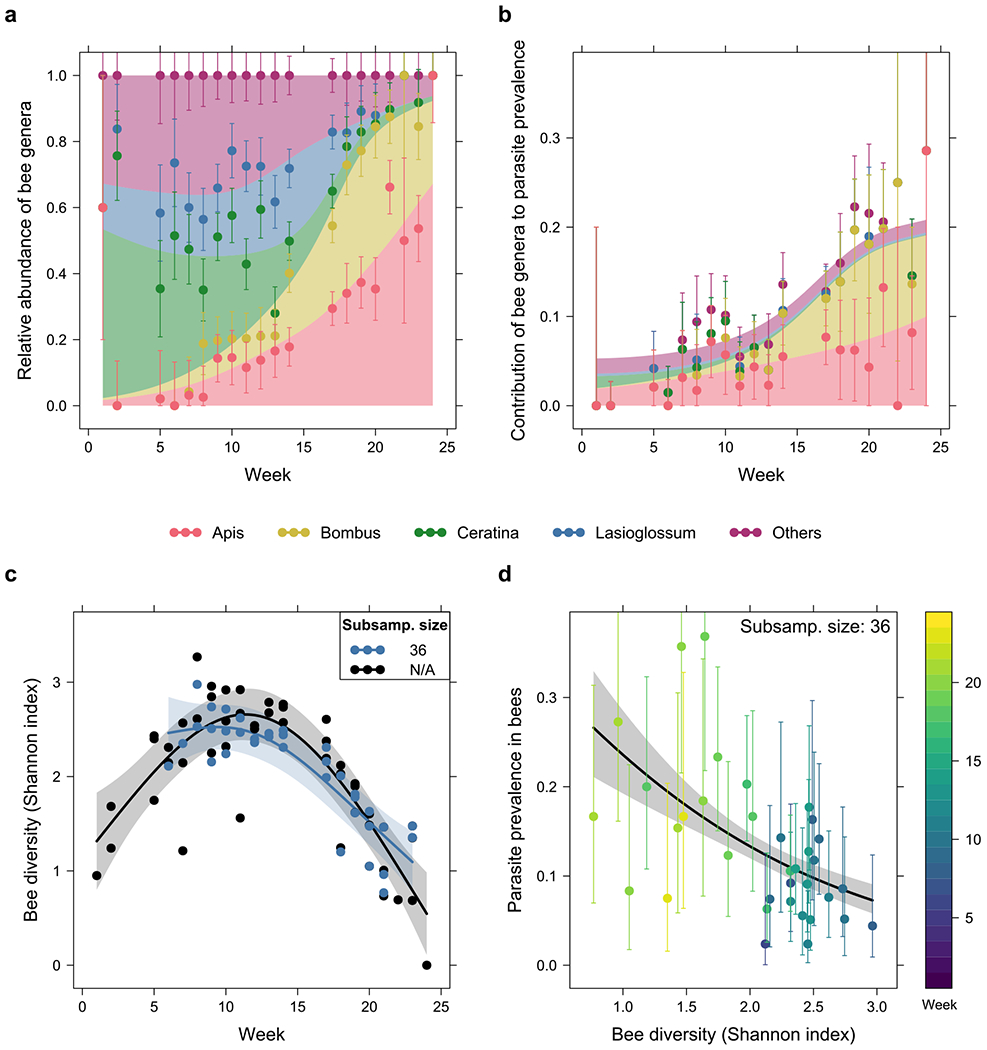
Pollinator reductions can leave communities less diverse and potentially at increased risk of infectious diseases. Species-rich plant and bee communities have high species turnover, making the study of disease dynamics challenging. To address how temporal dynamics shape parasite prevalence in plant and bee communities, we screened >5,000 bees and flowers over an entire growing season for five common bee microparasites (Nosema ceranae, Nosema bombi, Crithidia bombi, Crithidia expoeki and neogregarines). Over 110 bee species and 89 flower species were screened, revealing that 42% of bee species (12.2% individual bees) and 70% of flower species (8.7% individual flowers) had at least one parasite in or on them, respectively. Some common flowers (for example, Lychnis flos-cuculi) harboured multiple parasite species whilst others (for example, Lythrum salicaria) had few. Significant temporal variation of parasite prevalence in bees was linked to bee diversity, bee and flower abundance and community composition. Specifically, we found that bee communities had the highest prevalence late in the season, when social bees (Bombus spp. and Apis mellifera) were dominant and bee diversity was lowest. Conversely, prevalence on flowers was lowest late in the season when floral abundance was highest. Thus turnover in the bee community impacted community-wide prevalence, and turnover in the plant community impacted when parasite transmission was likely to occur at flowers. These results imply that efforts to improve bee health will benefit from the promotion of high floral numbers to reduce transmission risk, maintaining bee diversity to dilute parasites and monitoring the abundance of dominant competent hosts.
传粉媒介减少会使群落的物种多样性降低,并且使群落更容易感染传染病。物种丰富的植物和蜜蜂群落具有较高的物种周转率,这使得疾病动态的研究具有挑战性。为了研究时间动态如何影响植物和蜜蜂群落中寄生虫的流行率,我们在整个生长季节中对超过 5000 只蜜蜂和花朵进行了筛选,以检测五种常见的蜜蜂微寄生虫(N. ceranae、N. bombi、C. bombi、C. expoeki 和新孢子虫)。共筛选了 110 多种蜜蜂和 89 种花卉,结果表明,42%的蜜蜂物种(12.2%的个体蜜蜂)和 70%的花卉物种(8.7%的个体花卉)分别携带至少一种寄生虫。一些常见的花(例如,繁缕)携带多种寄生虫,而另一些花(例如,千屈菜)携带的寄生虫较少。蜜蜂寄生虫流行率的显著时间变化与蜜蜂多样性、蜜蜂和花卉丰度以及群落组成有关。具体来说,我们发现蜜蜂群落的寄生虫流行率在季节后期最高,此时社会性蜜蜂(熊蜂属和西方蜜蜂)占优势,蜜蜂多样性最低。相反,当花卉丰度最高时,花卉上的寄生虫流行率在季节后期最低。因此,蜜蜂群落的周转率会影响整个群落的流行率,而植物群落的周转率会影响在花卉上发生寄生虫传播的时间。这些结果表明,为了改善蜜蜂的健康状况,需要促进花卉数量的增加以降低传播风险,保持蜜蜂多样性以稀释寄生虫,并监测优势宿主的丰度。