Genome Data Science, Institute for Research in Biomedicine (IRB Barcelona), The Barcelona Institute for Science and Technology, Baldiri Reixac 10, Barcelona 08028, Spain.
Catalan Institution for Research and Advanced Studies (ICREA), Pg Lluís Companys, 23, Barcelona 08010, Spain.
Clin Sci (Lond). 2022 Mar 18;136(5):383-404. doi: 10.1042/CS20210682.
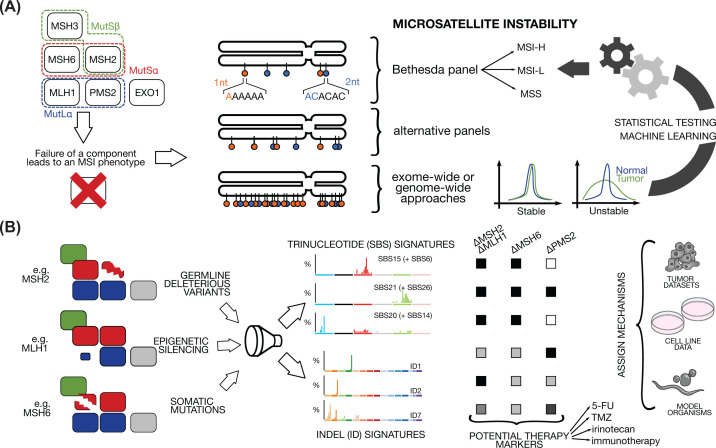
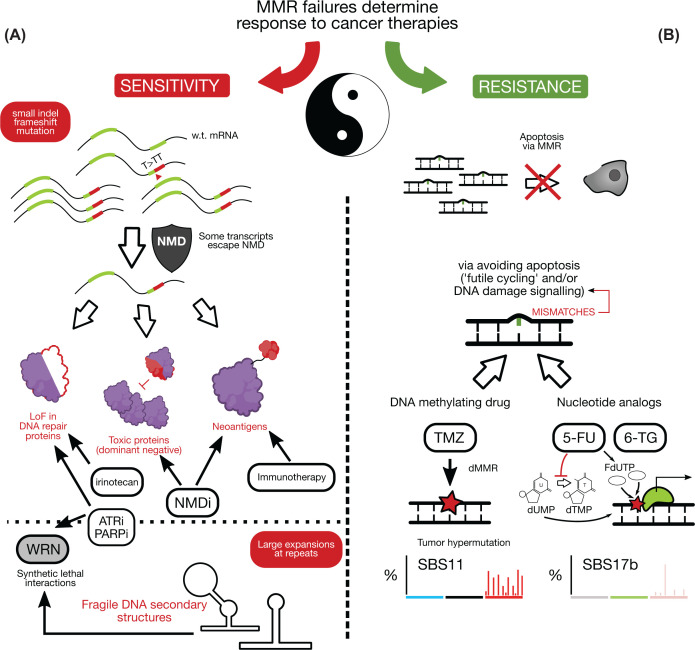
Genome sequencing can be used to detect DNA repair failures in tumors and learn about underlying mechanisms. Here, we synthesize findings from genomic studies that examined deficiencies of the DNA mismatch repair (MMR) pathway. The impairment of MMR results in genome-wide hypermutation and in the 'microsatellite instability' (MSI) phenotype-occurrence of indel mutations at short tandem repeat (microsatellite) loci. The MSI status of tumors was traditionally assessed by molecular testing of a selected set of MS loci or by measuring MMR protein expression levels. Today, genomic data can provide a more complete picture of the consequences on genomic instability. Multiple computational studies examined somatic mutation distributions that result from failed DNA repair pathways in tumors. These include analyzing the commonly studied trinucleotide mutational spectra of single-nucleotide variants (SNVs), as well as of other features such as indels, structural variants, mutation clusters and regional mutation rate redistribution. The identified mutation patterns can be used to rigorously measure prevalence of MMR failures across cancer types, and potentially to subcategorize the MMR deficiencies. Diverse data sources, genomic and pre-genomic, from human and from experimental models, suggest there are different ways in which MMR can fail, and/or that the cell-type or genetic background may result in different types of MMR mutational patterns. The spectrum of MMR failures may direct cancer evolution, generating particular sets of driver mutations. Moreover, MMR affects outcomes of therapy by DNA damaging drugs, antimetabolites, nonsense-mediated mRNA decay (NMD) inhibitors, and immunotherapy by promoting either resistance or sensitivity, depending on the type of therapy.
基因组测序可用于检测肿瘤中的 DNA 修复失败,并了解潜在的机制。在这里,我们综合了基因组研究中检查 DNA 错配修复 (MMR) 途径缺陷的研究结果。MMR 的损伤导致全基因组的超突变,并出现“微卫星不稳定性”(MSI)表型-短串联重复(微卫星)位点的插入缺失突变的发生。肿瘤的 MSI 状态传统上通过对选定的 MS 位点的分子测试或通过测量 MMR 蛋白表达水平来评估。如今,基因组数据可以更全面地了解基因组不稳定性的后果。多项计算研究分析了肿瘤中失败的 DNA 修复途径导致的体细胞突变分布。这些研究包括分析单核苷酸变体 (SNV) 的通常研究的三核苷酸突变谱,以及其他特征,如插入缺失、结构变体、突变簇和区域突变率重新分布。鉴定的突变模式可用于严格测量各种癌症类型中 MMR 失败的流行率,并可能对 MMR 缺陷进行细分。来自人类和实验模型的不同基因组和预基因组数据源表明,MMR 可能有不同的失败方式,或者细胞类型或遗传背景可能导致不同类型的 MMR 突变模式。MMR 失败的范围可能会指导癌症的进化,产生特定的驱动突变集。此外,MMR 通过促进耐药性或敏感性,影响 DNA 损伤药物、抗代谢物、无义介导的 mRNA 降解 (NMD) 抑制剂和免疫疗法的治疗效果,具体取决于治疗类型。