Institute for Clinical Diabetology, German Diabetes Center, Leibniz Center for Diabetes Research at Heinrich Heine University Düsseldorf, Düsseldorf, Germany.
Department of Endocrinology and Diabetology, Medical Faculty and University Hospital Düsseldorf, Heinrich Heine University Düsseldorf, Düsseldorf, Germany.
Diabetologia. 2022 Jun;65(6):1048-1057. doi: 10.1007/s00125-022-05674-w. Epub 2022 Mar 11.
AIMS/HYPOTHESIS: It remains unclear whether and which modality of exercise training as a component of lifestyle intervention may exert favourable effects on somatosensory and autonomic nerve tests in people with type 2 diabetes.
Cardiovascular autonomic and somatosensory nerve function as well as intraepidermal nerve fibre density (IENFD) were assessed in overweight men with type 2 diabetes (type 2 diabetes, n = 20) and male glucose-tolerant individuals (normal glucose tolerance [NGT], n = 23), comparable in age and BMI and serving as a control group, before and after a supervised high-intensity interval training (HIIT) intervention programme over 12 weeks. Study endpoints included clinical scores, nerve conduction studies, quantitative sensory testing, IENFD, heart rate variability, postural change in systolic blood pressure and spontaneous baroreflex sensitivity (BRS).
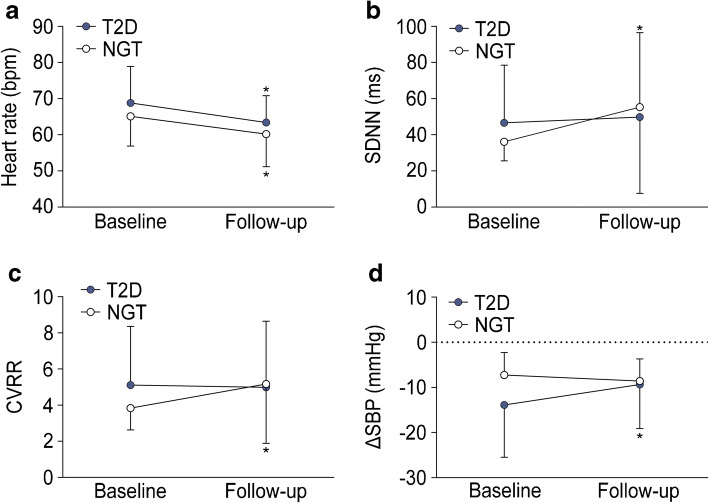
After 12 weeks of HIIT, resting heart rate decreased in both groups ([mean ± SD] baseline/12 weeks: NGT: 65.1 ± 8.2/60.2 ± 9.0 beats per min; type 2 diabetes: 68.8 ± 10.1/63.4 ± 7.8 beats per min), while three BRS indices increased (sequence analysis BRS: 8.82 ± 4.89/14.6 ± 11.7 ms/mmHg; positive sequences BRS: 7.19 ± 5.43/15.4 ± 15.9 ms/mmHg; negative sequences BRS: 12.8 ± 5.4/14.6 ± 8.7 ms/mmHg) and postural change in systolic blood pressure decreased (-13.9 ± 11.6/-9.35 ± 9.76 mmHg) in participants with type 2 diabetes, and two heart rate variability indices increased in the NGT group (standard deviation of R-R intervals: 36.1 ± 11.8/55.3 ± 41.3 ms; coefficient of R-R interval variation: 3.84 ± 1.21/5.17 ± 3.28) (all p<0.05). In contrast, BMI, clinical scores, nerve conduction studies, quantitative sensory testing, IENFD and the prevalence rates of diabetic sensorimotor polyneuropathy and cardiovascular autonomic neuropathy remained unchanged in both groups. In the entire cohort, correlations between the changes in two BRS indices and changes in [Formula: see text] over 12 weeks of HIIT (e.g. sequence analysis BRS: r = 0.528, p=0.017) were observed.
CONCLUSIONS/INTERPRETATION: In male overweight individuals with type 2 diabetes, BRS, resting heart rate and orthostatic blood pressure regulation improved in the absence of weight loss after 12 weeks of supervised HIIT. Since no favourable effects on somatic nerve function and structure were observed, cardiovascular autonomic function appears to be more amenable to this short-term intervention, possibly due to improved cardiorespiratory fitness.
目的/假设:目前尚不清楚作为生活方式干预组成部分的哪种运动训练模式是否会对 2 型糖尿病患者的躯体感觉和自主神经测试产生有利影响。
评估超重 2 型糖尿病患者(2 型糖尿病组,n=20)和男性糖耐量正常个体(糖耐量正常组,n=23)的心血管自主神经和躯体感觉神经功能以及表皮内神经纤维密度(IENFD),这些个体在年龄和 BMI 方面相匹配,并作为对照组,在经过 12 周的监督高强度间歇训练(HIIT)干预方案前后进行评估。研究终点包括临床评分、神经传导研究、定量感觉测试、IENFD、心率变异性、体位性收缩压变化和自发性血压反射敏感性(BRS)。
经过 12 周的 HIIT 后,两组的静息心率均下降([平均值±标准差] 基线/12 周:糖耐量正常组:65.1±8.2/60.2±9.0 次/分钟;2 型糖尿病组:68.8±10.1/63.4±7.8 次/分钟),而三个 BRS 指数增加(序列分析 BRS:8.82±4.89/14.6±11.7 ms/mmHg;阳性序列 BRS:7.19±5.43/15.4±15.9 ms/mmHg;阴性序列 BRS:12.8±5.4/14.6±8.7 ms/mmHg),2 型糖尿病患者的体位性收缩压变化下降(-13.9±11.6/-9.35±9.76 mmHg),而糖耐量正常组的两个心率变异性指数增加(RR 间期标准差:36.1±11.8/55.3±41.3 ms;RR 间期变异系数:3.84±1.21/5.17±3.28)(均 p<0.05)。相比之下,两组的 BMI、临床评分、神经传导研究、定量感觉测试、IENFD 和糖尿病感觉运动性多发性神经病和心血管自主神经病变的患病率均无变化。在整个队列中,HIIT 12 周期间两个 BRS 指数的变化与 [Formula: see text] 的变化之间存在相关性(例如,序列分析 BRS:r=0.528,p=0.017)。
结论/解释:在超重的 2 型糖尿病男性中,经过 12 周的监督 HIIT 后,BRS、静息心率和直立位血压调节得到改善,而体重无减轻。由于没有观察到对躯体神经功能和结构的有利影响,因此心血管自主功能似乎更容易受到这种短期干预的影响,这可能是由于心肺功能得到了改善。