Habets Denise H J, Pelzner Kim, Wieten Lotte, Spaanderman Marc E A, Villamor Eduardo, Al-Nasiry Salwan
Department of Obstetrics and Gynecology, Maastricht University Medical Centre (MUMC+), Maastricht, The Netherlands.
Department of Transplantation Immunology, Maastricht University Medical Centre (MUMC+), Maastricht, The Netherlands.
Allergy Asthma Clin Immunol. 2022 Mar 11;18(1):23. doi: 10.1186/s13223-022-00660-8.
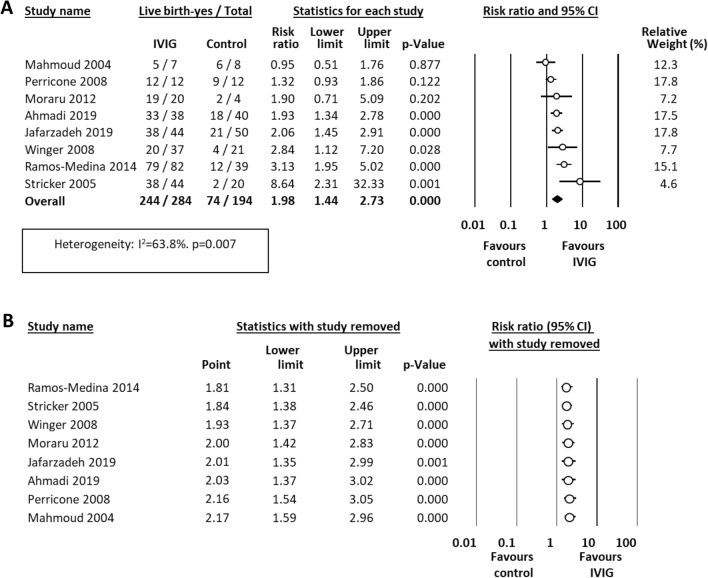
Intravenous immunoglobulin (IVIG) is increasingly used as a treatment for recurrent pregnancy loss (RPL) despite lack of clear evidence on efficacy. Recent data suggest IVIG might be more effective in a subgroup of women with an aberrant immunological profile. Therefore, a systematic review and meta-analysis of studies on the effectiveness of IVIG treatment on pregnancy outcome among women with RPL and underlying immunological conditions (e.g., elevated NK cell percentage, elevated Th1/Th2 ratio, diagnosis with autoimmune disorders) was conducted. Eight non-randomized controlled trials, including 478 women (intervention: 284; control: 194), met eligibility criteria. Meta-analysis showed that treatment with IVIG was associated with a two-fold increase in live birth rate (RR 1.98, 95% CI 1.44-2.73, P < 0.0001). The effect of IVIG was particularly marked in the subgroup of studies including patients based on presence of elevated (> 12%) NK-cell percentage (RR 2.32, 95% CI 1.77-3.02, P < 0.0001) and when starting intervention prior to or during cycle of conception (RR 4.47, 95% CI 1.53-13.05, P = 0.006). In conclusion, treatment with IVIG may improve live birth rate in women with RPL and underlying immune conditions. However, these results should be interpreted with caution as studies are limited by low number of participants and the non-randomized design, which represent seriously biases. Future randomized controlled trials in women with RPL and underlying immune conditions are needed before using IVIG in a clinical setting.
尽管缺乏关于疗效的确切证据,但静脉注射免疫球蛋白(IVIG)越来越多地被用作复发性流产(RPL)的治疗方法。最近的数据表明,IVIG可能对免疫谱异常的女性亚组更有效。因此,我们对IVIG治疗对患有RPL和潜在免疫疾病(例如,NK细胞百分比升高、Th1/Th2比率升高、自身免疫性疾病诊断)的女性妊娠结局有效性的研究进行了系统评价和荟萃分析。八项非随机对照试验符合纳入标准,共纳入478名女性(干预组:284名;对照组:194名)。荟萃分析表明,IVIG治疗使活产率提高了两倍(风险比1.98,95%置信区间1.44 - 2.73,P < 0.0001)。在包括NK细胞百分比升高(> 12%)患者的研究亚组中,IVIG的效果尤为显著(风险比2.32,95%置信区间1.77 - 3.02,P < 0.0001),以及在受孕周期之前或期间开始干预时(风险比4.47,95%置信区间1.53 - 13.05,P = 0.006)。总之,IVIG治疗可能会提高患有RPL和潜在免疫疾病女性的活产率。然而,这些结果应谨慎解释,因为研究受参与者数量少和非随机设计的限制,存在严重偏差。在临床环境中使用IVIG之前,需要对患有RPL和潜在免疫疾病的女性进行未来的随机对照试验。