Department of Neuroscience, University of Minnesota, Minneapolis, MN 55455.
Neuroscience Program, Bucknell University, Lewisburg, PA 17837.
eNeuro. 2022 Mar 28;9(2). doi: 10.1523/ENEURO.0476-21.2022. Print 2022 Mar-Apr.
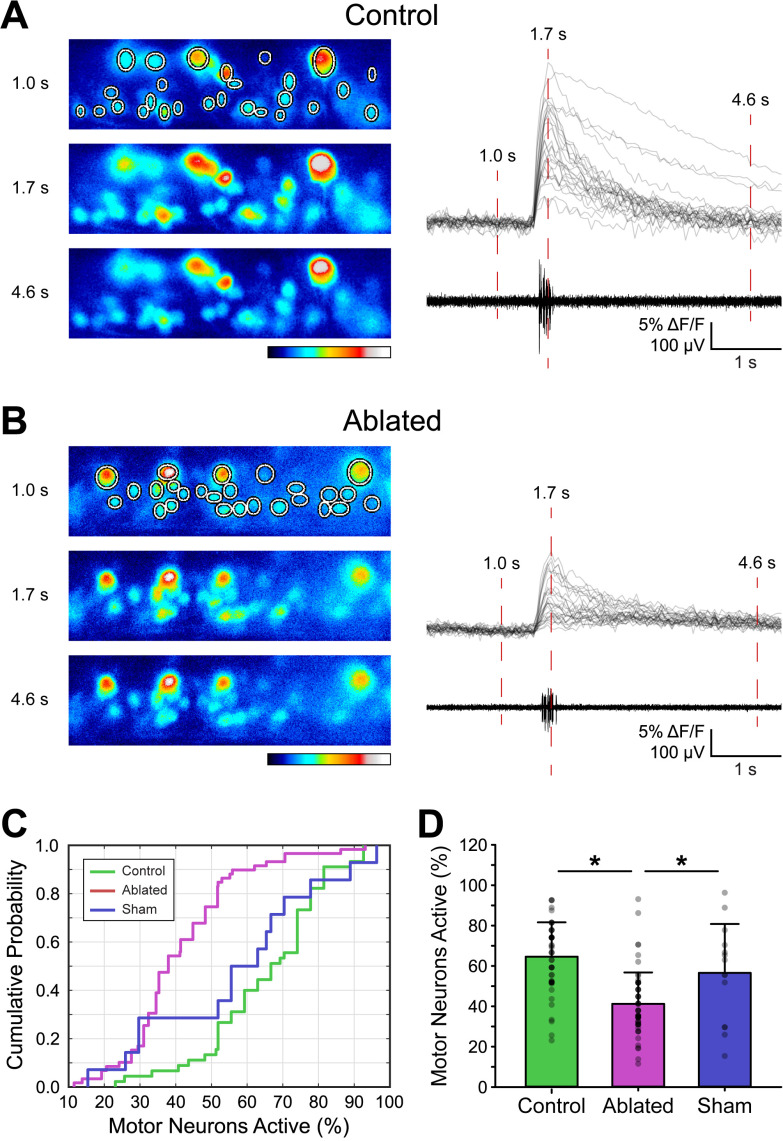
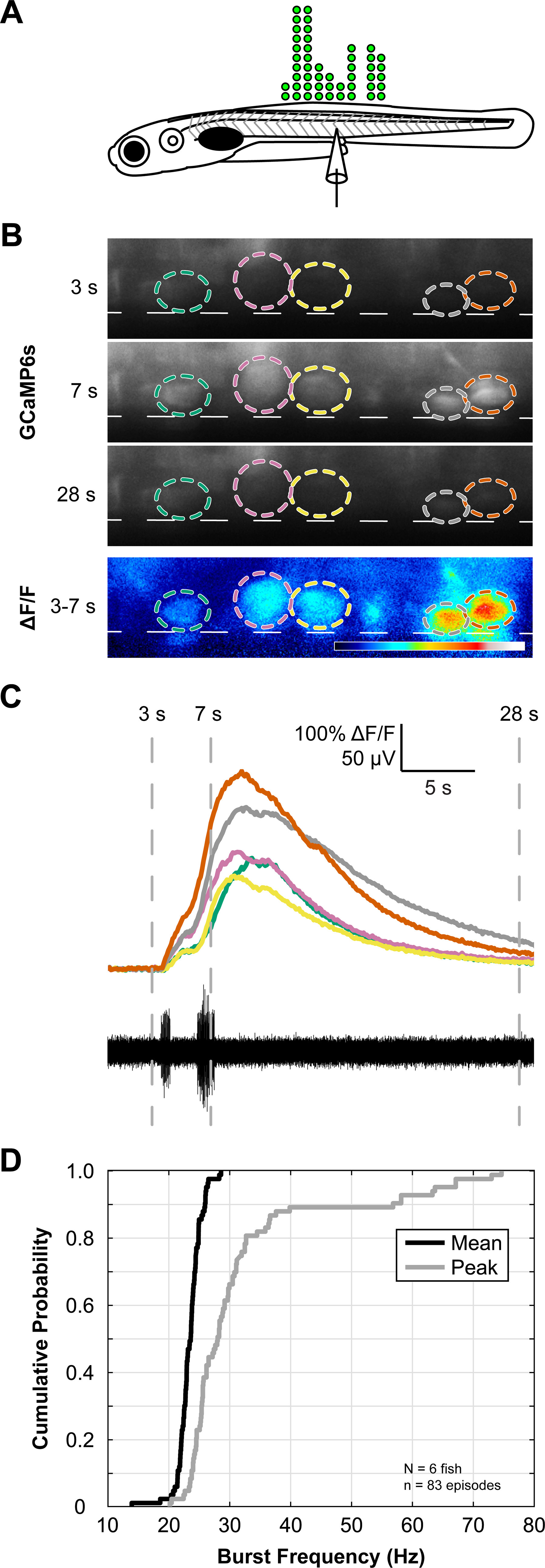
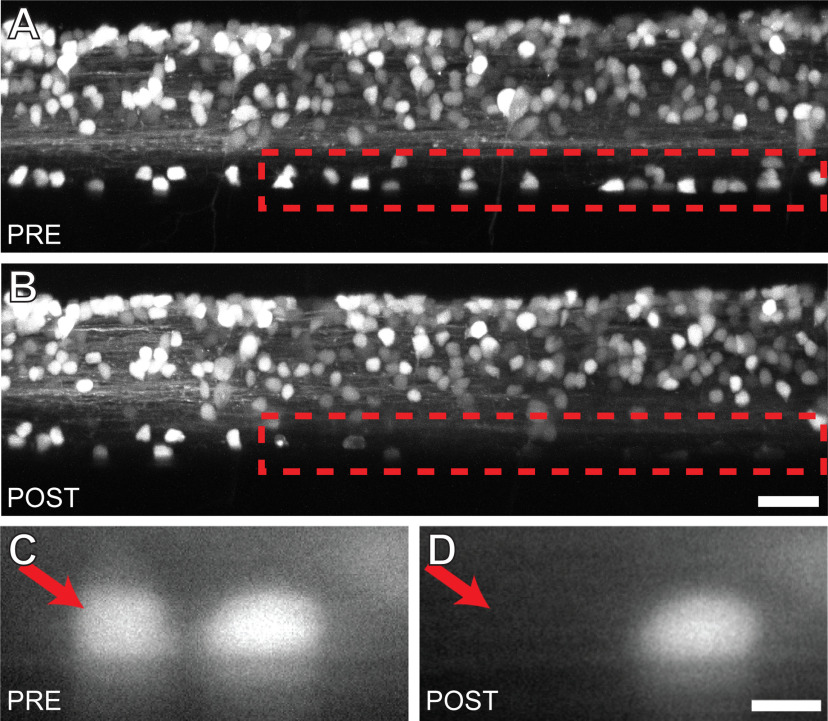
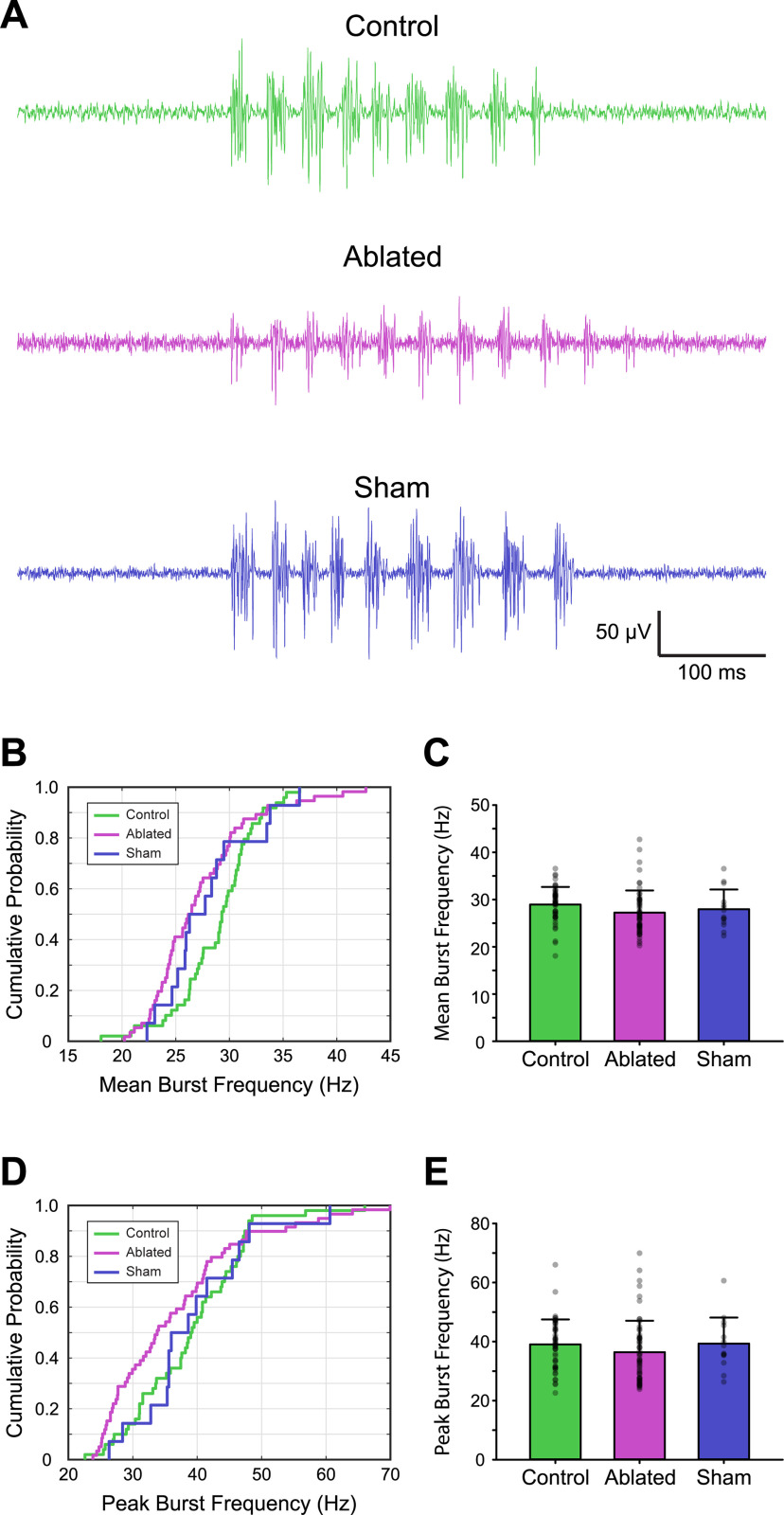
Survival for vertebrate animals is dependent on the ability to successfully find food, locate a mate, and avoid predation. Each of these behaviors requires motor control, which is set by a combination of kinematic properties. For example, the frequency and amplitude of motor output combine in a multiplicative manner to determine features of locomotion such as distance traveled, speed, force (thrust), and vigor. Although there is a good understanding of how different populations of excitatory spinal interneurons establish locomotor frequency, there is a less thorough mechanistic understanding for how locomotor amplitude is established. Recent evidence indicates that locomotor amplitude is regulated in part by a subset of functionally and morphologically distinct V2a excitatory spinal interneurons (Type II, nonbursting) in larval and adult zebrafish. Here, we provide direct evidence that most V3 interneurons (V3-INs), which are a developmentally and genetically defined population of ventromedial glutamatergic spinal neurons, are active during fictive swimming. We also show that elimination of the spinal V3-IN population reduces the proportion of active motor neurons (MNs) during fictive swimming but does not alter the range of locomotor frequencies produced. These data are consistent with V3-INs providing excitatory drive to spinal MNs during swimming in larval zebrafish and may contribute to the production of locomotor amplitude independently of locomotor frequency.
脊椎动物的生存依赖于成功觅食、寻找配偶和避免捕食的能力。这些行为中的每一种都需要运动控制,而运动控制是由运动学特性的组合来设定的。例如,运动输出的频率和幅度以乘法方式组合,以确定运动的特征,如行进距离、速度、力(推力)和活力。尽管人们对不同群体的兴奋性脊髓中间神经元如何建立运动频率有了很好的理解,但对于如何建立运动幅度的机制理解还不够透彻。最近的证据表明,运动幅度的调节部分是由幼虫和成年斑马鱼中功能和形态上不同的一组 V2a 兴奋性脊髓中间神经元(II 型,非爆发性)调节的。在这里,我们提供了直接证据,表明大多数 V3 中间神经元(V3-INs),它们是腹侧谷氨酸能脊髓神经元的一个发育和遗传定义群体,在虚构游泳期间是活跃的。我们还表明,消除脊髓 V3-IN 群体减少了虚构游泳期间活跃运动神经元(MNs)的比例,但不改变产生的运动频率范围。这些数据与 V3-INs 在幼体斑马鱼游泳期间向脊髓 MNs 提供兴奋性驱动一致,并且可能独立于运动频率对运动幅度的产生做出贡献。