Institute of Immunity and Transplantation, University College London Division of Infection and Immunity, Royal Free Campus, London, UK.
Nat Rev Immunol. 2022 Sep;22(9):567-575. doi: 10.1038/s41577-022-00693-5. Epub 2022 Mar 11.
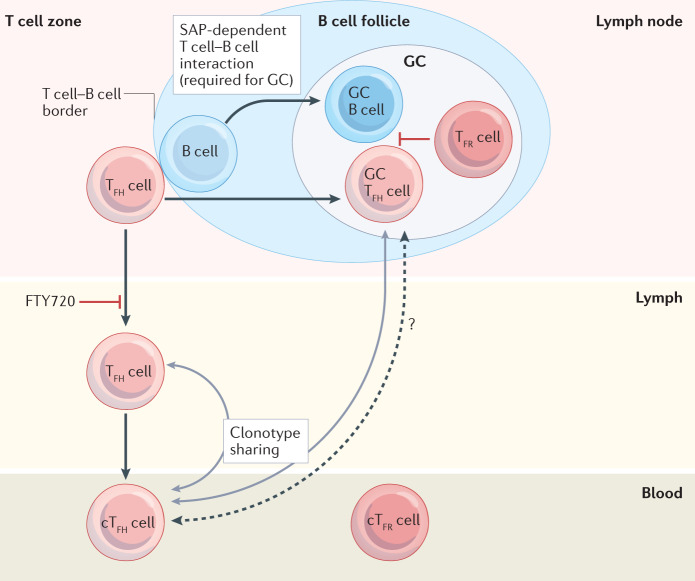
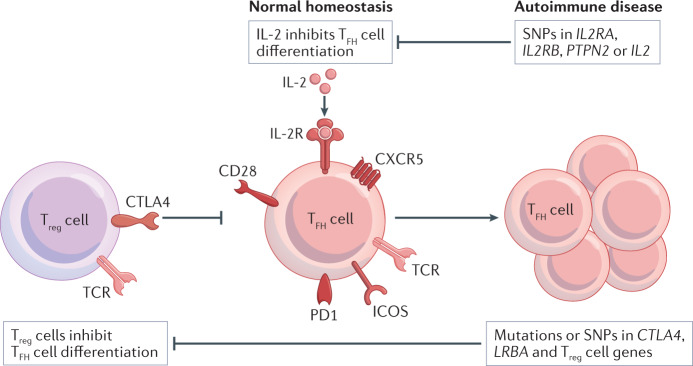
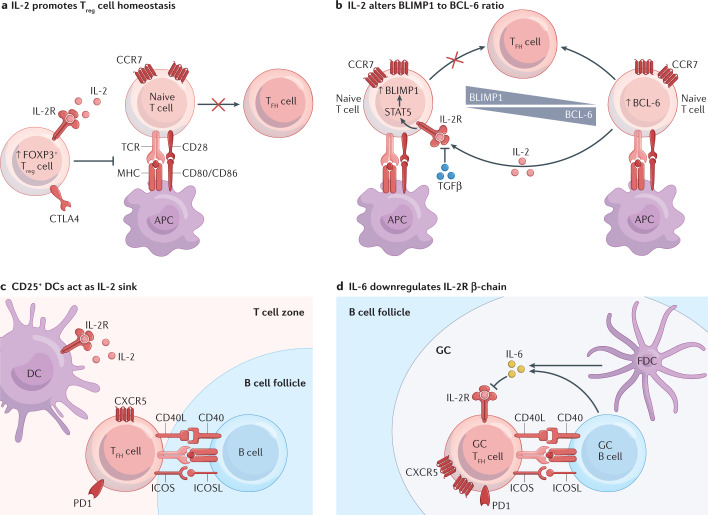
Follicular helper T (T) cells provide help to B cells, supporting the formation of germinal centres that allow affinity maturation of antibody responses. Although usually located in secondary lymphoid organs, T cells bearing features of T cells can also be identified in human blood, and their frequency and phenotype are often altered in people with autoimmune diseases. In this Perspective article, I discuss the increase in circulating T cells seen in autoimmune settings and explore potential explanations for this phenomenon. I consider the multistep regulation of T cell differentiation by the CTLA4 and IL-2 pathways as well as by regulatory T cells and highlight that these same pathways are crucial for regulating autoimmune diseases. The propensity of infection to serve as a cue for T cell differentiation and a potential trigger for autoimmune disease development is also discussed. Overall, I postulate that alterations in pathways that regulate autoimmunity are coupled to alterations in T cell homeostasis, suggesting that this population may serve as a core sentinel of dysregulated immunity.
滤泡辅助 T(Tfh)细胞为 B 细胞提供辅助,支持生发中心的形成,从而允许抗体反应的亲和力成熟。尽管 Tfh 细胞通常位于次级淋巴器官中,但在人类血液中也可以识别出具有 Tfh 细胞特征的 T 细胞,并且在自身免疫性疾病患者中,其频率和表型经常发生改变。在这篇观点文章中,我讨论了自身免疫环境中观察到的循环 T 细胞增加,并探讨了这种现象的潜在解释。我考虑了 CTLA4 和 IL-2 途径以及调节性 T 细胞对 T 细胞分化的多步骤调节,并强调这些相同的途径对于调节自身免疫性疾病至关重要。还讨论了感染作为 T 细胞分化的提示以及自身免疫性疾病发展的潜在触发因素的倾向。总体而言,我假设调节自身免疫的途径的改变与 T 细胞动态平衡的改变相关,这表明该群体可能作为失调免疫的核心哨兵。