Department of Chemical and Biomolecular Engineering, National University of Singapore, 4 Engineering Drive 4, Singapore, 117585, Singapore.
The Eighth Affiliated Hospital, Sun Yat-Sen University, 3025 Shennan Middle Road, Shenzhen, 518033, China.
Adv Sci (Weinh). 2022 May;9(14):e2105807. doi: 10.1002/advs.202105807. Epub 2022 Mar 11.
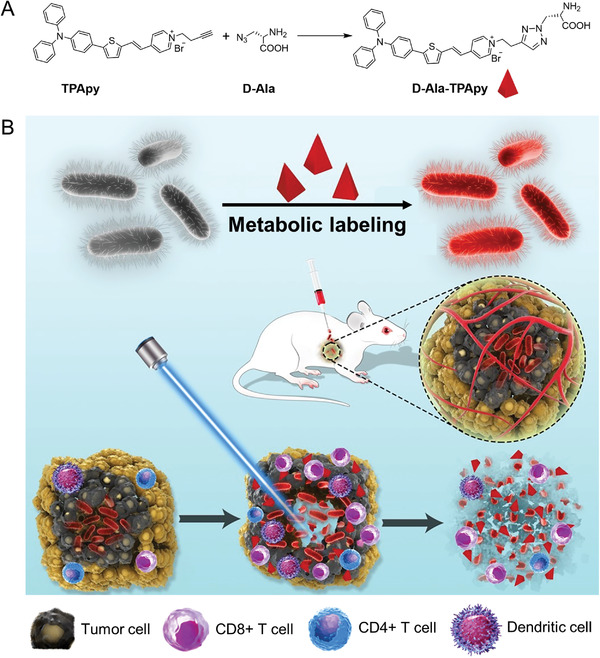
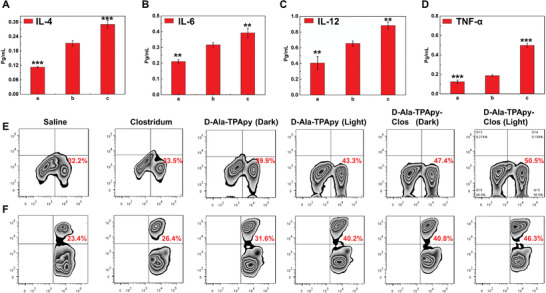
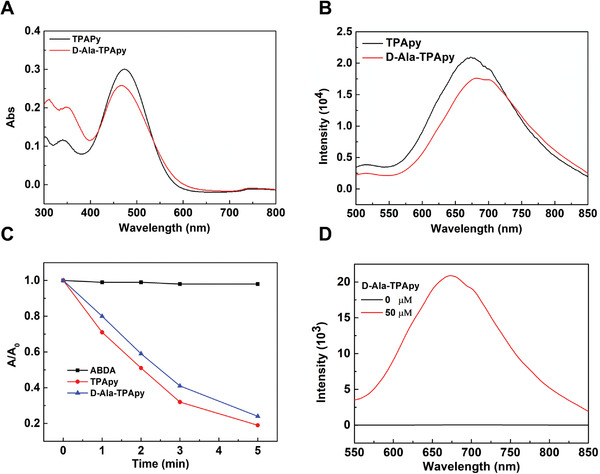
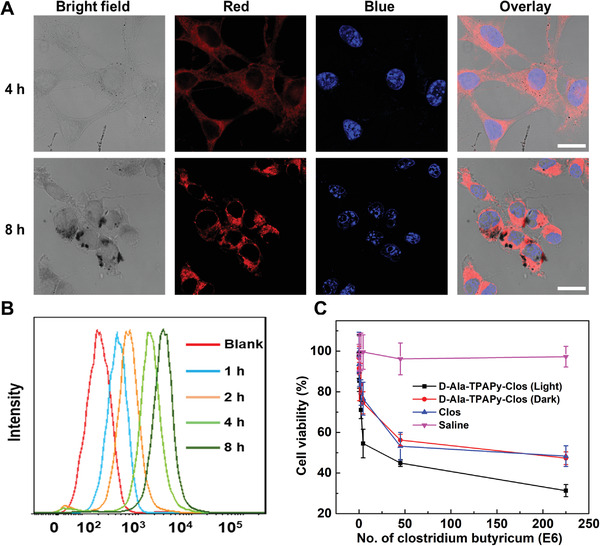
Due to the complexity, aggressiveness, and heterogeneity of malignant melanoma, it is difficult to eradicate the whole tumor through conventional treatment. Herein, a strategy of metabolic engineering labeled anaerobic oncolytic bacteria (Clostridium butyricum) is demonstrated to achieve the ablation of melanoma. In this system, the metabolic substrate of C. butyricum d-alanine (d-Ala) is first conjugated with a photosensitizer (TPApy) showing aggregation-induced emission (AIE). The yielded metabolic substrate of d-Ala-TPAPy can be metabolically incorporated into bacterial peptidoglycan to form engineered C. Butyricum. Once the engineered C. butyricum is injected into melanoma, the bacteria can only proliferate in an anaerobic zone, stimulate the tumor immune microenvironment, and ablate the tumor hypoxia region. Following that, the relatively rich oxygen content in the peripheral area can induce the death of C. butyricum. The photosensitizer (PS) on the bacteria can subsequently exert a photodynamic effect in the oxygen-rich region and further remove the melanoma residue under light irradiation. Prominent in vivo melanoma ablation results revealed that the engineering oncolytic bacteria can provide a promising regime for solid tumor eradication.
由于恶性黑色素瘤的复杂性、侵袭性和异质性,通过常规治疗很难彻底根除整个肿瘤。在此,我们展示了一种代谢工程标记的厌氧溶瘤菌(丁酸梭菌)策略,以实现黑色素瘤的消融。在该系统中,丁酸梭菌的代谢底物 D-丙氨酸(d-Ala)首先与表现出聚集诱导发射(AIE)的光敏剂(TPApy)缀合。生成的 d-Ala-TPAPy 代谢底物可以代谢掺入细菌肽聚糖中,形成工程化的丁酸梭菌。一旦将工程化的丁酸梭菌注入黑色素瘤中,细菌只能在厌氧区中增殖,刺激肿瘤免疫微环境并消融肿瘤缺氧区域。随后,周围区域相对丰富的氧气含量会导致丁酸梭菌死亡。细菌上的光敏剂(PS)随后可以在富含氧气的区域中发挥光动力作用,并在光照下进一步去除黑色素瘤残留。突出的体内黑色素瘤消融结果表明,工程溶瘤菌可为实体瘤的根除提供一种有前景的治疗方案。