School of Public Health, Li Ka Shing Faculty of Medicine, The University of Hong Kong, Hong Kong Special Administrative Region, China.
Agriculture, Fisheries and Conservation Department, Government of the Hong Kong Special Administrative Region, Hong Kong Special Administrative Region, China.
Lancet. 2022 Mar 12;399(10329):1070-1078. doi: 10.1016/S0140-6736(22)00326-9.
Transmission of SARS-CoV-2 from humans to other mammals, including pet animals, has been reported. However, with the exception of farmed mink, there is no previous evidence that these infected animals can infect humans, resulting in sustained human-to-human transmission. Following a confirmed SARS-CoV-2 infection of a pet shop worker, animals in the shop and the warehouse supplying it were tested for evidence of SARS-CoV-2 infection.
In this case study, viral swabs and blood samples were collected from animals in a pet shop and its corresponding warehouse in Hong Kong. Nasal swab or saliva samples from human COVID-19 patients epidemiologically linked to the pet shop and from subsequent local cases confirmed to be infected by SARS-CoV-2 delta variant were collected. Oral swabs were tested by quantitative RT-PCR (RT-qPCR) for SARS-CoV-2 and blood samples were serologically tested by a surrogate virus neutralisation test and plaque reduction neutralisation test. The SARS-CoV-2 RT-qPCR positive samples were sequenced by next generation viral full genome sequencing using the ISeq sequencing platform (Illumina), and the viral genomes were phylogenetically analysed.
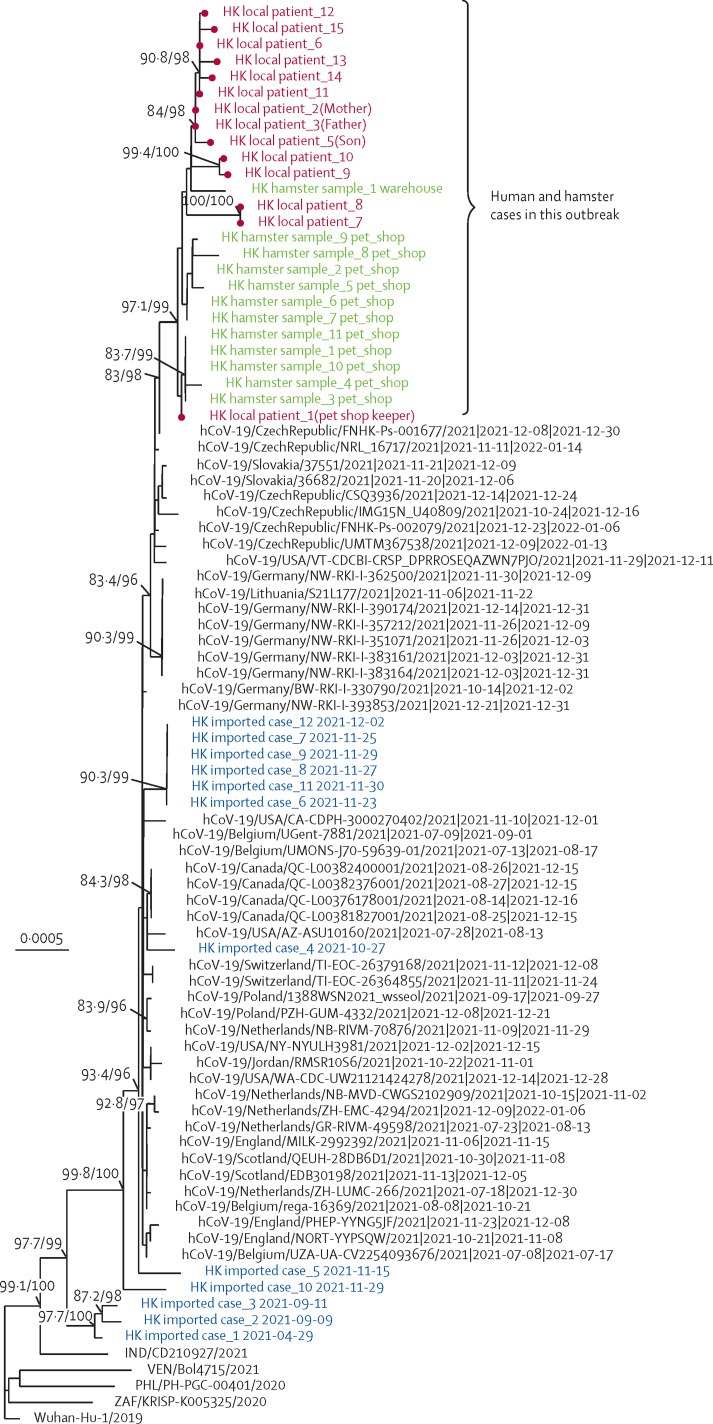
Eight (50%) of 16 individually tested Syrian hamsters in the pet shop and seven (58%) of 12 Syrian hamsters in the corresponding warehouse were positive for SARS-CoV-2 infection in RT-qPCR or serological tests. None of the dwarf hamsters (n=75), rabbits (n=246), guinea pigs (n=66), chinchillas (n=116), and mice (n=2) were confirmed positive for SARS-CoV-2 in RT-qPCR tests. SARS-CoV-2 viral genomes deduced from human and hamster cases in this incident all belong to the delta variant of concern (AY.127) that had not been circulating locally before this outbreak. The viral genomes obtained from hamsters were phylogenetically related with some sequence heterogeneity. Phylogenetic dating suggests infection in these hamsters occurred around Oct 14, 2021 (95% CI Sept 15 to Nov 9, 2021). Multiple zoonotic transmission events to humans were detected, leading to onward human-to-human transmission.
Pet hamsters can be naturally infected with SARS-CoV-2. The virus can circulate among hamsters and lead to human infections. Both genetic and epidemiological results strongly suggest that there was more than one hamster-to-human transmission event in this study. This incident also led to onward human transmission. Importation of SARS-CoV-2-infected hamsters was a likely source of this outbreak.
US National Institutes of Health, Research Grants Council of Hong Kong, Food and Health Bureau, and InnoHK.
已报告 SARS-CoV-2 从人类传播到其他哺乳动物,包括宠物动物。然而,除了养殖水貂外,尚无先前证据表明这些受感染的动物可以感染人类,从而导致持续的人际传播。在一家宠物店的工作人员被确诊感染 SARS-CoV-2 后,对店内和为其提供货物的仓库中的动物进行了 SARS-CoV-2 感染检测。
在这项病例研究中,从香港一家宠物店及其对应的仓库中的动物采集了病毒拭子和血液样本。采集与宠物店有流行病学关联的 COVID-19 患者的鼻腔拭子或唾液样本,以及随后经实验室检测确诊为感染了 SARS-CoV-2 德尔塔变异株的本地病例的样本。使用定量 RT-PCR(RT-qPCR)对口腔拭子进行 SARS-CoV-2 检测,对血液样本进行替代病毒中和试验和蚀斑减少中和试验进行血清学检测。对 RT-qPCR 阳性样本进行下一代病毒全基因组测序,使用 ISeq 测序平台(Illumina),对病毒基因组进行系统进化分析。
在宠物店的 16 只单独检测的叙利亚仓鼠中,有 8 只(50%)的仓鼠在 RT-qPCR 或血清学检测中呈 SARS-CoV-2 感染阳性,在对应的仓库中,12 只叙利亚仓鼠中有 7 只(58%)呈 SARS-CoV-2 感染阳性。未在 RT-qPCR 检测中确认 75 只小型仓鼠、246 只兔子、66 只豚鼠、116 只龙猫和 2 只老鼠感染了 SARS-CoV-2。从此次事件中人和仓鼠病例中推断出的 SARS-CoV-2 病毒基因组均属于 delta 变异株(AY.127),在此次疫情爆发之前,该变异株并未在本地传播。从仓鼠中获得的病毒基因组与一些序列异质性相关。系统进化日期表明,这些仓鼠的感染发生在 2021 年 10 月 14 日左右(95%置信区间为 2021 年 9 月 15 日至 11 月 9 日)。检测到多起人传人事件,导致人际传播。
宠物仓鼠可能会自然感染 SARS-CoV-2。该病毒可以在仓鼠中传播并导致人类感染。遗传和流行病学结果均强烈表明,在本研究中有不止一次的仓鼠到人类的传播事件。这一事件也导致了人际传播。SARS-CoV-2 感染仓鼠的进口可能是此次疫情的源头。
美国国立卫生研究院、香港研究资助局、食物及卫生局和 InnoHK。