Shang Xiaobin, Zhao Gang, Liang Fei, Zhang Chen, Zhang Weihong, Liu Liang, Li Runmei, Duan Xiaofeng, Ma Zhao, Yue Jie, Chen Chuangui, Meng Bin, Ren Xiubao, Jiang Hongjing
Department of Minimally Invasive Esophageal Surgery, Key Laboratory of Cancer Prevention and Therapy, National Clinical Research Center for Cancer, Tianjin Medical University Cancer Institute and Hospital, Tianjin, China.
Department of Pathology, Key Laboratory of Cancer Prevention and Therapy, National Clinical Research Center for Cancer, Tianjin Medical University Cancer Institute and Hospital, Tianjin, China.
Ann Transl Med. 2022 Feb;10(4):229. doi: 10.21037/atm-22-513.
Esophageal squamous cell carcinoma (ESCC) is one of the most refractory malignant tumors. Esophageal cancer (EC) is a malignant tumor with a high incidence worldwide, and over 50% of EC cases occur in China. Under the National Comprehensive Cancer Network (NCCN) guidelines, concurrent chemoradiotherapy is the only standard neoadjuvant treatment for locally advanced ESCC. In the first-line treatment of advanced ESCC, the efficacy of immune checkpoint inhibitors (ICIs) combined with systemic chemotherapy is significantly better than that of chemotherapy alone. Paclitaxel and cisplatin (TP), as one of the neoadjuvant chemotherapy regimens for locally advanced ESCC, have been widely used in China in recent years. ICIs combined with TP as neoadjuvant therapy seems promising.
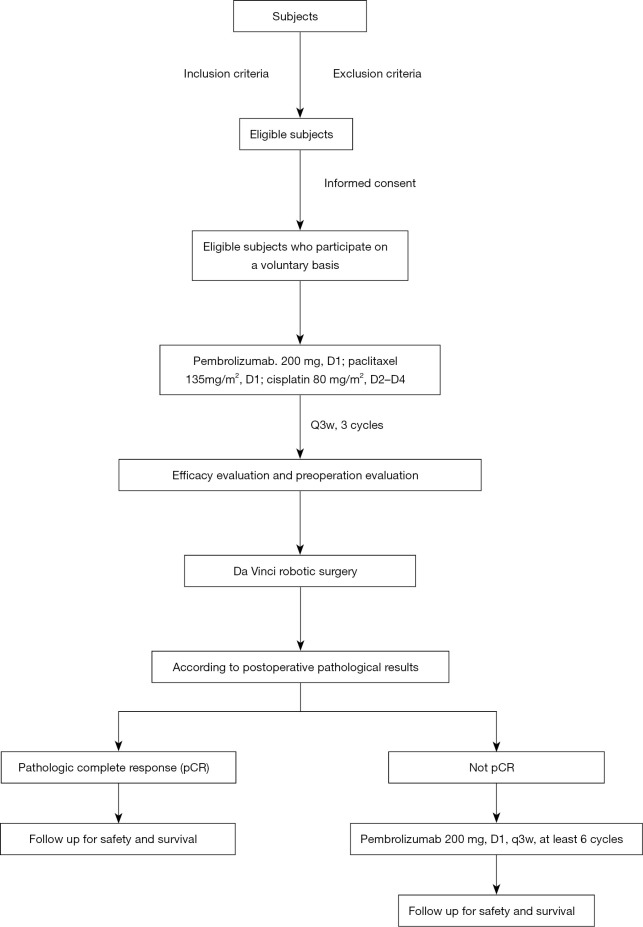
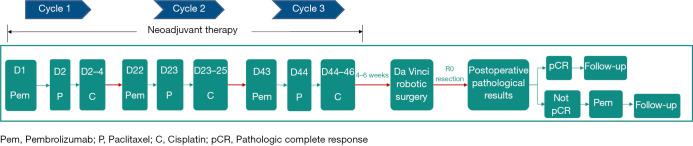
This is an open-label, single-arm, single-center, phase-II trial. Locally advanced resectable (stage III) ESCC patients who have not undergone previous systemic treatments will be enrolled in this study. All the subjects will intravenously receive 3 cycles of pembrolizumab (200 mg) on day 1, paclitaxel (135 mg/m) on day 2, and cisplatin (20 mg/m) on days 2-4, every 3 weeks. After an efficacy evaluation, the subjects will undergo Da Vinci robot-assisted radical resection. If the postoperative pathologic results do not reveal a complete response, pembrolizumab will be administrated for at least 6 cycles as an adjuvant therapy with the same usage as before. The primary endpoints are the major pathological response and safety. The secondary endpoints include the objective response rate (ORR), overall survival (OS), disease-free survival (DFS), the R0 resection rate, and perioperative complications. The exploratory endpoint is to examine the correlation between related biomarkers and tumor responses to this neoadjuvant treatment regimen.
This trial is the first enrolled study to evaluate the safety and efficacy of pembrolizumab combined with TP as neoadjuvant therapy for locally advanced ESCC. Currently, under the NCCN guidelines, neoadjuvant chemoradiotherapy (nCRT) is the only recommended treatment for locally advanced ESCC. This phase-II study will provide preliminary evidence of the efficacy of pembrolizumab combined with TP as novel neoadjuvant therapy for patients with locally advanced ESCC.
Clinicaltrials.gov (Identifier: NCT04389177).
食管鳞状细胞癌(ESCC)是最难治的恶性肿瘤之一。食管癌(EC)是一种在全球范围内发病率很高的恶性肿瘤,超过50%的EC病例发生在中国。根据美国国立综合癌症网络(NCCN)指南,同步放化疗是局部晚期ESCC唯一的标准新辅助治疗方法。在晚期ESCC的一线治疗中,免疫检查点抑制剂(ICIs)联合全身化疗的疗效明显优于单纯化疗。紫杉醇和顺铂(TP)作为局部晚期ESCC的新辅助化疗方案之一,近年来在中国已被广泛应用。ICIs联合TP作为新辅助治疗似乎很有前景。
这是一项开放标签、单臂、单中心的II期试验。未接受过先前全身治疗的局部晚期可切除(III期)ESCC患者将被纳入本研究。所有受试者将在第1天静脉注射3个周期的帕博利珠单抗(200mg),在第2天静脉注射紫杉醇(135mg/m²),并在第2 - 4天静脉注射顺铂(20mg/m²),每3周一次。在进行疗效评估后,受试者将接受达芬奇机器人辅助根治性切除术。如果术后病理结果未显示完全缓解,帕博利珠单抗将作为辅助治疗至少给药6个周期,用法与之前相同。主要终点是主要病理反应和安全性。次要终点包括客观缓解率(ORR)、总生存期(OS)、无病生存期(DFS)、R0切除率和围手术期并发症。探索性终点是研究相关生物标志物与肿瘤对这种新辅助治疗方案反应之间的相关性。
本试验是第一项评估帕博利珠单抗联合TP作为局部晚期ESCC新辅助治疗的安全性和疗效的入组研究。目前,根据NCCN指南,新辅助放化疗(nCRT)是局部晚期ESCC唯一推荐的治疗方法。这项II期研究将为帕博利珠单抗联合TP作为局部晚期ESCC患者的新型新辅助治疗的疗效提供初步证据。
Clinicaltrials.gov(标识符:NCT04389177)。