Wang Le, Fang Dalang, Liu Yuan
Department of Rheumatology, Liuzhou People's Hospital, Liuzhou, China.
Department of Breast and Thyroid Surgery, The Affiliated Hospital of Youjiang Medical University for Nationalities, Baise, China.
Ann Transl Med. 2022 Feb;10(4):228. doi: 10.21037/atm-22-70.
Dermatomyositis (DM) is an autoimmune disease mainly diagnosed by its symptoms and a physical examination, with only some subtypes of DM showing clear molecular changes. To date, few biomarkers have been identified to assess DM progression. Autophagy-related genes have been significantly correlated with inflammation, several types of autoimmune diseases, and the immune response, but few studies have explored the role of autophagy-related genes in DM. Therefore, this study aimed to investigate the roles of autophagy-related genes in DM.
We collected three datasets of dermatomyositis-related transcriptome from the Gene Expression Omnibus (GEO) database: GSE1551, GSE46239, and GSE143323 and analyzed the differentially expressed genes (DEGs). We also conducted functional enrichment analyses with Gene Ontology (GO) and Kyoto Encyclopedia of Genes and Genomes (KEGG) pathways. To explore whether the autophagy-related genes were differentially expressed in DM compared with normal samples, we performed an intersection between the DEGs and autophagy-related genes obtained from the Human Autophagy Database (HADb, http://www.autophagy.lu/). Finally, we used selected autophagy-related genes as biomarkers for diagnosing and analyzing the correlation with immune cell infiltration.
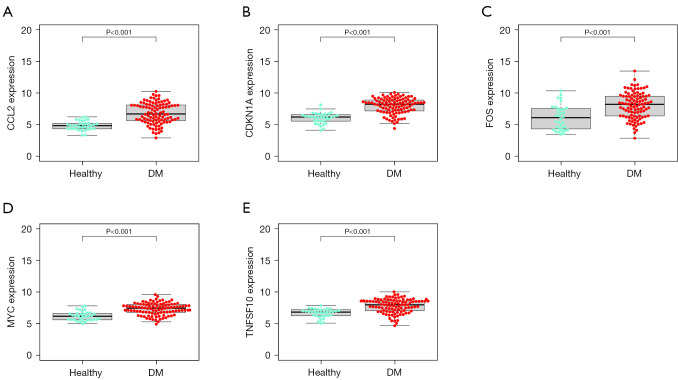
Our results showed that 143 genes were upregulated, and 14 were downregulated in the DM samples compared with healthy samples. The functional enrichment analysis revealed that these DEGs played a significant role in the type I interferon signaling pathway, cytokine activity, chemokine activity, double-stranded RNA binding, and blood microparticles. The intersection results identified , , , , and as the primary autophagy-related genes in DM. All showed significantly increased expressions in DM samples compared with healthy samples. We were also curious to investigate immune cell infiltration in DM. Our results showed that the selected autophagy-related genes significantly influenced the infiltration of multiple immune cells, such as B cells, macrophages, and natural killer cells. Finally, we assessed the diagnostic sensitivity of , , , , and for DM. The results showed the area under the curve (AUC) values of the ROC were 0.855, 0.889, 0.744, 0.826, and 0.816, respectively. The combined genes' diagnostic AUC value was 0.951.
, , , , and are potential diagnostic biomarkers for DM.
皮肌炎(DM)是一种主要通过症状和体格检查诊断的自身免疫性疾病,只有部分DM亚型显示出明显的分子变化。迄今为止,很少有生物标志物被确定用于评估DM的进展。自噬相关基因已与炎症、几种自身免疫性疾病以及免疫反应显著相关,但很少有研究探讨自噬相关基因在DM中的作用。因此,本研究旨在调查自噬相关基因在DM中的作用。
我们从基因表达综合数据库(GEO)收集了三个与皮肌炎相关的转录组数据集:GSE1551、GSE46239和GSE143323,并分析了差异表达基因(DEG)。我们还使用基因本体(GO)和京都基因与基因组百科全书(KEGG)通路进行了功能富集分析。为了探究与正常样本相比,自噬相关基因在DM中是否差异表达,我们对从人类自噬数据库(HADb,http://www.autophagy.lu/)获得的DEG和自噬相关基因进行了交集分析。最后,我们将选定的自噬相关基因用作诊断生物标志物,并分析其与免疫细胞浸润的相关性。
我们的结果显示,与健康样本相比,DM样本中有143个基因上调,14个基因下调。功能富集分析表明,这些DEG在I型干扰素信号通路、细胞因子活性、趋化因子活性、双链RNA结合和血液微粒中发挥重要作用。交集分析结果确定, 、 、 、 、 为DM中主要的自噬相关基因。与健康样本相比,所有这些基因在DM样本中的表达均显著增加。我们还对DM中的免疫细胞浸润情况进行了研究。结果显示,选定的自噬相关基因显著影响多种免疫细胞的浸润,如B细胞、巨噬细胞和自然杀伤细胞。最后,我们评估了 、 、 、 、 对DM的诊断敏感性(译者注:原文此处未明确具体基因名,可能存在信息缺失)。结果显示,ROC曲线下面积(AUC)值分别为0.855、0.889、0.744、0.826和0.816。联合基因的诊断AUC值为0.951。
、 、 、 、 是DM潜在的诊断生物标志物。